 flip
flipPérigord duck pâté en croûte
Périgord duck pâté en croûte
Why this dish? A great traveler, Montesquieu crisscrossed Europe — Vienna, Venice, Rome, London — for several years. The pâtés en croûte from the Southwest, sealed under their fat, kept well and traveled: ideal road food for a mind always on the move, and a pride of the Gascon terroir neighboring Gironde.
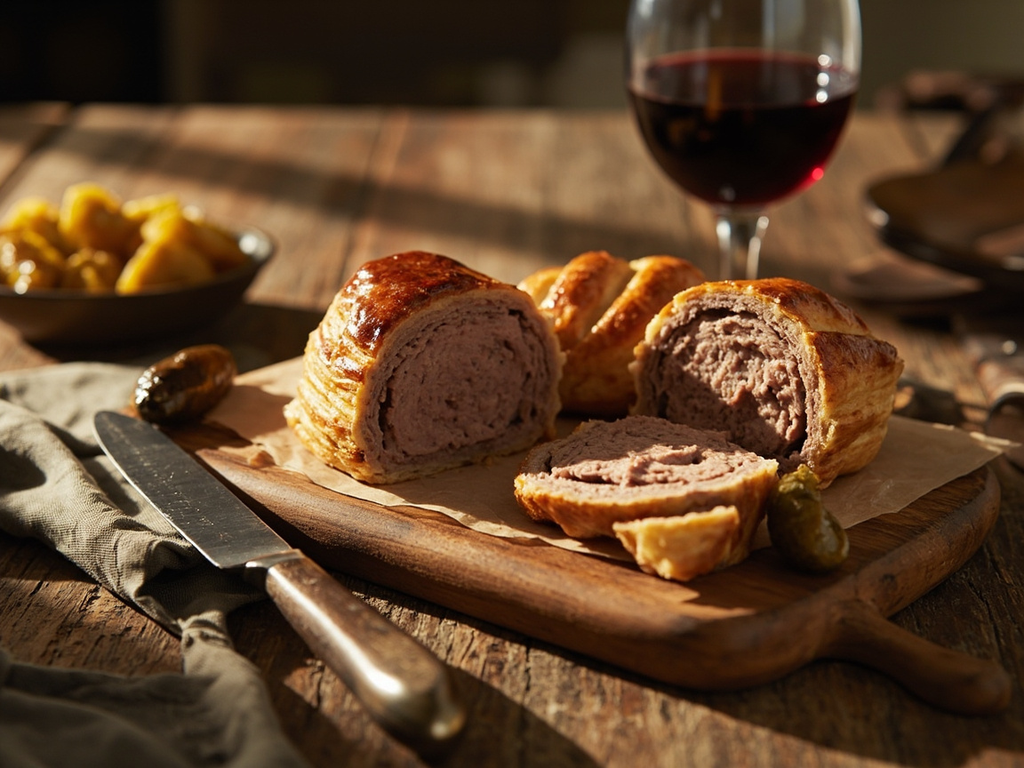
A stuffing of duck, pork, and liver, perfumed with sweet spices and wine, encased in a firm crust and sealed with fat for preservation. Eaten cold, in slices, from the château to the inn.
When one travels the roads of Europe as I have, from the Danube to the Thames, one learns that a good keeping pâté is worth more than a letter of recommendation. Mine, I had sealed with its fat, well closed in its crust, and it held up in the mail coach without losing any of its flavor. At the relay stations, I would cut a slice with a glass of my wine: one philosophizes all the better with a contented stomach.
- •Duck meat — a good portion (base)
- •Pork meat and bacon — in parts (fat binder)
- •Poultry liver — a few (richness)
- •Wine and eau-de-vie — a dash (flavor and preservation)
- •Sweet spices (nutmeg, clove, pepper) — a pinch (seasoning)
- •Pastry of flour, lard, and water — enough to wrap (keeping crust)
Périgord duck pâté en croûte
A stuffing of duck, pork, and liver, perfumed with sweet spices and wine, encased in a firm crust and sealed with fat for preservation. Eaten cold, in slices, from the château to the inn.
Why this dish? A great traveler, Montesquieu crisscrossed Europe — Vienna, Venice, Rome, London — for several years. The pâtés en croûte from the Southwest, sealed under their fat, kept well and traveled: ideal road food for a mind always on the move, and a pride of the Gascon terroir neighboring Gironde.
When one travels the roads of Europe as I have, from the Danube to the Thames, one learns that a good keeping pâté is worth more than a letter of recommendation. Mine, I had sealed with its fat, well closed in its crust, and it held up in the mail coach without losing any of its flavor. At the relay stations, I would cut a slice with a glass of my wine: one philosophizes all the better with a contented stomach.
Ingredients (period version)
- Duck meat — a good portion (base)
- Pork meat and bacon — in parts (fat binder)
- Poultry liver — a few (richness)
- Wine and eau-de-vie — a dash (flavor and preservation)
- Sweet spices (nutmeg, clove, pepper) — a pinch (seasoning)
- Pastry of flour, lard, and water — enough to wrap (keeping crust)
Ingredients
- Duck breast or boned leg — 400 g (base)
- Pork shoulder — 300 g (fat binder)
- Fresh belly / fat — 150 g (richness)
- Chicken livers — 150 g (richness)
- White wine + Armagnac — 5 cl + 2 cl (flavor, preservation)
- Spices (quatre-épices, nutmeg, pepper) — 1 tsp (seasoning)
- Pâté pastry (flour 300 g, butter/lard 150 g, water, 1 egg) — 1 sheet (crust)
- Salt — 12 g per kg of stuffing (seasoning and preservation)
Method
- Chop the duck, pork, and fat; cut part of the duck into strips for texture. Mix with the chopped livers, wine, Armagnac, salt, and spices; let rest in the fridge for a few hours.
- Line a loaf pan with pastry, fill with the stuffing pressing down, cover with a pastry lid, and make a steam hole.
- Brush with egg wash and bake at 180°C for about 1 hour 15 minutes (internal temperature 70°C).
- Let cool completely; optionally pour a little gelatin or fat through the steam hole to seal.
- Keep chilled and slice cold, over several days.
How it was made : Pâté en croûte was as much a preservation technique as a dish: the baked crust and poured fat expelled air and protected the stuffing, allowing the meat to keep for days without ice. It is the direct ancestor of canned food, indispensable for long journeys under the Ancien Régime.
The contemporary twist : Cut it into appetizer cubes skewered with a gherkin, or stand a slice upright with a dash of onion chutney in contemporary bistro style.
Montesquieu · Charactorium