 flip
flipCabbage Pirozhki
Cabbage Pirozhki
Why this dish? Pirozhki — small stuffed pastries — are the nomadic food of Russian families: taken on trips, trains, picnics. For a child tossed between her mother's Russia and her father's France, then for the harried law student at the Faculty of Paris, these hand-held bites are the memory of a people who know how to leave.
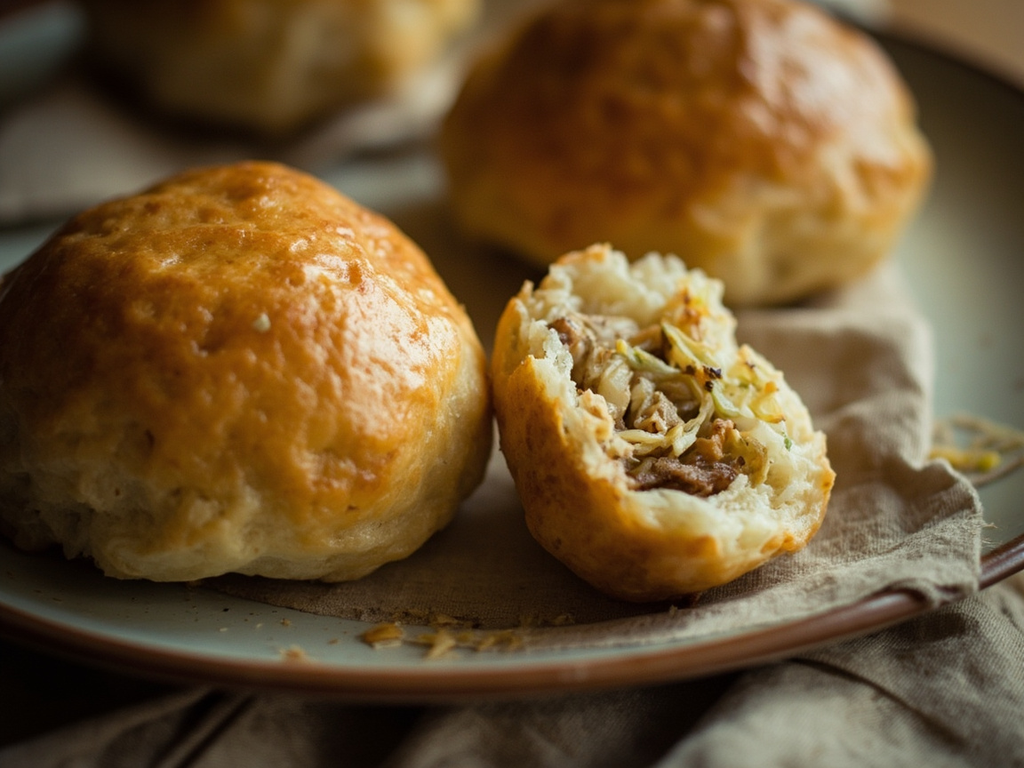
Small brioche or puff pastry buns, here filled with caramelized cabbage and onions. Golden-baked, they slip into a handkerchief or pocket and are eaten warm, without utensils.
We made whole trays of them, and you had to keep an eye out: a hand would reach out, then another, as if by chance, while we chatted. I preferred them with cabbage — the onion long-cooked, almost sweet, folded into the warm dough. For the train, my mother wrapped them in a cloth; we ate them on our laps, without a plate, watching the birches flash by and, later, the suburbs of Paris.
- •Wheat flour — enough for a dough (leavened dough)
- •Baker's yeast — a little (leavening)
- •Milk and butter — moderately (richness of dough)
- •White cabbage — half a head (filling)
- •Onions — 2 (filling)
- •Egg — 1 (egg wash)
Cabbage Pirozhki
Small brioche or puff pastry buns, here filled with caramelized cabbage and onions. Golden-baked, they slip into a handkerchief or pocket and are eaten warm, without utensils.
Why this dish? Pirozhki — small stuffed pastries — are the nomadic food of Russian families: taken on trips, trains, picnics. For a child tossed between her mother's Russia and her father's France, then for the harried law student at the Faculty of Paris, these hand-held bites are the memory of a people who know how to leave.
We made whole trays of them, and you had to keep an eye out: a hand would reach out, then another, as if by chance, while we chatted. I preferred them with cabbage — the onion long-cooked, almost sweet, folded into the warm dough. For the train, my mother wrapped them in a cloth; we ate them on our laps, without a plate, watching the birches flash by and, later, the suburbs of Paris.
Ingredients (period version)
- Wheat flour — enough for a dough (leavened dough)
- Baker's yeast — a little (leavening)
- Milk and butter — moderately (richness of dough)
- White cabbage — half a head (filling)
- Onions — 2 (filling)
- Egg — 1 (egg wash)
Ingredients
- All-purpose flour (T55) — 400 g (leavened dough)
- Active dry yeast — 7 g (leavening)
- Warm milk — 180 ml (hydration)
- Softened butter — 50 g (richness of dough)
- Shredded white cabbage — 400 g (filling)
- Sliced onions — 2 (filling)
- Beaten egg — 1 (egg wash)
- Salt, pepper — to taste (seasoning)
Method
- Knead flour, yeast, warm milk, butter, a pinch of salt, and a little sugar into a supple dough; let rise for 1 hour.
- Gently cook onions then cabbage in butter for 25–30 minutes until tender and lightly colored; season with salt and pepper, cool.
- Divide dough into balls, flatten, place a spoonful of filling, fold into a pastry, and seal edges.
- Let rise for 20 minutes, brush with beaten egg.
- Bake at 190°C for 18–22 minutes until golden brown. Eat warm.
How it was made : Pirozhki were endlessly varied according to season and budget: cabbage, rice and hard-boiled egg, minced meat, mushrooms, even fish or jam in sweet versions. They were baked or fried (jarenye), and kept for hours in a cloth — hence their role as travel provisions.
The contemporary twist : Mini appetizer bites for a literary evening, served warm with a bowl of lemon-scented smetana.
Nathalie Sarraute · Charactorium