 flip
flipBraised Celery Hearts from the Waldorf
Braised Celery Hearts from the Waldorf
Why this dish? Tesla dined regularly, alone and at a fixed hour, in grand New York hotels like the Waldorf-Astoria and Delmonico's, insisting on a table to himself and service regulated to the last detail. Celery, a star and refined vegetable of the American Gilded Age, suited this man wary of meat perfectly: elegant, crunchy, presented with ceremony.
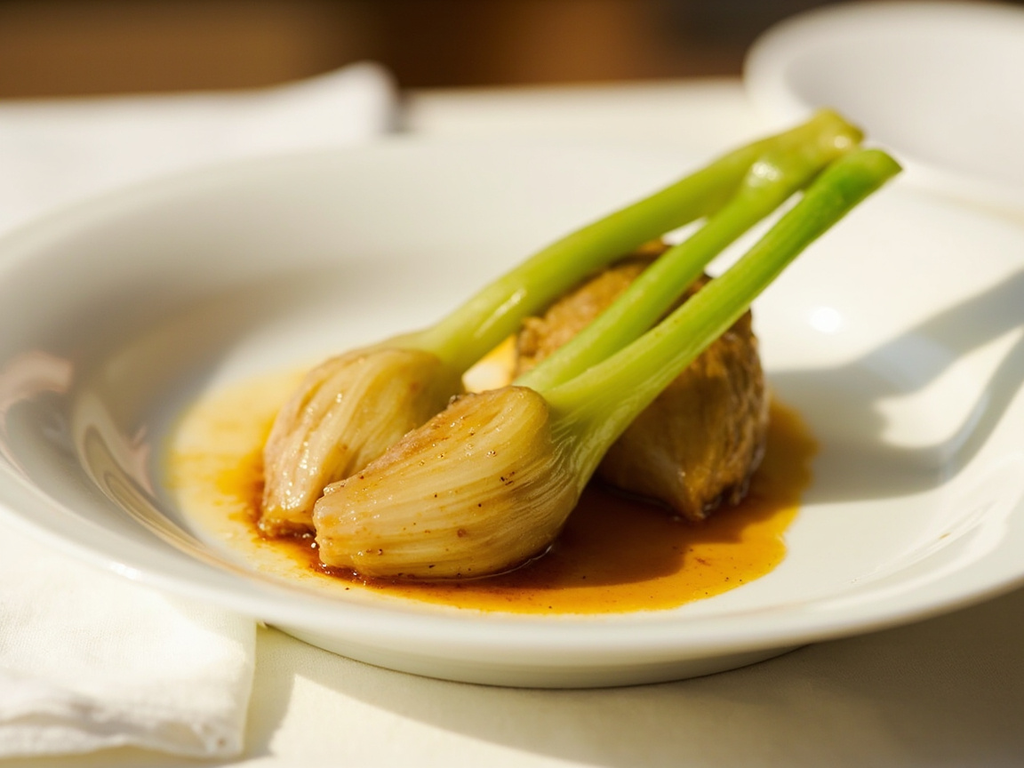
Celery hearts slowly braised in a light broth until tender, coated in their reduced juices. A sober and chic dish, both bitter and silky, worthy of the white tablecloths of the Gilded Age.
I was known in those great New York halls for my immutable habits: my table, my hour, my place setting arranged according to my order. I distrusted heavy meats; so I had celery served, that noble vegetable which opulent America proudly placed on its linens. Braised to tenderness, glazed in its own juice, it has that slight bitterness which awakens the mind without weighing down the body. That, sir, is how an inventor dines: with measure, and never betraying his method.
- •Celery hearts — a few stalks (star of the dish)
- •Light vegetable broth — enough to cover (braising liquid)
- •Butter — a knob (binder and shine)
- •Salt and pepper — to taste (seasoning)
Braised Celery Hearts from the Waldorf
Celery hearts slowly braised in a light broth until tender, coated in their reduced juices. A sober and chic dish, both bitter and silky, worthy of the white tablecloths of the Gilded Age.
Why this dish? Tesla dined regularly, alone and at a fixed hour, in grand New York hotels like the Waldorf-Astoria and Delmonico's, insisting on a table to himself and service regulated to the last detail. Celery, a star and refined vegetable of the American Gilded Age, suited this man wary of meat perfectly: elegant, crunchy, presented with ceremony.
I was known in those great New York halls for my immutable habits: my table, my hour, my place setting arranged according to my order. I distrusted heavy meats; so I had celery served, that noble vegetable which opulent America proudly placed on its linens. Braised to tenderness, glazed in its own juice, it has that slight bitterness which awakens the mind without weighing down the body. That, sir, is how an inventor dines: with measure, and never betraying his method.
Ingredients (period version)
- Celery hearts — a few stalks (star of the dish)
- Light vegetable broth — enough to cover (braising liquid)
- Butter — a knob (binder and shine)
- Salt and pepper — to taste (seasoning)
Ingredients
- Celery hearts — 2 stalks, trimmed (star)
- Vegetable broth — 300 ml (braising)
- Butter — 30 g (binder, shine)
- Lemon juice — 1 tsp (brightness)
- Salt and pepper — to taste (seasoning)
Method
- Trim the celery stalks, remove strings, and split hearts lengthwise.
- Place them flat in a sauté pan, cover with broth, add a knob of butter and a pinch of salt.
- Cover and braise gently for 25-30 minutes, until a knife tip slides in without resistance.
- Remove celery hearts and keep warm.
- Reduce the braising liquid over high heat until syrupy, add remaining butter and a squeeze of lemon.
- Nap the celery with this glossy sauce and serve immediately.
How it was made : In Gilded Age America, celery was a prestige food, served raw in tall cut-glass vases at table center, or braised as a fine vegetable at Delmonico's. Grown with care (often blanched from light to tenderize), it symbolized bourgeois refinement — and suited diners concerned with lightness.
The contemporary twist : Arrange two hearts side by side, glossy and perfectly aligned, under the name 'Wardenclyffe' — sober, vertical, ambitious like his famous tower.
Nikola Tesla · Charactorium