 flip
flipPolenta with milk and barn cheese
Polenta with milk and barn cheese
Why this dish? At the Villa of Brusuglio, on his lands near Cormano, Manzoni lived off the products of his estate. Corn polenta was the daily bread of Lombards of all ranks in the 19th century; it appears in *The Betrothed* as the people's food. At his own table, it was paired with milk and barn cheese.
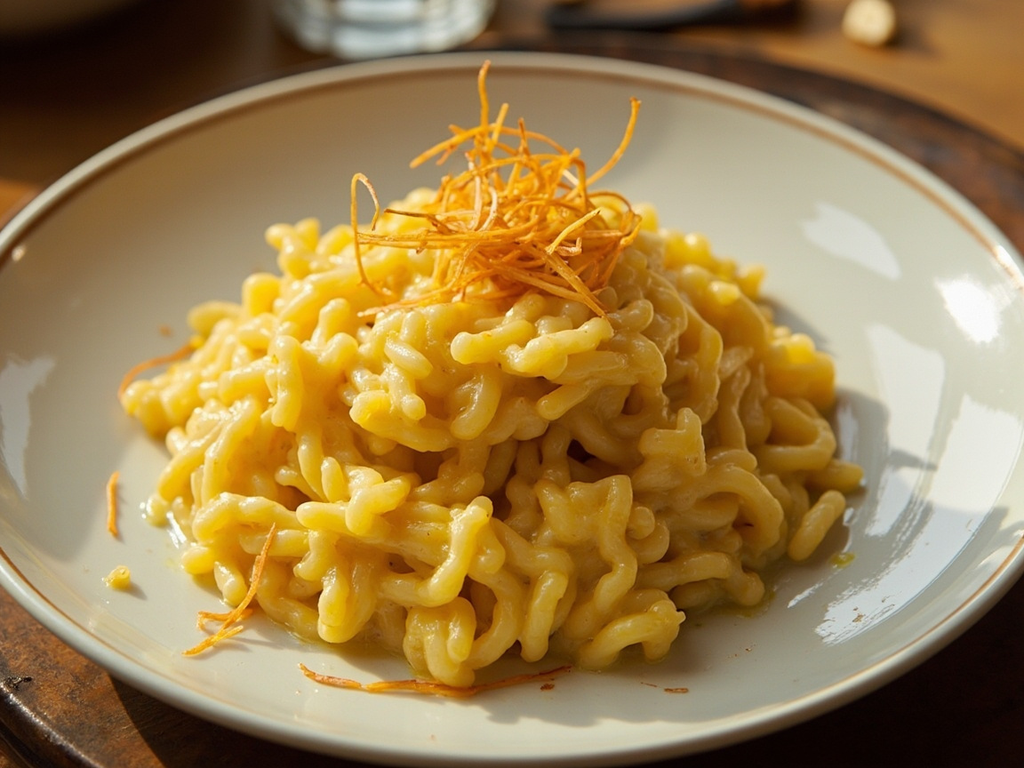
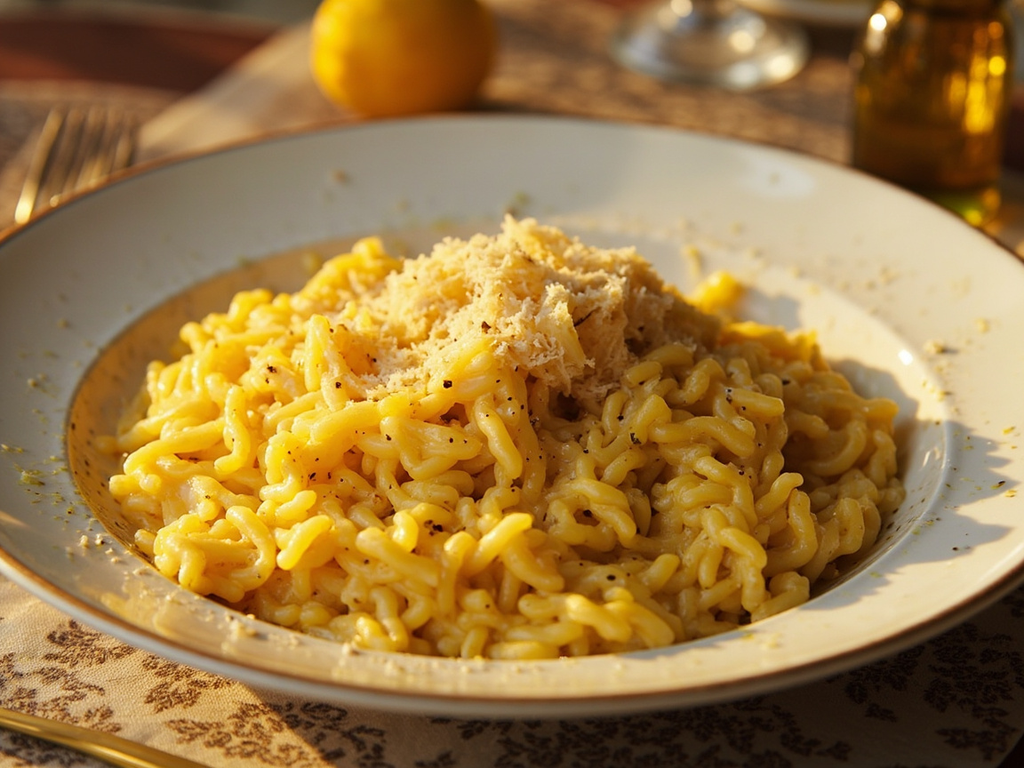
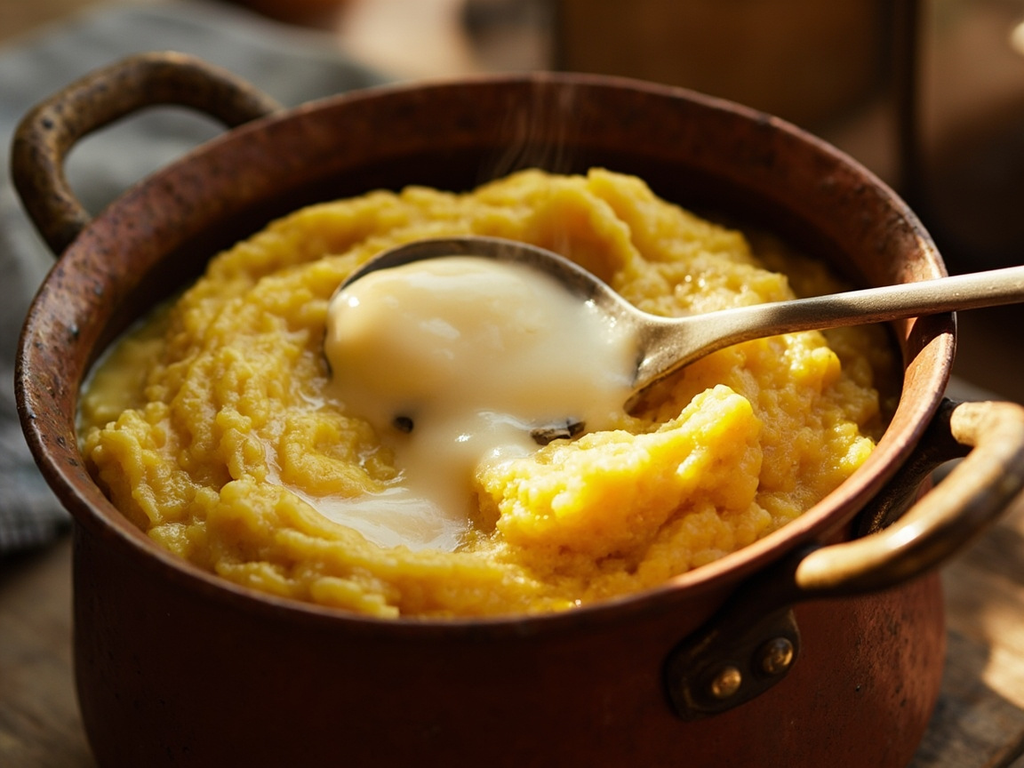
A golden porridge of cornmeal, long stirred in a cauldron, topped with warm milk or sprinkled with melting cheese. Comforting, nourishing, it is the humble and faithful heart of Lombard cuisine.
See this polenta: there is no humbler or more faithful dish on our Lombard lands. At Brusuglio, I had the flour from my own fields poured into the copper cauldron, and we stirred, stirred without respite for a full hour, for patience alone makes it creamy. In the evening, a little warm milk from the barn, a slice of cheese that melts gently, and there you have the bread of our countryside — the very one with which I feed my humble characters. Believe me, whoever scorns this table knows nothing of the people.
- •Yellow cornmeal (granoturco) — two handfuls per person (base)
- •Spring water — as needed (cooking)
- •Salt — a generous pinch (seasoning)
- •Whole milk from the barn — one bowl (accompaniment)
- •Aged mountain cheese — one piece (garnish)
Polenta with milk and barn cheese
A golden porridge of cornmeal, long stirred in a cauldron, topped with warm milk or sprinkled with melting cheese. Comforting, nourishing, it is the humble and faithful heart of Lombard cuisine.
Why this dish? At the Villa of Brusuglio, on his lands near Cormano, Manzoni lived off the products of his estate. Corn polenta was the daily bread of Lombards of all ranks in the 19th century; it appears in *The Betrothed* as the people's food. At his own table, it was paired with milk and barn cheese.
See this polenta: there is no humbler or more faithful dish on our Lombard lands. At Brusuglio, I had the flour from my own fields poured into the copper cauldron, and we stirred, stirred without respite for a full hour, for patience alone makes it creamy. In the evening, a little warm milk from the barn, a slice of cheese that melts gently, and there you have the bread of our countryside — the very one with which I feed my humble characters. Believe me, whoever scorns this table knows nothing of the people.
Ingredients (period version)
- Yellow cornmeal (granoturco) — two handfuls per person (base)
- Spring water — as needed (cooking)
- Salt — a generous pinch (seasoning)
- Whole milk from the barn — one bowl (accompaniment)
- Aged mountain cheese — one piece (garnish)
Ingredients
- Polenta (cornmeal) — 250 g (base)
- Water — 1 liter (cooking)
- Salt — 1 teaspoon (seasoning)
- Whole milk — 200 ml (accompaniment)
- Cheese such as Branzi or Bitto (or Comté) — 120 g (garnish)
Method
- Bring salted water to a simmer in a large heavy-bottomed pot.
- Pour in the polenta in a thin stream while whisking to prevent lumps.
- Reduce heat and stir with a wooden spoon for 40 to 45 minutes, until the mass pulls away from the sides.
- Stir in the cheese pieces and let them melt while stirring.
- Serve hot, topped with warm milk to taste.
How it was made : Corn, which arrived from the Americas after 1492, had become widespread in the Po Valley by the 17th century, to the point of being the staple food of Lombard and Venetian peasants. It was cooked in a copper cauldron (il paiolo) hung from a hook, stirred with a long stick (il tarello) sometimes for an hour. Its excessive and exclusive consumption also caused pellagra, a scourge of 19th-century rural areas.
The contemporary twist : Serve the creamy polenta in a shallow bowl with a melting cheese heart in the center and a twist of black pepper — a comfort version that warms winter evenings.
Sources : Massimo Montanari, La fame e l'abbondanza. Storia dell'alimentazione in Europa · Alessandro Manzoni, I Promessi Sposi (1827)
Alessandro Manzoni · Charactorium