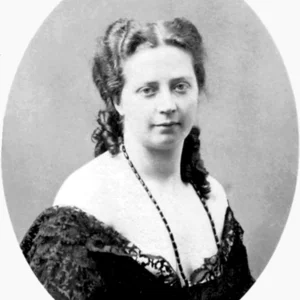

Olympe Audouard (1832–1890) was a French writer, journalist, and feminist. A tireless traveler, she journeyed through the Middle East and the United States and published accounts of her travels. She campaigned for women's rights, particularly the right to divorce and access to education.
Olympe Audouard(1832 — 1890)
Olympe Audouard
France
8 min read
Frequently asked questions
Key Facts
- 1832: born in Aix-en-Provence
- 1862: founded the feminist journal *Le Papillon*
- 1860s–1870s: travels to Egypt, the Middle East, and the United States; travel accounts published
- Actively campaigned for the reinstatement of divorce, abolished since the Civil Code of 1804
- 1890: died in Nice
Works & Achievements
Her most celebrated militant work, in which she forcefully demands the reinstatement of divorce, abolished since 1816. She denounces the condition of the married woman reduced to the status of a civil minor under the Napoleonic Code.
An account of her journey to the Orient describing the lives of Turkish women with an ethnographic curiosity rare for the time. This book transforms the purely exotic vision of the Orient into a nuanced, comparative observation.
A firsthand account of Egyptian and Syrian societies, the fruit of an exceptional solo journey for a woman of her era. Olympe Audouard weaves together landscape descriptions, local customs, and comparisons with French society.
An account of her stay in the United States, where she discovered with admiration the far greater freedom enjoyed by American women. She compares the situation of women on both sides of the Atlantic, decidedly in favor of the Americans.
A Parisian literary and artistic periodical that Olympe Audouard founded and directed, using the press as a platform to spread her feminist ideas while publishing society columns and travel writing.
Anecdotes
Married very young to a Marseille merchant, Olympe Audouard endured an unhappy union that left a deep mark on her. This personal experience of marital oppression became the driving force behind all her activism: throughout her life, she campaigned for the restoration of divorce — abolished since 1816 — to free women from unbearable marriages.
In 1866, Olympe Audouard traveled alone to Egypt and Syria — an exceptional journey for a woman of her era. There she observed the condition of women in the East and brought back an account that caused a sensation in Paris, blending ethnographic observations with feminist reflections. Some readers refused to believe that a woman could have undertaken such a journey on her own.
In the United States, Olympe Audouard met pioneers of American feminism and gave public lectures in English before mixed audiences — something exceedingly rare for a French woman of her time. Back in France, she recounted in her books that American women enjoyed a social freedom far greater than that of French women.
Olympe Audouard was one of the first French women to dare take the podium and deliver paid public lectures. In 1866, she rented a Parisian hall to speak about the condition of women before a large audience. This boldness earned her as much admiration as it did sharp criticism in the conservative press.
Founder of the literary journal *Le Papillon* around 1862, Olympe Audouard served as its editor and chief contributor. She used it to champion the cause of women while publishing travel and society chronicles. The title symbolized for her the superficial lightness that society imposed on women — the very thing she sought to transcend.
Primary Sources
The American woman is free: she can work, travel, appear alone in public without her reputation suffering for it. No one asks her to account for her comings and goings, and this freedom, far from ruining her, seems to elevate her.
I wanted to see for myself what is called the Orient, without intermediaries, without an official guide, in order to bring back a true and personal impression. A woman alone in these lands causes surprise; but surprise is not always unpleasant.
Divorce must be restored. Without this fundamental freedom, woman remains bound to a contract she sometimes signed as a child, knowing neither the world nor herself. The law makes a wife a minor for life.
The Turkish woman, believed to be confined and ignorant, often possesses a sharpness of mind and a knowledge of the world that surprises the European traveler who is quick to pity her without knowing her.
Key Places
Birthplace of Olympe Audouard in 1832, in the south of France. Her Provençal roots shaped her independent character and determined temperament.
The center of all her intellectual and activist work: it was in Paris that she founded *Le Papillon*, delivered her public lectures, and moved in the literary and feminist circles of her time.
Olympe Audouard visited Egypt in the 1860s and brought back a fascinated account of Oriental women and Egyptian society, which fed her comparative reflections on the condition of women.
Her journey to the United States allowed her to meet the pioneers of American feminism and observe a society where women enjoyed greater freedoms. She drew on this experience for her book *À travers l'Amérique*.
Olympe Audouard died in Nice in 1890, in this Mediterranean coastal city that had only been part of France since 1860.
Typical Objects

Olympe Audouard always carried a notebook to jot down her observations during her journeys to the Orient and America. These field notes fed directly into the travel accounts she published upon her return to Paris.

The daily tool of the journalist and writer, the pen dipped in inkwell allowed her to draft her articles, columns, and books. She wrote every day, whether in her Parisian apartment or on the road.

This literary periodical, which she founded and directed around 1862, was both her platform and her creation. She published her activist texts there and championed the cause of women for a cultivated Parisian readership.

For her long journeys to Egypt, Syria, or the United States, Olympe Audouard packed a large trunk containing clothes, books, and writing materials. Traveling alone with her luggage was in itself a remarkable act of independence.

Audouard was among the first French women to give paid public lectures. The podium from which she addressed Parisian audiences symbolized her hard-won right to speak out in the public sphere.

This body of law enacted in 1804, which subjected married women to their husbands' absolute authority and reduced them to the status of legal minors, was the central theoretical adversary that Olympe Audouard cited and fought against in her activist writings.
School Curriculum
Vocabulary & Tags
Key Vocabulary
Daily Life
Morning
Olympe Audouard rose early to write in the quiet of the morning, before visitors and social obligations could claim her attention. She devoted the first hours of the day to drafting articles, books, or correspondence, a steel-nib pen in hand over her notebooks.
Afternoon
Her afternoons were spent visiting Parisian literary salons, attending editorial meetings for her journal, or preparing her public lectures. She met with journalists, feminist activists, and figures from the world of letters.
Evening
In the evenings, she frequented the dinners and social gatherings where Parisian intellectuals and artists mingled. These circles allowed her to expand her network, promote her ideas, and gather the information that fed her columns.
Food
Like many bourgeois Parisian women of the educated 19th-century class, she ate a light lunch and a more substantial dinner of meat, vegetables, and bread. During her travels in the East, she readily adapted to local cuisines, which she described with great curiosity in her travel writing.
Clothing
Audouard wore the crinoline and bustle dresses characteristic of the Second Empire and the Third Republic — constraining attire she sometimes criticized in her writing. On her distant travels, she adapted her clothing to local conditions, which occasionally drew astonished remarks from her contemporaries.
Housing
She lived in Paris in a bourgeois apartment where she received collaborators, friends, and fellow activists. Her Parisian home served at once as a living space, an editorial office, and an informal intellectual salon.
Historical Timeline
Period Vocabulary
Liens externes & ressources
Références
Œuvres
La Femme dans ses rapports avec le mariage
1863
Les Mystères du sérail et des harems turcs
1863
Voyage en Syrie et en Égypte
1866
À travers l'Amérique : le Far-West
1869
Le Papillon (journal fondé et dirigé)
1862