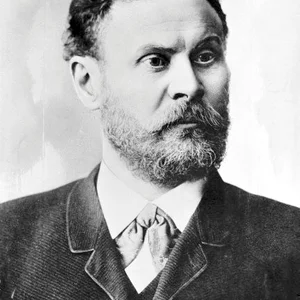

German engineer and inventor (1848–1896), Otto Lilienthal was the first person to achieve repeated and controlled gliding flights. His experiments with gliders laid the scientific foundations of modern aviation.
Otto Lilienthal(1848 — 1896)
Otto Lilienthal
royaume de Prusse
8 min read
Frequently asked questions
Famous Quotes
« Opfer müssen gebracht werden. (Sacrifices must be made.)»
Key Facts
- 1848: Born in Anklam, Prussia
- 1889: Publication of *Der Vogelflug als Grundlage der Fliegekunst*, a landmark work on aerodynamics
- 1891: First successful gliding flight aboard a glider of his own design
- 1891–1896: More than 2,000 gliding flights completed
- 1896: Death following a glider accident; his work directly inspired the Wright Brothers
Works & Achievements
A landmark scientific treatise in which Lilienthal published his tables of lift coefficients measured on curved wing profiles. Translated into English as early as 1911, this work became the bible of aviation pioneers, including the Wright brothers.
A cambered monoplane glider, the result of several years of optimization, which Lilienthal sold to around a dozen customers. It represents the first mass-produced glider ever sold to third parties.
An experimental biplane designed to increase lifting surface without extending the wingspan. Lilienthal tested it successfully in 1895, anticipating the configurations that would later be adopted by the first powered aircraft.
The first German patent specifically covering a cambered-profile glider. This filing officially established Lilienthal's priority on the principle of the curved wing as a technical solution for human gliding flight.
Popular science articles in which Lilienthal reported on his experiments for a well-educated general audience. These publications, illustrated with photographs, spread his work far beyond the circle of engineers.
Anecdotes
Before building his first gliders, Otto Lilienthal spent years observing storks and swallows flying around his hometown of Anklam. He filled entire notebooks with wing sketches, measuring the angles and curves of feathers, convinced that nature had already solved the problem of flight.
To practice without depending on natural hills, Lilienthal had a fifteen-meter artificial mound built in 1894 in the Berlin suburb of Lichterfelde, known as the Fliegeberg. He could thus launch himself into the wind regardless of its direction, accumulating hundreds of flights from this hillock he had designed himself.
On August 9, 1896, a gust of wind suddenly pitched his glider upward at about ten meters altitude. Lilienthal crashed to the ground and broke his spine. Transported to Berlin, he died the following day. His last words, as reported by his brother Gustav, were said to be: “Sacrifices must be made.”
The Wright Brothers openly acknowledged their debt to Lilienthal. By reading his work on wing profiles and his lift coefficient tables, they had a solid scientific foundation on which to build their Flyer. Without the data published by the German engineer, their first powered flight of 1903 would likely have been delayed by several years.
Lilienthal was not content merely to fly: he ran a factory in Berlin that manufactured small steam engines. It was this business that funded his aeronautical research. He even sold about a dozen gliders to other experimenters across Europe, making him the first serial aircraft manufacturer in history.
Primary Sources
Die Kenntnis des Vogelfluges ist die Grundlage der Flugkunst. [...] Wer fliegen will, muss den Vogelflug studieren.
The apparatus consists of a curved wing-shaped lifting surface, made of wicker covered with cotton, allowing a man to suspend himself by his arms and glide over short distances.
I am fully convinced that flight is very near at hand, and that we need a great deal more experimental work before we can succeed with power-driven machines.
Ich habe in diesem Sommer mehr als 200 Gleitflüge ausgeführt und dabei die Gewissheit gewonnen, dass ein geübter Mensch sich in der Luft zu halten und zu manövrieren vermag.
Key Places
Lilienthal's birthplace, where as a child he watched storks gliding along the banks of the Peene River. This formative experience set the course of his entire life toward the study of animal flight.
Site of Lilienthal's first controlled gliding flights in 1891, launched from a natural hill about 10 metres high. It was here that he proved for the first time that a man could fly repeatedly and in a controlled manner.
An artificial hill 15 metres high built by Lilienthal in 1894 near his home in the suburbs of Berlin. The site of several hundred training flights, it is today a listed historic monument.
Site of Lilienthal's final flight, on 9 August 1896. A sudden gust of wind caused his glider to stall at roughly 15 metres altitude; he crashed to the ground and died the following day in Berlin.
The industrial workshop where Lilienthal manufactured and sold small steam engines. The profits from this business entirely funded his aeronautical research and the construction of his gliders.
Typical Objects

Fixed-wing monoplane glider built from willow laths covered with cotton fabric, weighing around 20 kg. This is the aircraft with which Lilienthal completed the vast majority of his 2,000 gliding flights between 1891 and 1896.

A small instrument for measuring wind speed that Lilienthal routinely brought into the field. The data he collected allowed him to select optimal flying conditions and refine his lift calculations.

Graph-ruled notebooks in which Lilienthal recorded after each flight the wind speed, duration, distance covered, and his impressions of handling. These notes formed the empirical foundation of his scientific publications.

In his Berlin workshop, Lilienthal used a drafting table to design his wing plans, calculating the profile curves inspired by stork wings. Each version of the glider was the subject of precise technical drawings.

A system of thick leather straps allowing the pilot to suspend himself by the shoulders and wrists from the wing structure. Lilienthal controlled his trajectory by shifting his center of gravity, swinging his legs and hips.

In 1895, Lilienthal experimented with a small carbon dioxide-powered engine to mechanically drive the tips of his wings. This device, never brought to completion, demonstrated his ambition to move from gliding to powered flight.
School Curriculum
Vocabulary & Tags
Key Vocabulary
Daily Life
Morning
Lilienthal started his day early, around six o'clock, consulting weather records and watching the weathervanes from his window. If the wind was favorable (between 5 and 10 m/s), he would notify his brother Gustav and prepare the disassembled glider in his cart. The journey to the Fliegeberg took less than an hour by horse-drawn carriage.
Afternoon
When conditions allowed, he would make several series of gliding flights from the hill, each lasting anywhere from a few seconds to around thirty seconds. Between runs, he noted his observations, adjusted the straps or willow rods, and chatted with the curious onlookers and journalists who frequently came to watch. On windless days, he worked at his desk on plans for the next version of the glider.
Evening
In the evening, back in his workshop-home in Lichterfelde, Lilienthal recorded the day's data in his notebooks and replied to his correspondence, which grew increasingly voluminous as his reputation spread. He also read the work of other experimenters, particularly American and French ones, and sometimes replied to their letters in English or French.
Food
Lilienthal belonged to Berlin's industrial bourgeoisie and ate in the manner of his social milieu: rye bread, cold cuts, potatoes, meat in gravy, and seasonal vegetables. Like many hygienists of the era, he was also firmly convinced of the benefits of fresh air and physical exercise, and he applied these principles to his own life.
Clothing
In daily life, Lilienthal wore the dark three-piece suit typical of a Prussian engineer-entrepreneur of the late 19th century. For flying, he put on a looser flannel suit without a tie, and buckled his leather harness over it. In flight photographs, he is often seen wearing a flat cap, his legs dangling beneath the wing frame.
Housing
He lived in a bourgeois house in Berlin-Lichterfelde, a residential neighborhood recently connected to central Berlin by Europe's first electric tramway. The house had a large workshop on the ground floor, adjoining a courtyard where the glider was assembled and inspected before each outing.
Historical Timeline
Period Vocabulary
Liens externes & ressources
Références
Œuvres
Der Vogelflug als Grundlage der Fliegekunst
1889
Normalsegelapparat (planeur standard)
1891–1896
Doppeldecker (biplan expérimental)
1895
Brevet n° 77916 — Appareil pour le vol plané à aile courbée
1893
Série d'articles dans la revue Prometheus
1894–1896