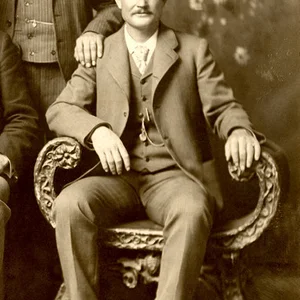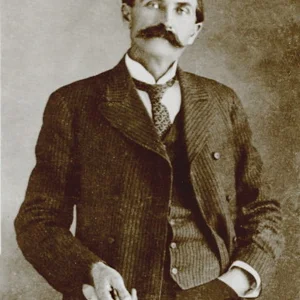

Pat Garrett was an American lawman of the Old West, who became famous for tracking down and killing the outlaw Billy the Kid in 1881. A former cowboy and buffalo hunter, he embodied the figure of the law during the Lincoln County War in New Mexico.
Pat Garrett(1850 — 1908)
Pat Garrett
États-Unis
6 min read
Frequently asked questions
Key Facts
- Born on June 5, 1850 in Alabama, he grew up in Louisiana before heading West
- Elected sheriff of Lincoln County (New Mexico) in 1880, against the backdrop of the Lincoln County War
- Killed the outlaw Billy the Kid on July 14, 1881 at Fort Sumner
- Published an account in 1882, “The Authentic Life of Billy, the Kid,” which forged his legend
- Murdered on February 29, 1908 near Las Cruces, under circumstances that remain controversial
Works & Achievements
Garrett and his posse surrounded the Kid's gang in an isolated cabin and secured their surrender. This arrest made Garrett a local hero.
By gunning down the most wanted outlaw in the territory, Garrett entered the legend of the Wild West and brought a long manhunt to an end.
A book credited to Garrett (written by Ash Upson) recounting the Kid's life. Despite its exaggerations, it became a major source of the myth.
Garrett restored order in a county ravaged by a local civil war, cementing his reputation as a determined lawman.
Garrett took part in several law-enforcement missions across the West, pursuing cattle rustlers and bandits.
Appointed by President Theodore Roosevelt, he held this federal post that crowned his public career.
Anecdotes
Before wearing the sheriff's star, Pat Garrett earned his living as a buffalo hunter on the plains of Texas. It is said that he killed hundreds of animals for their hides, until the disappearance of the great herds pushed him to seek another trade in New Mexico.
Garrett and Billy the Kid knew each other well before their confrontation. The two men had frequented the same saloons in Fort Sumner, and some said they were almost friends. Legend gave them the nicknames “Big Casino” (Garrett, who stood nearly 6 feet 2 inches tall) and “Little Casino” (the Kid).
On the night of July 14, 1881, Garrett waited in the darkness of a room at Fort Sumner. Billy the Kid entered without seeing him and asked in Spanish, *¿Quién es?* (“Who's there?”). Garrett fired two shots: the first killed the outlaw instantly.
To capitalize on his fame, Garrett published a book recounting the life of Billy the Kid as early as 1882. The text was actually written by his journalist friend Ash Upson, and it wove in so many exaggerated facts that the book became one of the great sources of the legend of the Wild West.
Pat Garrett met a tragic and mysterious end: in 1908, he was shot down on a road near Las Cruces during a quarrel. The man who confessed to the murder, Wayne Brazel, was tried and then acquitted, and the case was never truly solved.
Primary Sources
“Quién es? Quién es?” (“Who is it?”) — these were, according to Garrett, the last words Billy the Kid spoke before Garrett fired in the darkness of Pete Maxwell's bedroom.
In it, Garrett reports that he has killed “the Kid” at Fort Sumner and claims the reward promised for the outlaw's capture.
The newspaper recounts how Sheriff Garrett surprised and shot down Billy the Kid at Pete Maxwell's home, putting an end to the hunt for the young bandit.
The document formalizes Garrett's appointment to this federal post, a reward for his reputation as a Western lawman.
Key Places
Region in the southern United States where Pat Garrett was born in 1850, before his family moved to Louisiana.
A former military post turned small town where Garrett shot Billy the Kid on the night of July 14, 1881.
A vast and violent territory where Garrett became sheriff in 1880, the stage for the famous Lincoln County War.
A border city where Garrett held the post of collector of customs after his appointment by President Roosevelt in 1901.
The town near which Pat Garrett was murdered in 1908 during a dispute that remains partly unexplained.
A Texas outpost around which Garrett hunted buffalo in the 1870s, before becoming a lawman.
Typical Objects

Metal star-shaped badge worn on the chest, a symbol of legal authority in the American West. It distinguished the lawman from the outlaws he pursued.

Revolver emblematic of the Wild West, nicknamed the “Peacemaker.” It was the classic sidearm of sheriffs and outlaws alike.

Lever-action rifle allowing repeated shots without reloading after each round. Indispensable for hunting and long pursuits on horseback.

Sturdy leather saddle fitted with a horn for attaching the lasso, designed for long days on horseback. It accompanied the man of the West on all his travels.

Wide felt hat protecting against sun and rain, which became the cowboy's signature item of clothing. It was also called the “ten-gallon hat.”

Iron bracelets used to restrain captured prisoners. Garrett notably used them to bring Billy the Kid back alive after his capture.

Official document authorizing a sheriff to capture an outlaw. It provided the legal basis for the pursuits carried out by lawmen.
School Curriculum
Vocabulary & Tags
Key Vocabulary
Tags
Daily Life
Morning
Up before dawn, the lawman would saddle his horse and check his weapons. The morning might be spent patrolling the town, reading wanted posters, or organizing a manhunt across the surrounding territory.
Afternoon
The afternoon was often spent on horseback, on dusty trails, questioning witnesses or keeping watch over the ranches. The long rides under the New Mexico sun were the daily routine of a sheriff.
Evening
In the evening, Garrett would return to a town where people played cards and drank in the saloons. It was precisely at night, in the darkness of a bedroom, that he trapped Billy the Kid.
Food
Food in the West was simple and filling: beans, beef or game meat, hardtack biscuits, and very strong black coffee. During manhunts, men ate whatever they carried in their saddlebags.
Clothing
Garrett wore the rugged clothing of the cowboy: a cotton shirt, heavy trousers, leather boots with spurs, a bandana against the dust, and a wide-brimmed hat. The sheriff's star marked his authority.
Housing
He lived in the wooden or adobe (sun-dried mud brick) houses typical of New Mexico. During long pursuits, he slept under the stars or in makeshift cabins.
Historical Timeline
Period Vocabulary
Liens externes & ressources
Références
Œuvres
Capture de Billy the Kid à Stinking Springs
décembre 1880
Mort de Billy the Kid à Fort Sumner
14 juillet 1881
The Authentic Life of Billy the Kid
1882
Mandat de shérif du comté de Lincoln
1880-1882
Service de Texas Ranger et de capitaine de rangers
années 1880
Collecteur des douanes d'El Paso
1901-1905