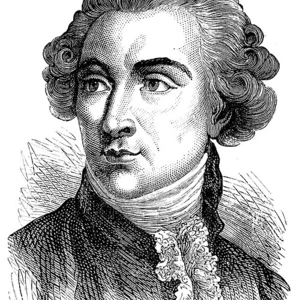

Pierre Choderlos de Laclos was an eighteenth-century French writer and artillery officer. He is the author of the famous epistolary novel *Les Liaisons dangereuses* (1782), a cruel portrayal of the libertine intrigues of the aristocracy.
Pierre Choderlos de Laclos(1741 — 1803)
Pierre Choderlos de Laclos
France
6 min read
Frequently asked questions
Key Facts
- Born in 1741 in Amiens into a family of minor nobility
- A career officer in the artillery, the scholarly branch of the royal army
- Published *Les Liaisons dangereuses* in 1782, an immense success and scandal
- Rallied to the Revolution and frequented the Jacobin Club
- Died in 1803 in Taranto, a general in Napoleon's service
Works & Achievements
Libretto written by Laclos set to music by the Chevalier de Saint-Georges. The piece was a failure, but it marked his literary beginnings.
A satirical poem attributed to Laclos, targeting the morals of the court. One of his earliest forays into social criticism through letters.
The epistolary novel that made his fame: a cruel and clear-eyed portrayal of the libertine manipulations of the aristocracy, now a classic of French literature.
An essay left unpublished in his lifetime, in which Laclos links the condition of women to their lack of education and criticizes their social subjugation.
A technical and polemical text disputing Vauban's system of fortification, which earned him a recall to his regiment.
Anecdotes
An artillery officer often posted to monotonous provincial garrisons, Laclos wrote *Dangerous Liaisons* partly to stave off boredom. The novel made him famous overnight, but its scandalous reputation earned him the suspicion of his military superiors.
Published in 1782, the novel was a resounding success: the first edition sold out within days and booksellers had to reprint it in haste. People scrambled for copies in the salons, despite (or because of) its whiff of scandal.
Legend has it that Queen **Marie-Antoinette** owned a copy of the novel, bound with no title on the cover to conceal a read deemed immoral. The anecdote illustrates the aristocracy's secret fascination with this book that portrayed it so cruelly.
In **1786**, Laclos published a letter criticizing the fortification system of Marshal de **Vauban**, a national glory and all but untouchable figure. The audacity caused a scandal in the army: he was curtly recalled to his regiment and his career suffered lasting damage.
During the Revolution, Laclos became the secretary and trusted confidant of **Philippe d'Orléans** (Philippe Égalité). Imprisoned during the Terror, he narrowly escaped the guillotine and owed his release only to the fall of **Robespierre** in **1794**.
Rehabilitated under **Napoleon**, he returned to service as an artillery general and was sent to Italy. He died there of dysentery in **Taranto** in **1803**; his grave, on an island in the bay, later vanished without a trace.
Primary Sources
But as for me, what do I have in common with those reckless women?... I can say that I am my own creation.
One grows weary of everything, my angel; it is a law of nature; it is not my fault.
Wherever there is slavery, there can be no education: in every society, women are slaves; therefore the social woman is not capable of education.
In it, Laclos challenges the preeminence of Vauban's bastioned system and defends Montalembert's perpendicular fortifications.
Key Places
Laclos's birthplace, in Picardy, where he grew up in a family of minor nobility of the robe.
Home of the Royal Artillery School where Laclos received his officer training around 1760.
Garrison where Laclos was posted; part of the writing of *Les Liaisons dangereuses* is traditionally placed during this tedious period.
The center of his public life: literary salons, service under the Duke of Orléans, revolutionary involvement, then imprisonment during the Terror.
Port in southern Italy where General Laclos died of dysentery in 1803, during a military mission for Napoleon.
Typical Objects

The writer's instruments: Laclos covered hundreds of pages — both fictional letters and real correspondence — with a cut quill and ink.

Each letter was sealed with a wax seal bearing one's coat of arms; a broken seal revealed a letter that had been opened. This object lies at the heart of the plot of an epistolary novel.

A blue coat with the facings of the royal artillery, worn by Laclos throughout his decades of service. It reminds us that the author of the most libertine novel of the century was first and foremost a soldier.

A standardized and more mobile artillery piece that revolutionized the French army at the end of the Ancien Régime — the everyday technical reality of an officer like Laclos.

*Les Liaisons dangereuses* presents itself as a collection of 175 letters exchanged between the characters. The book itself, bound and sometimes hidden away, becomes an object of desire and scandal.

A weapon and a mark of noble status, worn at the side. It symbolizes the standing of the man of the sword that Laclos combined with that of the man of letters.
School Curriculum
Vocabulary & Tags
Key Vocabulary
Daily Life
Morning
In garrison, an artillery officer's morning is structured by roll call, troop inspection and gun drills. Laclos also devotes these quiet hours to reading and writing, seated at his desk.
Afternoon
The afternoon mixes administrative duties, ballistics calculations and fortification work. With no military operations in peacetime, boredom runs deep, which drives Laclos to fill page after page of his novel.
Evening
In the evening, when he is in town, he frequents the circles and salons—places of conversation, gaming and intrigue that feed his observation of aristocratic manners. In Paris, these evenings also become political gatherings.
Food
An 18th-century officer's diet rests on bread, meats, soups and wine, more refined in town than in the field. In the salons, people take chocolate, coffee and ices, markers of fashionable luxury.
Clothing
On duty, Laclos wears the blue coat of the royal artillery, with waistcoat and breeches and a sword at his side. In society, a finely made civilian coat, powdered wig and silk stockings signal his rank.
Housing
Depending on his postings, he lodges in barracks, in garrison quarters or in a rented apartment in town. In Paris, he resides within the circle of the Duke of Orléans, at the heart of fashionable and political life.
Historical Timeline
Period Vocabulary
Liens externes & ressources
Références
Œuvres
Ernestine (livret d'opéra-comique)
1777
Épître à Margot
1777
Les Liaisons dangereuses
1782
De l'éducation des femmes
vers 1783
Lettre sur l'éloge de Vauban
1786