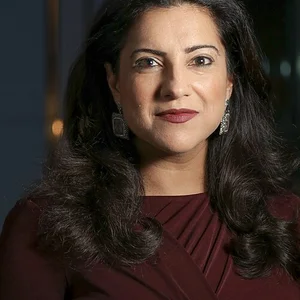

American lawyer and activist, founder of Girls Who Code in 2012, an organization aimed at closing the gender gap in technology careers. She also ran for the U.S. Congress and advocates for women's inclusion in tech.
Reshma Saujani(1975 — ?)
Reshma Saujani
États-Unis
8 min read
Frequently asked questions
Famous Quotes
« Teach girls bravery, not perfection.»
« We have to socialize our girls to be comfortable with imperfection.»
Key Facts
- Born in 1975 in Chicago to Indian immigrant parents
- Founded Girls Who Code in 2012 to teach girls to code
- First Indian-American woman to run for the U.S. Congress (2010)
- Girls Who Code has trained more than 500,000 young women in the United States and around the world
- Author of the book Brave, Not Perfect (2019)
Works & Achievements
A nonprofit organization founded in New York to introduce girls to computer coding and close the gender gap in tech. It has trained more than 500,000 participants across the United States and several other countries.
Reshma Saujani's first book, in which she urges women to take risks, stand up for themselves, and support other women rather than waiting their turn within male-dominated hierarchical structures.
An introductory coding manual aimed at teenage girls, blending hands-on tutorials with profiles of pioneering women in computing. Widely used in Girls Who Code clubs across the United States.
A TED Talk viewed millions of times in which Reshma Saujani shares her observations on gendered education and calls for bravery and the freedom to fail to be celebrated in girls from the earliest age.
A *New York Times* bestseller in which she develops her central argument: society raises girls to pursue perfection and boys to take risks, with profound consequences for their careers and self-esteem.
A national initiative launched during the COVID-19 pandemic demanding financial compensation for mothers forced out of the workforce. The op-ed was published in the *New York Times* and backed by hundreds of public figures.
A book in which Reshma Saujani analyzes persistent economic inequalities between men and women and proposes a concrete action plan for businesses, governments, and individuals.
Anecdotes
Reshma Saujani's parents were refugees of Indian origin expelled from Uganda by dictator Idi Amin in 1972. Arriving in the United States with nothing, they bet everything on their daughter's education, instilling in her the values of hard work and perseverance. This family history marked by exile deeply shaped Reshma's commitment to inclusion and equal opportunity.
In 2010, Reshma Saujani became the first woman of South Asian descent to run for the U.S. Congress, in New York's 14th congressional district. Although she did not win the election, the campaign took her into New York City schools, where she discovered that computer science classrooms were almost exclusively male — a revelation that led her to found Girls Who Code two years later.
During her school visits on the 2010 campaign trail, Reshma Saujani was struck by a simple observation: computer labs had almost no girls in them. Shocked by this gap, she decided to take concrete action. In 2012, Girls Who Code launched with 20 participants; by 2022, the organization had trained more than 500,000 girls and young women across the United States and around the world.
In her book *Brave, Not Perfect* (2019), Reshma Saujani develops a central idea: girls are taught to be perfect, and boys are taught to be brave. She illustrates this difference through learning to code — when they hit an error, boys persist while girls tend to give up. Her program is designed precisely to reverse this dynamic by celebrating trying, failing, and trying again.
In 2021, in the midst of the COVID-19 pandemic, Reshma Saujani launched the Marshall Plan for Moms, a call to governments and businesses to compensate the millions of mothers who were forced to leave their jobs during lockdowns. Drawing on the Marshall Plan of 1948 that rebuilt Europe, this initiative makes the case that women's economic equality cannot wait until a crisis is over.
Primary Sources
We're raising our girls to be perfect, and we're raising our boys to be brave. [...] I want to talk to you about a problem we have with bravery. And I think the solution to it starts with girls learning to code.
There are 1.4 million computing jobs that will be available by 2020, and women are set to fill only 3% of those jobs. We need to change this — and we can, starting today, starting right here.
Mothers are being pushed out of the workforce at an alarming rate. It's not a personal failing; it's a national economic crisis. We need a Marshall Plan for Moms.
For most of my life, I was terrified to try anything that I wasn't sure I could nail. I played it safe, I colored inside the lines, I did everything I was supposed to do. [...] I wasted years of my life doing this.
Key Places
The state where Reshma Saujani was born in 1975, after her parents — refugees from Uganda — settled there. Her childhood in an immigrant family shaped her values of inclusion, resilience, and hard work.
Reshma Saujani earned her law degree at Yale, one of the most prestigious universities in the United States. This rigorous legal training laid the foundation for her career as a lawyer before she turned to activism.
The city where Reshma Saujani built her political career and founded Girls Who Code in 2012. New York is the organization's headquarters and the territory of her 2010 congressional campaign.
The federal capital where Reshma Saujani brought her advocacy to Congress and the White House, pushing for policies promoting gender equality in tech and the workforce.
The capital from which Reshma Saujani's parents were expelled in 1972 during the ethnic purge ordered by Idi Amin. This place of tragic family origin remains central to her identity and her commitment to minority communities.
Typical Objects

The central tool of her mission, the laptop symbolizes the digital access that Reshma Saujani wants to democratize for all girls. Girls Who Code provides computers to participants who cannot afford them.

Girls Who Code participants use notebooks to write down their first algorithms and projects. Reshma Saujani champions learning by doing, experimentation, and the right to make mistakes.

Her 2019 bestseller embodies her philosophy: encouraging girls to take risks and embrace failure as a normal part of the process. Distributed in American high schools and universities, it has become a pedagogical tool.

Reshma Saujani is a recognized public speaker (TED, economic forums, universities). The microphone represents her public advocacy strategy to shift mindsets around gender, tech, and education.

During her run for Congress in 2010, Reshma Saujani ran a door-to-door campaign in New York. This button symbolizes her initial political commitment, before the founding of Girls Who Code.

An everyday tool for communication and digital activism, the smartphone represents the mobile revolution that transformed access to computing — a revolution that Girls Who Code integrates into its programs.
School Curriculum
Vocabulary & Tags
Key Vocabulary
Tags
Daily Life
Morning
Reshma Saujani starts her days early, with her family in New York, before diving into emails and strategic meetings at Girls Who Code. She reads the business press and tech news to stay on top of the issues she champions publicly.
Afternoon
Her afternoons are devoted to meetings with the organization's teams, corporate partners (Google, Microsoft, Twitter), or U.S. elected officials. She also prepares her public appearances, conference talks, and advocacy work before Congress.
Evening
In the evenings, Reshma Saujani dedicates time to her family and to writing. Her books and op-eds are often drafted at night. She also attends fundraising events for Girls Who Code, an organization funded entirely through donations and private partnerships.
Food
As a New Yorker of Indian descent, Reshma Saujani enjoys the diverse food scene of New York City, blending family Indian influences with contemporary American habits. Like many high-energy activists, she adapts her diet to a packed schedule and frequent travel.
Clothing
Reshma Saujani favors a polished, assertive style for her many public appearances: colorful suits and elegant dresses. She embraces a visible, confident image — a deliberate pushback against the invisibility she criticizes in a tech culture long dominated by men in hoodies.
Housing
Reshma Saujani lives in New York City with her husband Nihal Mehta and their children. The city — a global crossroads of finance, tech, and politics — is the natural backdrop for her activism and her intense professional life.
Historical Timeline
Period Vocabulary
Liens externes & ressources
Références
Œuvres
Girls Who Code (organisation)
2012
Women Who Don't Wait in Line
2013
Girls Who Code: Learn to Code and Change the World
2017
TED Talk 'Teach girls bravery, not perfection'
2016
Brave, Not Perfect
2019
Marshall Plan for Moms
2021
Pay Up: The Future of Women and Work
2022