 flip
flipSamboûsak-e gûsht (spiced lamb stuffed pastries)
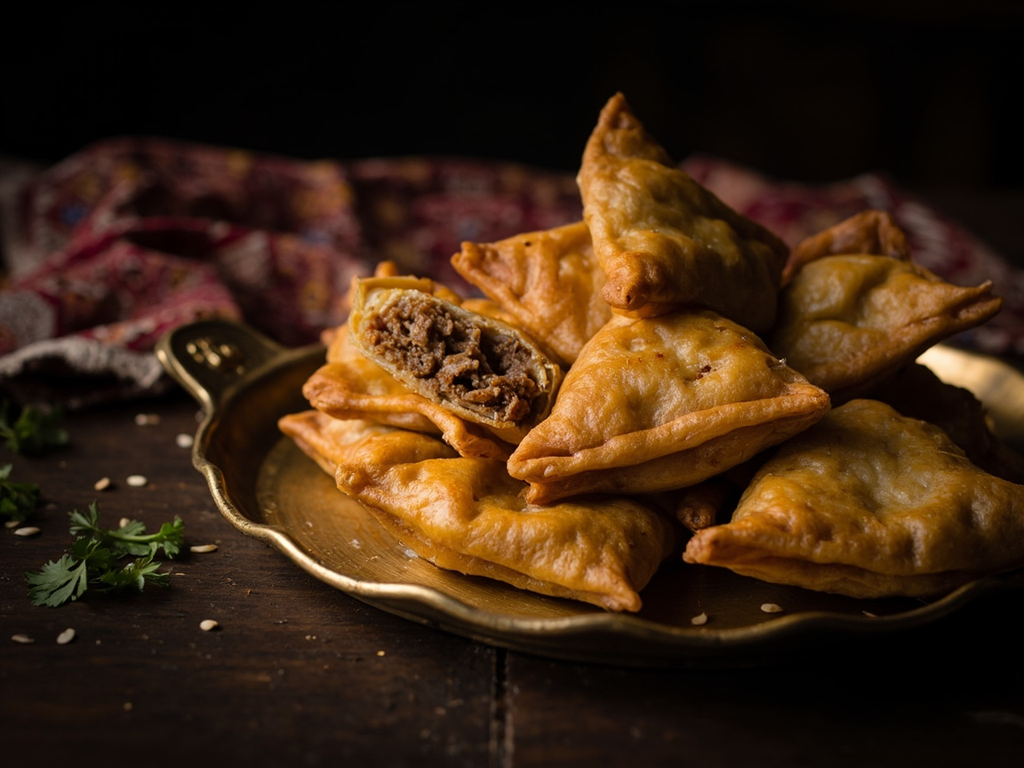
Samboûsak-e gûsht (spiced lamb stuffed pastries)
Why this dish? Samboûsak — ancestors of samosas — are abundantly documented in Abbasid and Samanid court feasts. At the banquets where Rûdakî sang while accompanying himself on the barbat, these crispy bites circulated among the guests with the wine. The poet himself evokes the pleasures of the princely table in his surviving fragments.
Triangles of fine, crispy dough stuffed with spiced minced lamb — coriander, cumin, and cinnamon — fried in clarified butter. A banquet morsel eaten with the fingers while listening to music.
When the emir commands a banquet, the cooks bustle from dawn, rolling the dough thin as a bride's veil and filling it with spiced minced meat. They plunge them into boiling butter and they emerge golden as little crispy suns. I have eaten a hundred in a single evening, one after another, between two odes and three cups of Herat wine. The samboûsak, you see, is the musician's perfect companion: you take one with one hand while the other plucks the barbat strings. And when the filling is well spiced, the wine is only better.
- •Dough of wheat flour, water, salt — enough for two dozen (Crispy wrapper)
- •Minced mutton — a good amount (Filling)
- •Finely chopped onion — one (Filling aroma)
- •Coriander seeds, crushed — a pinch (Spice)
- •Cumin — a pinch (Spice)
- •Cinnamon — a hint (Sweet spice)
- •Salt and pepper — to taste (Seasoning)
- •Clarified butter for frying — plenty (Cooking)
Samboûsak-e gûsht (spiced lamb stuffed pastries)
Triangles of fine, crispy dough stuffed with spiced minced lamb — coriander, cumin, and cinnamon — fried in clarified butter. A banquet morsel eaten with the fingers while listening to music.
Why this dish? Samboûsak — ancestors of samosas — are abundantly documented in Abbasid and Samanid court feasts. At the banquets where Rûdakî sang while accompanying himself on the barbat, these crispy bites circulated among the guests with the wine. The poet himself evokes the pleasures of the princely table in his surviving fragments.
When the emir commands a banquet, the cooks bustle from dawn, rolling the dough thin as a bride's veil and filling it with spiced minced meat. They plunge them into boiling butter and they emerge golden as little crispy suns. I have eaten a hundred in a single evening, one after another, between two odes and three cups of Herat wine. The samboûsak, you see, is the musician's perfect companion: you take one with one hand while the other plucks the barbat strings. And when the filling is well spiced, the wine is only better.
Ingredients (period version)
- Dough of wheat flour, water, salt — enough for two dozen (Crispy wrapper)
- Minced mutton — a good amount (Filling)
- Finely chopped onion — one (Filling aroma)
- Coriander seeds, crushed — a pinch (Spice)
- Cumin — a pinch (Spice)
- Cinnamon — a hint (Sweet spice)
- Salt and pepper — to taste (Seasoning)
- Clarified butter for frying — plenty (Cooking)
Ingredients
- All-purpose flour — 300 g (Dough)
- Warm water — 150 ml (Dough)
- Salt — ½ tsp (dough) + ½ tsp (filling) (Seasoning)
- Olive oil — 1 tbsp (in dough) (Flexibility)
- Minced lamb — 250 g (Filling)
- Yellow onion — 1 small, finely chopped (Filling aroma)
- Ground coriander — 1 tsp (Spice)
- Ground cumin — ½ tsp (Spice)
- Ground cinnamon — ¼ tsp (Sweet spice)
- Black pepper — ¼ tsp (Heat)
- Frying oil (sunflower or ghee) — for deep frying (Cooking)
Method
- Make the dough: mix flour, salt, olive oil, and warm water. Knead for 5 minutes until smooth. Cover with a cloth and rest for 30 minutes.
- Make the filling: sauté the chopped onion in a little ghee, add the minced lamb, spices, and salt. Cook over high heat for 8 minutes, breaking up the meat. Let cool slightly.
- Divide the dough into small walnut-sized balls. Roll each ball into a thin circle (2 mm thick).
- Place a spoonful of filling in the center of each circle, fold into a triangle, and seal the edges by pressing with fork tines.
- Heat oil to 170°C. Fry the samboûsak in small batches for 3–4 minutes, turning once, until golden brown.
- Drain on paper towels and serve hot.
How it was made : Samboûsak (sambûsaj) is one of the most frequently mentioned dishes in Arabic and Persian culinary works of the 9th–10th centuries. Al-Warraq gives several variants. The word comes from Persian and gave rise to the Indian samosa. At the Samanid court, these bites accompanied poetic assemblies (majlis) and banquets (bazm).
The contemporary twist : Shape the samboûsak into half-moons instead of triangles and bake them (200°C, 20 min, brushed with egg yolk) for a lighter version.
Sources : Nawal Nasrallah, Annals of the Caliph's Kitchens: Ibn Sayyār al-Warrāq's Tenth-Century Baghdadi Cookbook (Brill, 2007) · David Waines, In a Caliph's Kitchen (Riad El-Rayyes, 1989)
Rudaki · Charactorium