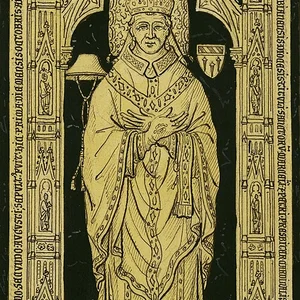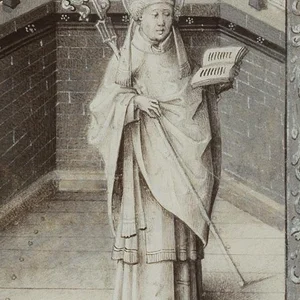

Bishop of Paris from 555 to 576, Germain is one of the great figures of the Merovingian Church. Founder of the Abbey of Saint-Germain-des-Prés, he was renowned for his charity toward the poor and his influence over the Frankish kings.
Saint Germain of Paris(496 — 576)
Germain of Paris
royaume des Francs
8 min read
Frequently asked questions
Key Facts
- Born around 496 in Autun, Burgundy
- Appointed Bishop of Paris in 555 by King Childebert I
- Founded around 558 the monastery that would become the Abbey of Saint-Germain-des-Prés
- Died on May 28, 576 in Paris, canonized very shortly after his death
- Influential advisor to the Merovingian kings Childebert I and Clotaire II
Works & Achievements
Germain persuaded Childebert I to build and endow a basilica to house the relics of Saint Vincent brought back from Spain. This monastery became one of the most important cultural and religious centers of the Middle Ages, exerting influence for over eight centuries.
Germain was an active signatory at the Councils of Paris (561) and Tours (567), helping to organize ecclesiastical discipline, protect the poor, and define the relationship between the Church and Merovingian royal authority.
Germain devoted his personal fortune and episcopal revenues to the service of the poor, the sick, and prisoners. He organized a systematic distribution of food and clothing, turning the bishopric into a center of aid for the most destitute.
As spiritual adviser to several Frankish rulers, Germain played a mediating role in the fratricidal wars among the sons of Chlothar I. He publicly rebuked Chilperic I, demonstrating the moral authority the Church could wield against royal power.
Written by the poet Venantius Fortunatus shortly after Germain's death, this hagiographic biography gathers his miracles and deeds. It was the principal vehicle for his cult in the West and remains the primary historical source on his life.
Anecdotes
According to the *Vita Germani* written by Venantius Fortunatus shortly after his death, Germain is said to have healed King Childebert I of a serious illness through the power of his prayers alone. The grateful king then funded the construction of a basilica dedicated to Saint Vincent and the Holy Cross — the forerunner of the Abbey of Saint-Germain-des-Prés, which bears his name to this day.
Tradition holds that a fierce fire threatened to devastate Paris when Germain stood before the flames, arms outstretched in the shape of a cross, and prayed. The flames are said to have retreated and died out miraculously, sparing the city. This episode earned him extraordinary veneration among the people of Paris.
Germain was renowned for freeing prisoners: he regularly visited jails to seek pardons for the condemned, especially during the Easter feasts. It was said that his words alone were enough to break chains — several hagiographic legends describe shackles falling away of their own accord at his approach.
Although Bishop of Paris and adviser to the Merovingian kings, Germain led a life of extreme austerity. He slept on a simple mat, drank only water, and gave his food to the poor. It is said that his deacons sometimes had to order him to change his clothes before official ceremonies, so worn were his garments.
At his death in 576, the basilica he had helped to found was renamed in his honor: Saint-Germain-des-Prés. His relics became a major object of pilgrimage, and numerous healing miracles were attested at his tomb, making the shrine one of the most visited in the Frankish kingdom.
Primary Sources
Venantius Fortunatus describes the bishop as a man whose holiness manifested itself through constant miracles: healings, the freeing of prisoners, and the calming of the elements. "There was no human misery his prayer could not relieve, nor any chain his blessing could not break."
Gregory of Tours mentions Germain as a figure of unquestioned moral authority among the Merovingian kings, capable of publicly rebuking Chilperic I for his excesses. "This bishop did not hesitate to reproach kings themselves when they strayed from the path of God."
Germain appears among the signatories of the synodal acts that organized ecclesiastical discipline within the Frankish kingdom. His prominent place among the signatories attests to his central role in the conciliar life of the Merovingian Church of Gaul.
The acts of the Council of Tours bear the signature of Germain, bishop of Paris, among the prelates gathered to debate clerical discipline and the protection of the poor. This council confirms his recognized authority throughout the Church of Gaul.
Key Places
Germain's birthplace, an important Gallo-Roman and episcopal center since late Antiquity. It was here that he received his Christian education before entering clerical life in Paris.
Founded at Germain's initiative with royal backing around 558, this basilica was the heart of his pastoral work and the site of his burial. It became one of the most important monastic and cultural centers of the medieval West, renowned in particular for its scriptorium.
Germain's episcopal seat, a Merovingian structure that preceded the Gothic cathedral of Notre-Dame. From this location, Germain exercised his authority over the diocese and received the faithful, the poor, and royal delegations.
The city from which the relics of Saint Vincent were brought back during a Frankish expedition around 548. These sacred relics directly prompted the founding of the Parisian basilica, which originally bore their name before being rededicated in Germain's honor.
Typical Objects

A curved staff shaped like a shepherd's crook, symbolizing the bishop's role as a pastor who guides and gathers his flock. Germain carried it during processions and liturgical ceremonies as a sign of his spiritual authority over the diocese of Paris.

Germain had relics of the martyr Vincent of Saragossa brought back from Spain, which prompted Childebert I to build the basilica. This precious reliquary was the very reason for the founding sanctuary of Saint-Germain-des-Prés and the heart of its miraculous renown.

A collection of biblical prayers recited several times a day during the Divine Office. For Germain, rooted in a monastic tradition, the chanting of psalms structured every hour of the day and night — from Matins to Compline — forming the guiding thread of his spiritual life.

Unlike bishops of his rank who wore rich ornaments, Germain was known for his coarse wool clothing worn outside of ceremonies. This deliberately plain garment was the visible sign of his asceticism and his identification with the poor he served.

A symbolic object linked to the many legends of prisoner liberation attributed to Germain. Medieval iconography often depicted the saint holding broken chains, an emblem of his power to free men from both temporal and spiritual captivity.

Consecrated oil used for anointings at baptisms, confirmations, and the sacrament of the sick. The miraculous healings attributed to Germain typically involved the laying on of hands and anointing with blessed oil — a gesture inherited from apostolic practice.
School Curriculum
Vocabulary & Tags
Key Vocabulary
Daily Life
Morning
Germain rose before dawn for Matins, the first of the canonical hours recited with his clergy in the basilica. After the office, he received the poor and the sick who had been waiting outside the bishop's residence since nightfall, personally distributing bread and blessed oil.
Afternoon
The afternoons were devoted to audiences: nobles, abbots, merchants, and ordinary faithful came to seek his counsel or arbitration. He also made regular visits to the jails of Paris to negotiate the release of prisoners with Merovingian officers.
Evening
In the evening, Germain joined his community of clergy for Vespers and Compline. He declined banquets hosted by the powerful, preferring a bowl of vegetable soup eaten in silence, and spent part of the night in solitary prayer lying on his rush mat.
Food
Germain observed strict abstinence: boiled vegetables, barley bread, and water made up the bulk of his daily fare. He fasted regularly and gave to the poor the food offered to him by nobles and kings, refusing all refined dishes.
Clothing
Outside liturgical ceremonies, where he wore the episcopal vestments (stole, cope, mitre), Germain dressed in a coarse wool tunic and a deliberately plain rough cloak — more in the manner of a monk than a high-ranking prelate.
Housing
Germain lived in the bishop's residence in Paris, a modest building he had refused to embellish. His personal room was unadorned, furnished only with a mat for sleeping and a lectern for reading the Scriptures; he turned down all the comforts his rank would have entitled him to.
Historical Timeline
Period Vocabulary
Liens externes & ressources
Références
Œuvres
Fondation de l'abbaye Saint-Germain-des-Prés
vers 558
Participation aux conciles de l'Église franque
561 et 567
Œuvre charitable et sociale à Paris
555-576
Médiation diplomatique entre rois mérovingiens
561-575
Vita Germani — Venance Fortunat (hagiographie)
vers 576-600