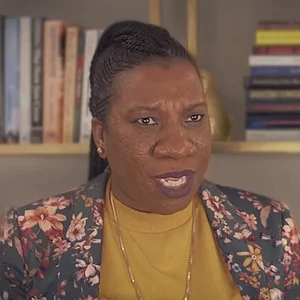

Tarana Burke is an American civil rights activist and founder of the #MeToo movement in 2006. She has dedicated her life to supporting survivors of sexual violence, particularly in underprivileged Black communities.
Tarana Burke(1973 — ?)
Tarana Burke
États-Unis
7 min read
Frequently asked questions
Famous Quotes
« Me Too is about empathy. It's about connecting with another survivor and saying, 'I see you. I hear you. I believe you.'»
« Healing doesn't happen in a vacuum.»
Key Facts
- 1973: Born in the Bronx, New York
- 2006: Coins the phrase 'Me Too' to support survivors of sexual violence in underprivileged communities
- 2017: The viral spread of the #MeToo hashtag on social media brings the movement to global prominence
- 2017: Burke and the 'Silence Breakers' are named Person of the Year by Time magazine
- Since 2018: Leads the organization 'me too. International' to support survivors
Works & Achievements
Tarana Burke launched the #MeToo movement in 2006, but it gained worldwide recognition in 2017 as a platform to speak out against sexual violence and harassment. The movement enabled millions of women to share their stories and transformed the public conversation around sexual abuse.
Tarana Burke created the 'Me Too' organization to support survivors of sexual violence, particularly Black women and women of color. The organization provides emotional support, resources, and a platform for collective healing.
Burke worked to amplify the voices of Black women and women of color who had experienced sexual violence, a group often rendered invisible within mainstream feminist movements. Her work placed intersectionality and inclusion at the center of the conversation.
A memoir in which Tarana Burke recounts her personal journey, her activist work, and the origins of the #MeToo movement. The book documents her vision of restorative and transformative justice.
Burke championed a model of justice centered on healing and transformation rather than punishment alone, shaping debates about how to address sexual abuse and violence.
Anecdotes
In 2006, Tarana Burke, an American women's rights activist, founded the 'Me Too' movement to support survivors of sexual assault, particularly Black women and women of color. She created the movement in response to the sexual violence she had witnessed in marginalized communities — well before the #MeToo hashtag went viral in 2017.
Tarana Burke grew up in Alabama in a family of preachers and activists, which deeply shaped her social commitment from an early age. She took part in various civil rights and social justice movements before focusing specifically on the issue of sexual violence.
Tarana Burke's Me Too movement spread worldwide in October 2017 when actress Alyssa Milano revived the hashtag on social media, exposing the scale of sexual assault in Hollywood. Millions of women then shared their stories, turning Me Too into a global movement of speaking out.
In 2018, Tarana Burke was named one of Time magazine's 100 Most Influential People in the World, recognized for her courage in giving a voice to survivors of sexual assault. This international recognition confirmed the lasting impact of her activism.
Tarana Burke worked for years as a youth educator before becoming a public figure, which gave her a deep understanding of the challenges faced by teenage girls and young women confronting violence. Her hands-on experience gave her invaluable credibility in her fight.
Primary Sources
I created the phrase 'Me Too' back in 2006 as a way to reach in to communities of color where I was working with underprivileged and underage girls.
The movement we created is a movement about the trauma of sexual assault and sexual harassment and how we heal.
Just Be Inc. is a not-for-profit organization dedicated to 'healing justice' for girls of color who have survived sexual abuse and exploitation.
Tarana Burke launched the Me Too movement to center survivors of sexual assault, particularly women of color.
Key Places
Tarana Burke's birthplace, where she was born in 1973. She grew up in this New York City borough and developed her social consciousness before becoming an activist.
The state where Tarana Burke worked as a community organizer and advocate for the rights of women and marginalized people throughout the 1990s and 2000s.
A major hub of Tarana Burke's activism, where she founded and grew the #MeToo movement, making it the heart of her fight against sexual violence and harassment.
The city where the #MeToo movement gained momentum and went global, fueled by the support of public figures and the viral spread of the hashtag in 2017.
The institution where Tarana Burke studied and first became socially engaged, shaping her convictions around social justice.
Typical Objects

A symbol of the 2000s–2010s, this tool enabled Tarana Burke to launch the #MeToo movement on social media in 2017, turning the denunciation of sexual violence into a viral, worldwide phenomenon.

The visual symbol of the movement founded by Tarana Burke, this hashtag has become the emblem of survivors of harassment and sexual assault speaking out collectively since 2017.

A tool representing Tarana Burke's role as an activist giving voice to survivors, particularly Black women and marginalized members of the community.

Digital platforms (Twitter, Facebook) used to amplify survivors' voices and build a community of solidarity around the #MeToo movement.

Representing the written accounts and testimonies of survivors, documenting the realities of sexual violence and harassment in contemporary society.

A symbol of solidarity and identification with the worldwide movement against sexual violence initiated by Tarana Burke.

A tool used to document #MeToo marches and mobilizations, as well as to give visibility to survivors' testimonies.
School Curriculum
Vocabulary & Tags
Key Vocabulary
Tags
Daily Life
Morning
Tarana Burke wakes up early to prepare for her day as an activist and community organizer. She has a light breakfast before checking her messages and scheduling meetings with the organizations she supports. From the first hours of the day, she is engaged in phone calls or working sessions tied to her social commitments.
Afternoon
Her afternoons are devoted to community meetings, awareness workshops, or mentoring sessions with young women. She moves through the neighborhoods of Harlem and other urban communities to connect directly with the people she helps. Her work as an organizer keeps her in constant motion, moving between association offices and community spaces.
Evening
In the evenings, Tarana Burke often attends awareness events or panel discussions, or continues her organizational administrative work. She stays connected with her activist network through calls and correspondence. She sets aside time for personal reflection and documenting her projects before resting.
Food
Her diet reflects that of an urban African American woman of the middle class working at a relentless pace: quick, practical meals between meetings, with a preference for balanced cooking when time allows. She regularly frequents restaurants and cafés in the Harlem neighborhood during her professional rounds.
Clothing
Tarana Burke wears professional yet approachable clothing: blazers, slacks, shirts, and comfortable shoes suited to her constant movement. Her style reflects her identity as a modern urban activist — practical and self-assured, without ostentation.
Housing
She lives in an urban neighborhood in New York, likely Harlem or the Bronx, in a modest home typical of Black American middle-class life. Her living space is functional, serving as a community hub where she sometimes holds meetings with her collaborators.
Historical Timeline
Period Vocabulary
Visual Style
Un style d'illustration moderne et engagé mêlant réalisme portraitiste et éléments abstraits, aux couleurs chaudes et profondes. Influence de l'art activiste contemporain avec typographie intégrée et une esthétique urbaine, reflétant le mouvement #MeToo et la lutte pour la justice sociale.
Sound Ambience
Une ambiance urbaine contemporaine mêlant les sons d'une mobilisation citoyenne, des voix portant des messages d'empowerment et de solidarité, avec en arrière-plan les bruits de la vie urbaine et les technologies numériques symbolisant le mouvement #MeToo initié par Tarana Burke.
Liens externes & ressources
Références
Œuvres
Mouvement #MeToo
2017
Fondation de 'Me Too'
2006
Campagne 'Me Too' dans les communautés marginalisées
2006-2010s
Livre 'Unbreakable: My Story, My Way'
2021
Advocacy pour la justice réparatrice
2010s-2020s