 flip
flipBlack Sea fish with oenogaron
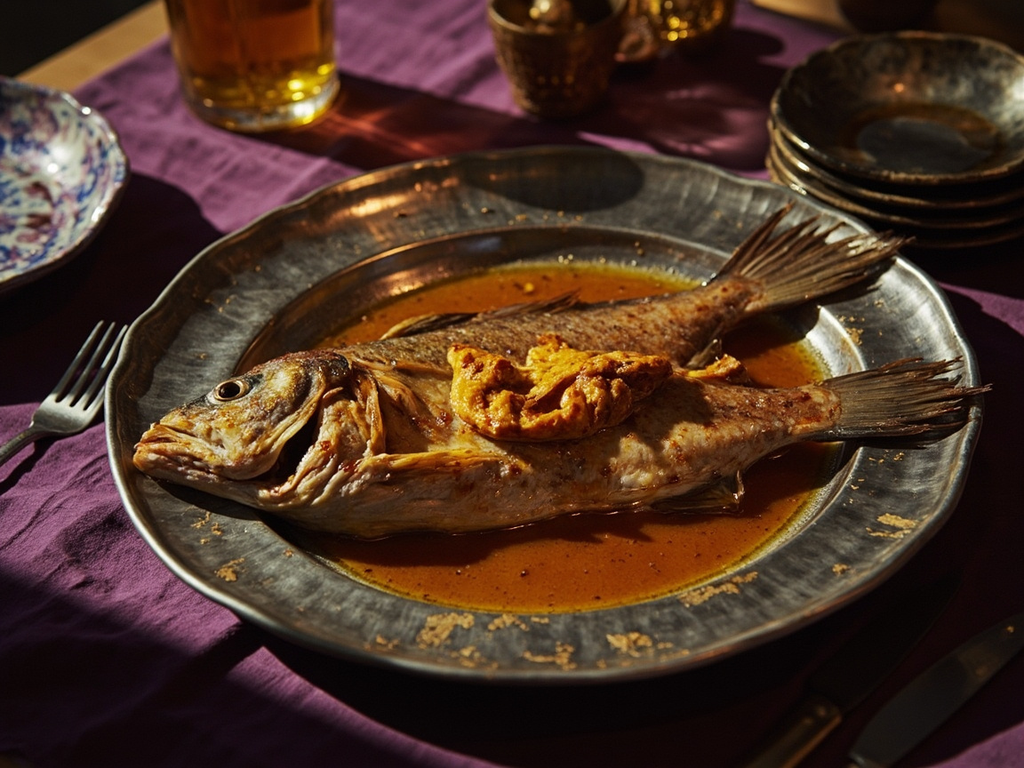
Black Sea fish with oenogaron
Why this dish? Constantinople lies between two seas, and the tables of the Sacred Palace overflowed with fish from the Mediterranean and the Black Sea. For an empress who feasted with Justinian after great ceremonies, this fish coated in a garum-and-wine sauce was a dish of prestige while remaining true to Byzantine taste.
A whole roasted fish, drizzled with a hot sauce where garum, wine, and honey respond to each other. Sweet-and-sour and briny, it is the heart of a festive meal in Byzantium.
Approach and see what is brought to our table. I who was born far from the Purple have learned that nothing honors a guest better than a fine fish from our two seas. It is laid whole, bathed in a well-fermented garum, a little sweet wine, and a spoonful of honey — for among us, salt is not ashamed to wed sweetness. Taste, and you will understand why God placed our city between the waters.
- •Whole sea fish (sea bass, sea bream, mullet) — one fine fish (centerpiece)
- •Garon (garum) — a few dashes (umami salt)
- •Sweet white wine — one cup (sauce base)
- •Honey — one spoonful (sweetness)
- •Olive oil — a drizzle (fat)
- •Pepper, coriander, lovage — to taste (aromatics)
Black Sea fish with oenogaron
A whole roasted fish, drizzled with a hot sauce where garum, wine, and honey respond to each other. Sweet-and-sour and briny, it is the heart of a festive meal in Byzantium.
Why this dish? Constantinople lies between two seas, and the tables of the Sacred Palace overflowed with fish from the Mediterranean and the Black Sea. For an empress who feasted with Justinian after great ceremonies, this fish coated in a garum-and-wine sauce was a dish of prestige while remaining true to Byzantine taste.
Approach and see what is brought to our table. I who was born far from the Purple have learned that nothing honors a guest better than a fine fish from our two seas. It is laid whole, bathed in a well-fermented garum, a little sweet wine, and a spoonful of honey — for among us, salt is not ashamed to wed sweetness. Taste, and you will understand why God placed our city between the waters.
Ingredients (period version)
- Whole sea fish (sea bass, sea bream, mullet) — one fine fish (centerpiece)
- Garon (garum) — a few dashes (umami salt)
- Sweet white wine — one cup (sauce base)
- Honey — one spoonful (sweetness)
- Olive oil — a drizzle (fat)
- Pepper, coriander, lovage — to taste (aromatics)
Ingredients
- Whole gutted sea bream or sea bass — 1 (about 600 g) (centerpiece)
- Fish sauce (nuoc-mam or colatura) — 1 tbsp (replaces garum)
- Medium-sweet white wine — 10 cl (sauce base)
- Honey — 1 tsp (sweetness)
- Olive oil — 2 tbsp (fat)
- Pepper, ground coriander, a little celery — 1 pinch each (aromatics)
Method
- Preheat oven to 200 °C. Score the fish, oil it, and salt very lightly (the sauce will salt).
- Roast for 20–25 minutes depending on size, until the flesh flakes.
- Meanwhile, gently simmer the wine with honey, fish sauce, pepper, and coriander until slightly syrupy.
- Off the heat, whisk in olive oil and a little chopped celery.
- Nap the fish with this hot sauce at serving time.
How it was made : The Byzantines, heirs to Roman cuisine, loved compound sauces where garum was mixed with wine (oenogaron), vinegar (oxygaron), or honey. The physician Anthimus, a contemporary of Justinian, recommends fresh fish well cooked and warns against overly fatty preparations.
The contemporary twist : Serve the fish on a dark slate, amber sauce in a cordon, like a mosaic of Hagia Sophia where gold stands out from the background.
Sources : Anthimus, De observatione ciborum (6th c.) · Apicius, De re coquinaria
Theodora · Charactorium