 flip
flipFat-Tail Shorpa — Khan's Festive Broth
Fat-Tail Shorpa — Khan's Festive Broth
Why this dish? Fatty shorpa opened the great feasts of the Golden Horde — coronations, victories, ambassador receptions. When Tokhtamysh reunified the Horde and received emissaries from the Russian principalities at Sarai, this rich and fragrant broth inaugurated the banquet. The amount of fat in the shorpa was a sign of the khan's generosity and power — a lean broth would have been an insult.
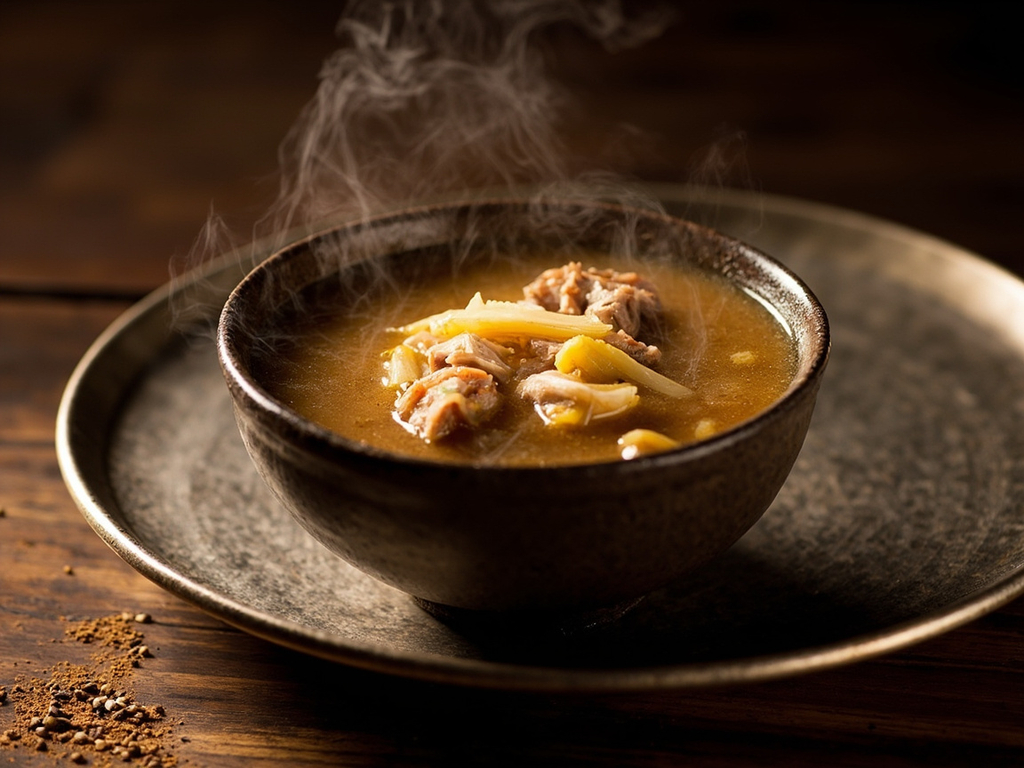
A long, deep mutton broth enriched with melted fat-tail fat, perfumed with cumin and steppe herbs, with pieces of turnip and onion. Served boiling hot in bowls, it warms and prepares the stomach for the feast to come. Its golden, glistening surface is as much a spectacle as a dish.
The feast always begins with shorpa — it is the law of the dastarkhan that even a khan does not break. When the broth steams in the bowls and the fat shines like molten gold, then my emirs know that peace reigns under my yurt. I have them throw in the cumin that my merchants bring from Bukhara and a firm turnip from the lower Volga. He who empties his bowl in one gulp shows me he trusts me — for it is in the shorpa that an enemy would slip poison. I always drink first.
- •Marrow bones of mutton — an armful (Broth base)
- •Fat-tail sheep fat — a good piece (Richness and unctuousness)
- •Onion — two or three (Aromatic)
- •Turnip — one or two (Vegetable)
- •Cumin seeds — a pinch (Spice)
- •Rock salt — to taste (Seasoning)
- •Steppe herbs (wild thyme, coriander seeds) — a handful (Flavor)
Fat-Tail Shorpa — Khan's Festive Broth
A long, deep mutton broth enriched with melted fat-tail fat, perfumed with cumin and steppe herbs, with pieces of turnip and onion. Served boiling hot in bowls, it warms and prepares the stomach for the feast to come. Its golden, glistening surface is as much a spectacle as a dish.
Why this dish? Fatty shorpa opened the great feasts of the Golden Horde — coronations, victories, ambassador receptions. When Tokhtamysh reunified the Horde and received emissaries from the Russian principalities at Sarai, this rich and fragrant broth inaugurated the banquet. The amount of fat in the shorpa was a sign of the khan's generosity and power — a lean broth would have been an insult.
The feast always begins with shorpa — it is the law of the dastarkhan that even a khan does not break. When the broth steams in the bowls and the fat shines like molten gold, then my emirs know that peace reigns under my yurt. I have them throw in the cumin that my merchants bring from Bukhara and a firm turnip from the lower Volga. He who empties his bowl in one gulp shows me he trusts me — for it is in the shorpa that an enemy would slip poison. I always drink first.
Ingredients (period version)
- Marrow bones of mutton — an armful (Broth base)
- Fat-tail sheep fat — a good piece (Richness and unctuousness)
- Onion — two or three (Aromatic)
- Turnip — one or two (Vegetable)
- Cumin seeds — a pinch (Spice)
- Rock salt — to taste (Seasoning)
- Steppe herbs (wild thyme, coriander seeds) — a handful (Flavor)
Ingredients
- Lamb marrow bones (shank, spine) — 800 g (Broth base)
- Lamb neck or breast — 400 g (Meat)
- Lamb fat or suet — 60 g (Richness)
- Yellow onions — 2 (Aromatic)
- Turnips — 2 medium (Vegetable)
- Cumin seeds — 1 tsp (Main spice)
- Coriander seeds — 1/2 tsp (Spice)
- Dried thyme — 1/2 tsp (Herb)
- Salt — to taste (Seasoning)
- Water — 3 liters (Broth)
Method
- Roast the lamb bones in the oven at 200 °C for 25 minutes to develop flavors.
- Transfer bones to a large pot, add lamb meat, cover with cold water and bring to a boil. Skim thoroughly.
- Add onions cut into quarters, thyme, and reduce heat. Simmer gently for 2.5 hours.
- Meanwhile, dry-toast cumin and coriander in a small pan for 2 minutes, then coarsely crush in a mortar.
- After 2 hours, add turnips cut into quarters and crushed spices. Continue cooking for 30 minutes.
- Melt the lamb fat in a small pan and pour into the broth.
- Remove meat, shred roughly. Adjust salt.
- Serve the broth boiling hot in bowls, with a few pieces of meat and turnip, the surface shiny with golden fat.
How it was made : Arab and Persian chroniclers of the 14th century describe the feasts of the Golden Horde as grandiose events where dozens of sheep were sacrificed. Ibn Battuta, visiting the court of Khan Özbeg (Tokhtamysh's predecessor) in 1333, describes a strict service protocol and mentions mutton broth served in gold and silver bowls. Cumin, imported from Transoxiana via caravan routes, was one of the few spices used in Horde cuisine.
The contemporary twist : Serve in a dark stoneware bowl with a spoonful of yogurt beaten with toasted cumin placed on the surface — the white-on-gold contrast creates a striking visual effect.
Sources : Ibn Battûta, « Rihla », XIVe siècle (trad. Defremery & Sanguinetti, tome II) · Charles J. Halperin, « Russia and the Golden Horde », Indiana University Press, 1985
Tokhtamysh · Charactorium