 flip
flipSamarkand Plov
Samarkand Plov
Why this dish? Plov is inseparable from Samarkand, the capital Tamerlane made shine as the jewel of his empire. Every victory, every foreign embassy was celebrated with banquets where pilaf rice, cooked in mutton fat and spices, fed hundreds of guests. Ruy González de Clavijo, a Castilian ambassador received by Tamerlane in 1404, describes these lavish feasts in detail.
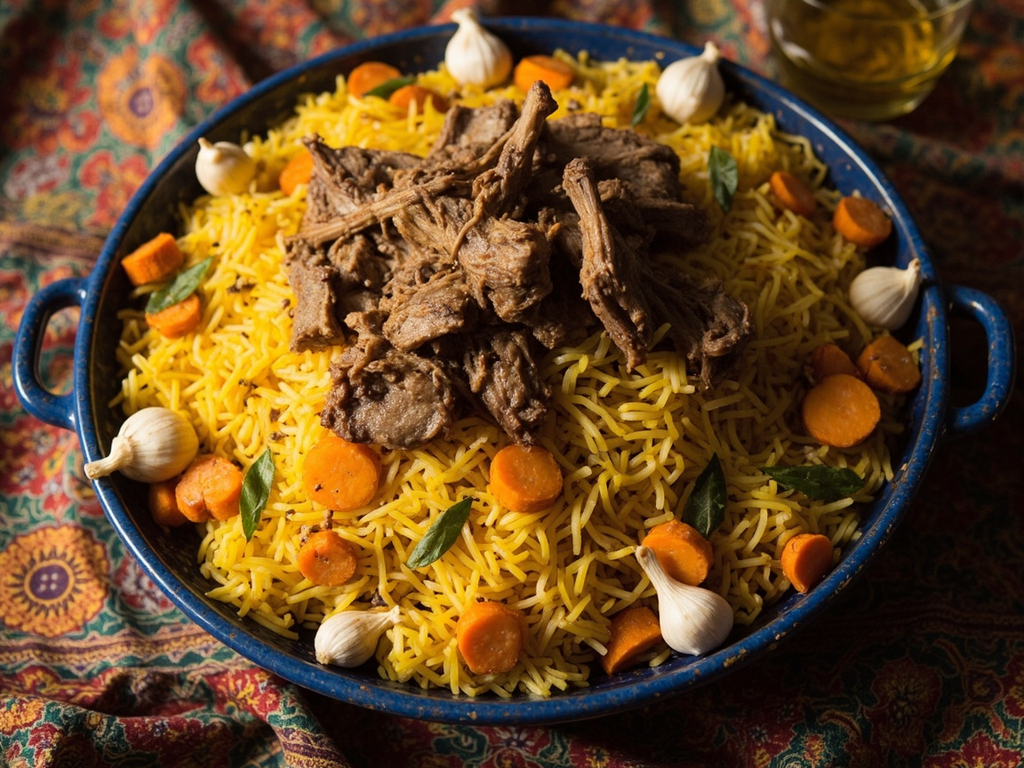
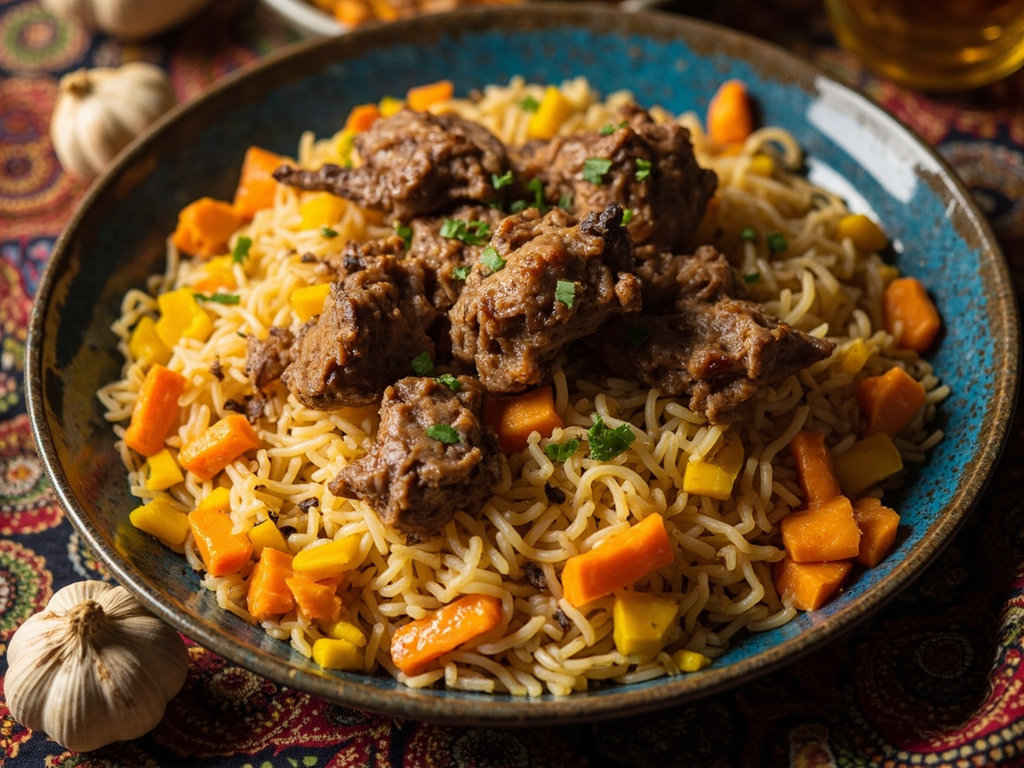
Rice slowly cooked with lamb, yellow carrots, chickpeas, whole garlic heads, and cumin, all seared in melted sheep tail fat. Plov is the king of the Central Asian dastarkhan.
Know, you who sit at my dastarkhan, that Samarkand's rice is no ordinary rice. When my armies return victorious, I have cauldrons the size of chariots set up — into them goes the fat of a hundred sheep, then the golden carrots of Mawarannahr, and the rice comes to drink it all until it grows as fat as a sated emir. The cumin, I want it dry-roasted before mixing — that is the secret. At my table, a man eats with his hands and leaves not a single grain, for each grain is a soldier of the empire.
- •Long-grain rice — a large measure (Base of the dish)
- •Lamb shoulder with bone — a fine piece (Main meat)
- •Sheep tail fat (dumba) — a good piece (Cooking fat)
- •Yellow carrots — as much as the rice (Sweet vegetable)
- •Onions — three or four (Aromatic base)
- •Dried chickpeas, soaked — a handful (Legume)
- •Whole garlic heads — two (Buried aroma)
- •Cumin seeds — a good pinch (Main spice)
- •Salt — to taste (Seasoning)
Samarkand Plov
Rice slowly cooked with lamb, yellow carrots, chickpeas, whole garlic heads, and cumin, all seared in melted sheep tail fat. Plov is the king of the Central Asian dastarkhan.
Why this dish? Plov is inseparable from Samarkand, the capital Tamerlane made shine as the jewel of his empire. Every victory, every foreign embassy was celebrated with banquets where pilaf rice, cooked in mutton fat and spices, fed hundreds of guests. Ruy González de Clavijo, a Castilian ambassador received by Tamerlane in 1404, describes these lavish feasts in detail.
Know, you who sit at my dastarkhan, that Samarkand's rice is no ordinary rice. When my armies return victorious, I have cauldrons the size of chariots set up — into them goes the fat of a hundred sheep, then the golden carrots of Mawarannahr, and the rice comes to drink it all until it grows as fat as a sated emir. The cumin, I want it dry-roasted before mixing — that is the secret. At my table, a man eats with his hands and leaves not a single grain, for each grain is a soldier of the empire.
Ingredients (period version)
- Long-grain rice — a large measure (Base of the dish)
- Lamb shoulder with bone — a fine piece (Main meat)
- Sheep tail fat (dumba) — a good piece (Cooking fat)
- Yellow carrots — as much as the rice (Sweet vegetable)
- Onions — three or four (Aromatic base)
- Dried chickpeas, soaked — a handful (Legume)
- Whole garlic heads — two (Buried aroma)
- Cumin seeds — a good pinch (Main spice)
- Salt — to taste (Seasoning)
Ingredients
- Basmati or long-grain rice — 500 g (Base of the dish)
- Lamb shoulder with bone — 700 g (Main meat)
- Sheep tail fat or neutral vegetable oil — 100 g (Cooking fat)
- Carrots (yellow preferred, or orange) — 500 g (Vegetable)
- Yellow onions — 3 medium (Aromatic base)
- Dried chickpeas, soaked overnight — 100 g (Legume)
- Whole garlic heads — 2 (Aroma)
- Cumin seeds — 2 tbsp (Spice)
- Salt — 2 tsp (Seasoning)
- Hot water — about 800 ml (Cooking liquid)
Method
- Rinse the rice in cold water until the water runs clear, then soak for 30 minutes. Drain.
- Cut the sheep tail fat into small cubes and melt over medium heat in a large pot or kazan (heavy casserole). Remove the solid residue.
- Sear the lamb pieces in the hot fat until golden brown on all sides. Set aside.
- In the same fat, fry the onions sliced into thick rings until well caramelized.
- Add the carrots cut into thick sticks and sauté for 5 minutes without stirring too much.
- Return the meat, add the dry-roasted cumin, salt, drained chickpeas, and cover with hot water. Simmer covered for 40 minutes (this is the zirvak).
- Spread the drained rice in an even layer over the zirvak without mixing. Push the whole garlic heads into the rice.
- Pour in hot water to 2 cm above the rice. Bring to a boil over high heat uncovered, until the water is no longer visible.
- Mound the rice into a dome, poke a few holes with a spoon handle, cover tightly, and cook over very low heat for 30 minutes.
- Invert the plov onto a large serving platter: meat on top, golden rice around, garlic heads in the center. Serve hot.
How it was made : Plov is attested in Persian and Central Asian culinary tradition long before Tamerlane, but it was under the Timurids that Samarkand became the undisputed capital of this dish. The zirvak technique (a base of meat and vegetables simmered under the rice) is specifically Central Asian. Clavijo's accounts of Tamerlane's banquets mention immense quantities of mutton and rice served on gold platters.
The contemporary twist : Serve each portion in a turquoise ceramic bowl reminiscent of Samarkand faience, with a pinch of crushed pistachios and a few saffron threads for a royal presentation.
Sources : Ruy González de Clavijo, Embajada a Tamorlán (1406), account of the Castilian embassy to Tamerlane's court · Charles Perry, Medieval Arab Cookery (2001), chapter on Persian and Turkish pilafs
Tamerlane · Charactorium