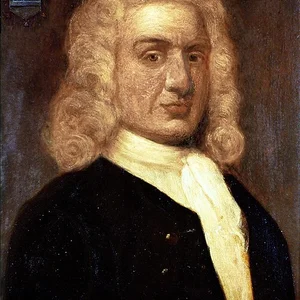

A Scottish sailor first commissioned as a privateer in the service of the English Crown to hunt down pirates in the Indian Ocean. Accused of piracy himself, he was tried and hanged in London in 1701, becoming a legendary figure of the Golden Age of Piracy.
William Kidd(1645 — 1701)
William Kidd
Royaume-Uni de Grande-Bretagne et d'Irlande
7 min read
Frequently asked questions
Key Facts
- Around 1695, he obtained a letter of marque from the English Crown to hunt down pirates and French ships
- He commanded the Adventure Galley during his expedition in the Indian Ocean
- In 1698, he captured the Quedagh Merchant, a wealthy merchant ship, an act that tipped him into illegality
- Arrested in Boston in 1699 and then transferred to London to stand trial
- Hanged for piracy and murder on 23 May 1701 in London; his body was displayed over the River Thames
Works & Achievements
Kidd fights the French in the West Indies at the start of the Nine Years' War. This early career earns him a reputation as a reliable sailor, loyal to the Crown.
Backed by powerful Whig lords and King William III, Kidd has a ship built specially designed to hunt down the pirates of the Indian Ocean.
A long and difficult voyage to Madagascar and India. Prizes are scarce, and illness and tensions threaten to spark a mutiny.
A rich merchant ship taken under a French pass off the coast of India. This prize, regarded as an act of piracy by his enemies, seals his fate.
Kidd conceals part of his loot before his arrest. Recovered by the authorities, this treasure gave rise to the legend of buried pirate treasure.
Anecdotes
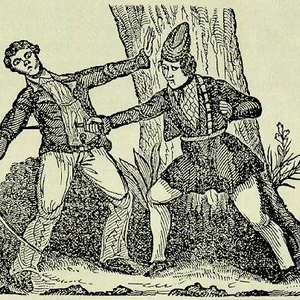
In 1697, during a quarrel aboard the Adventure Galley, Kidd struck his gunner William Moore on the head with an iron-bound bucket. Moore died the next day. This fit of rage, far more than his prizes at sea, led to his conviction for murder.
Kidd had kept the “French passes” seized from the ships he had captured: these safe-conducts proved, in his view, that his prizes were lawful. Yet these documents vanished as if by magic at the time of his trial. They were not found in the London archives until the early 20th century, more than two centuries later.
Before his arrest, Kidd buried part of his loot — gold, silver, and precious stones — on Gardiners Island, near Long Island. The treasure was dug up and used as evidence against him in court. This tale of buried pirate treasure later inspired writers such as Edgar Allan Poe and Robert Louis Stevenson.
On the day of his execution at Execution Dock, on 23 May 1701, the rope broke on the first attempt and Kidd fell to the ground. He had to be hanged a second time. His body, coated in tar, was then displayed for years in an iron cage on the banks of the Thames, to warn sailors tempted by piracy.
Kidd's expedition had been secretly financed by some of the most powerful Whig lords in England, with the discreet blessing of King William III himself. When the affair went sour, these protectors abandoned him: his trial became a political matter in which Kidd served as a scapegoat.
Primary Sources
Upon six several indictments, at the Admiralty-Sessions held by His Majesty's Commission at the Old-Bailey, the 8th and 9th of May, 1701.
My name was Captain Kid, when I sail'd, when I sail'd, and so wickedly I did, God's laws I did forbid, when I sail'd.
Authorization granted to Kidd to “apprehend, seize, and take” the pirates named therein — Thomas Tew, John Ireland, Thomas Wake, and William Maze — as well as to capture any French ships encountered at sea.
Report describing Kidd's arrival in the colonies, his arrest in Boston, and the seizure of the gold and silver he had buried on Gardiners Island.
Key Places
Scottish port town often cited as Kidd's birthplace, around 1645. His exact origins, however, remain uncertain.
The city where Kidd settled, married a wealthy widow, and became a man of standing. It was from here that he prepared part of his expedition.
An island in the Indian Ocean that served as a den for the very pirates Kidd was supposed to hunt down. A key stop on his voyage to Indian waters.
The waters where Kidd seized the Quedagh Merchant in January 1698, his most famous capture and the one with the gravest consequences.
The island where Kidd buried part of his loot before his arrest. The treasure was recovered there and used as evidence against him.
A Thames quay where those condemned for maritime crimes were executed. Kidd was hanged here on 23 May 1701, and his body was then displayed on the gibbet.
Typical Objects

Official document sealed by the sovereign that authorized Kidd to attack pirates and enemy ships. Without it, he would have been nothing but an outlaw pirate.

A safe-conduct found aboard a captured ship, proving that it sailed under French protection. Kidd kept them as proof that his prizes were lawful.

Kidd's warship, fitted with 34 cannons and oars that let it advance without wind. It served both as a fighting vessel and as transport for the crew.

A short, sturdy blade, ideal for close combat on the crowded decks of ships. It was the supreme weapon of boarding actions.

A handheld firearm, inaccurate but fearsome at close range. Sailors often carried several, since reloading took a long time.

An instrument used to measure the height of the sun or a star in order to estimate latitude. Indispensable for crossing the Indian Ocean without getting lost.

A chest used to store the gold, silver and precious stones of the plunder. The treasure Kidd actually buried on Gardiners Island fueled the legend of buried pirate treasure.
School Curriculum
Vocabulary & Tags
Key Vocabulary
Tags
Daily Life
Morning
Aboard ship, the captain's day begins early: the crew "clears the decks," washes the deck, and changes the watch. Kidd consults the boatswain, checks the heading with the compass and quadrant, and inspects the sails and rigging.
Afternoon
The afternoon is devoted to navigation, gun drills, and repairs. When the wind dies, the crew rows, for the Adventure Galley is fitted with oars. The captain scans the horizon through his spyglass for any ship that might make a prize, and keeps his logbook.
Evening
In the evening, rations are handed out and the night watches are arranged. The mood is often tense: with few prizes taken, the crew grumbles, and the captain must constantly head off mutiny while keeping watch on the horizon.
Food
The diet consisted mainly of ship's biscuit (a very hard cracker), salted beef or pork kept in barrels, dried peas, and cheese. Water went stale quickly, hence the reliance on beer or rum cut with water. On long crossings, scurvy, caused by the lack of fresh fruit and vegetables, wreaked havoc.
Clothing
Sailors wore a linen shirt, wide trousers, a wool jacket, and a cap or hat. As a captain and a man of standing, Kidd sported a more refined outfit: a long coat, a waistcoat, a hat, and sometimes a sword at his side to mark his rank.
Housing
At sea, Kidd had a cabin at the stern of the ship, beneath the quarterdeck, while his men slept in hammocks crowded together on a dark, damp lower deck. On land, in New York, he lived in a fine gentleman's house, a sign of his social success.
Historical Timeline
Period Vocabulary
Liens externes & ressources
Références
Œuvres
Service de corsaire dans les Caraïbes (commandement du Blessed William)
vers 1689
Obtention d'une commission royale et armement de l'Adventure Galley
1695-1696
Expédition de chasse aux pirates dans l'océan Indien
1696-1698
Capture du Quedagh Merchant
janvier 1698
Trésor enterré sur Gardiners Island
1699