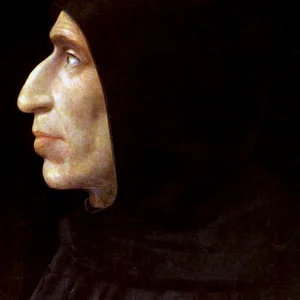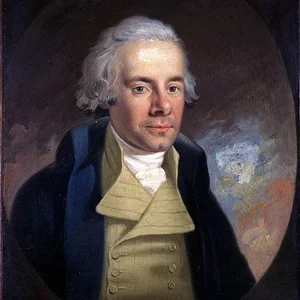

British politician and philanthropist, a leading figure in the parliamentary fight against the slave trade. An evangelical Member of Parliament, he devoted his life to the abolition of slavery throughout the British Empire.
William Wilberforce(1759 — 1833)
William Wilberforce
royaume de Grande-Bretagne, Royaume-Uni de Grande-Bretagne et d'Irlande
6 min read
Frequently asked questions
Famous Quotes
« You may choose to look the other way but you can never say again that you did not know.»
Key Facts
- Elected Member of Parliament for Kingston upon Hull in 1780, then for Yorkshire in 1784
- From 1787 onward, led the parliamentary campaign against the slave trade
- Secured the passage of the Slave Trade Act in 1807, abolishing the slave trade throughout the British Empire
- Co-founder of the Society for the Suppression of Vice and of various philanthropic movements
- Died in 1833, shortly before the Slavery Abolition Act that abolished slavery itself across the Empire
Works & Achievements
Wilberforce becomes the society's parliamentary spokesman. It structures the first great mass humanitarian movement in history.
A religious bestseller in which Wilberforce defends a lived and committed Christianity. The work had a lasting influence on Victorian morality.
The culmination of eighteen years of struggle: the law banned the slave trade throughout the British Empire. A historic victory for Wilberforce.
Wilberforce takes part in the creation of the forerunner of the RSPCA. A testament to his broad conception of moral reform.
A law abolishing slavery itself across nearly the entire Empire. Wilberforce learned of its passage three days before his death.
Wilberforce co-founds several missionary and biblical societies. They spread evangelicalism and philanthropic action.
Anecdotes
In 1785, during a journey through Europe, Wilberforce went through a profound spiritual crisis that converted him to a fervent evangelical Christianity. At first he considered leaving politics, but his friend John Newton — a repentant former slave trader and author of the hymn *Amazing Grace* — convinced him to stay in Parliament to serve a great cause.
Every year from 1789 onward, Wilberforce tirelessly introduced motions to abolish the slave trade, and every year they were rejected. It took nearly eighteen years of relentless struggle before the law abolishing the trade was finally passed in **1807**.
To convince the members of Parliament, the abolitionists displayed the plan of the slave ship *Brookes*, showing how hundreds of enslaved people were packed into the hold. Wilberforce drew on this shocking document and on the testimony gathered by **Thomas Clarkson** to reveal the horror of the trade.
Wilberforce was short in stature and frail in health, suffering from intestinal problems that forced him to take opium; yet his eloquence was such that the diarist James Boswell, hearing him speak at the podium, nicknamed him “a shrimp that had become a whale.”
On 26 July 1833, as he lay dying, Wilberforce learned that Parliament had just voted to abolish slavery throughout the British Empire. He passed away three days later, having seen the triumph of his life's great cause.
Primary Sources
Let the consequences be what they may, I am now resolved: I will never rest until the slave trade is abolished. The evil is of such a nature that it admits of neither palliation nor compromise.
A commerce founded on injustice and carried on by cruelty can never be reconciled with the principles of justice and humanity.
True Christianity is not a mere assent to doctrines, but a living principle that transforms the heart and governs the whole of one's conduct.
God Almighty has set before me two great objects: the suppression of the slave trade and the reformation of manners.
Key Places
Port city in Yorkshire where Wilberforce was born in 1759 and which he represented as a Member of Parliament. His birthplace is today a museum dedicated to slavery.
Seat of the British Parliament where Wilberforce waged his parliamentary battle against the slave trade for decades. It was here that the laws of 1807 and 1833 were passed.
London district where the “Clapham Sect” met, a circle of evangelical reformers. Wilberforce lived there and developed his humanitarian campaigns.
College where Wilberforce studied and met the future Prime Minister William Pitt the Younger, his friend and political ally.
Burial place of Wilberforce, interred near his friend William Pitt in 1833. A statue there honours his memory.
Typical Objects

Engraving showing hundreds of enslaved people packed into a ship's hold. This image became the most effective propaganda weapon of the abolitionist movement.

Ceramic cameo depicting a kneeling enslaved man in chains with the inscription “Am I not a man and a brother?”. Worn as jewellery, it spread the cause throughout society.

Long rolls of paper covered with thousands of signatures demanding an end to the slave trade. Wilberforce laid them before Parliament to prove the scale of popular support.

Wilberforce's bedside book, the source of his faith and his moral struggle. His daily reading nourished his conviction that slavery was a sin.

Metal shackles displayed by the abolitionists to show the concrete reality of the slave trade. Thomas Clarkson carried some in a trunk of evidence.

The flagship product of the slave plantations. Abolitionists launched a boycott of “blood-stained” sugar to strike the slave trade economically.
School Curriculum
Vocabulary & Tags
Key Vocabulary
Tags
Daily Life
Morning
Wilberforce began his day with a long prayer and meditative Bible reading, faithful to his evangelical discipline. He then devoted the morning to his abundant correspondence and to preparing his parliamentary speeches.
Afternoon
The afternoon often took him to the House of Commons, where he debated and tabled his motions. Between sessions, he received activists such as Thomas Clarkson, who brought him testimonies and evidence about the slave trade.
Evening
In the evening, Wilberforce frequented the political salons and dinners of London, where his wit and melodious voice charmed all. He frequently ended his days among his Clapham friends, discussing strategy and reform.
Food
A man of high society, he ate hearty English meals, but his fragile health forced him into moderation. He took part in the boycott of West Indian sugar and regularly took opium prescribed for his intestinal pains.
Clothing
Wilberforce wore the sober, elegant attire of the Georgian gentleman: frock coat, waistcoat, breeches and stockings, with a wig or powdered hair in his youth. His appearance remained dignified but unostentatious, a reflection of his evangelical restraint.
Housing
He lived in comfortable residences, notably at Clapham within his community of reformer friends, then in various houses across the south of England. His homes were open, lively, and always filled with visitors and causes to champion.
Historical Timeline
Period Vocabulary
Liens externes & ressources
Références
Œuvres
Fondation de la Society for the Abolition of the Slave Trade
1787
A Practical View of the Prevailing Religious System
1797
Slave Trade Act (abolition de la traite)
1807
Fondation de la Société pour la prévention de la cruauté envers les animaux (SPCA)
1824
Slavery Abolition Act (abolition de l'esclavage)
1833
Création de la Church Mission Society et de la British and Foreign Bible Society
1799