 flip
flipNkatenkwan — The Great Peanut Soup with Guinea Fowl
Nkatenkwan — The Great Peanut Soup with Guinea Fowl
Why this dish? Peanut soup with poultry was THE dish of honor for grand occasions at the court of Ejisu. Yaa Asantewaa's record notes that she was offered game and poultry as tribute, along with peanut sauces spiced with chili: this is exactly the table of an Ashanti queen mother receiving her chiefs.
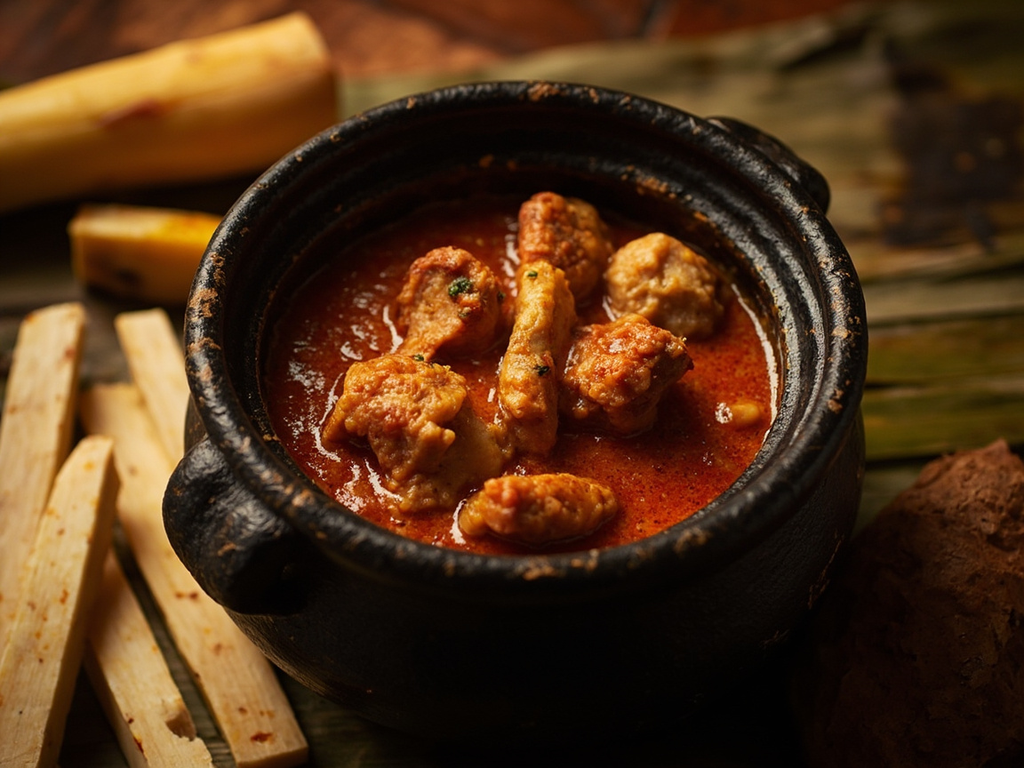
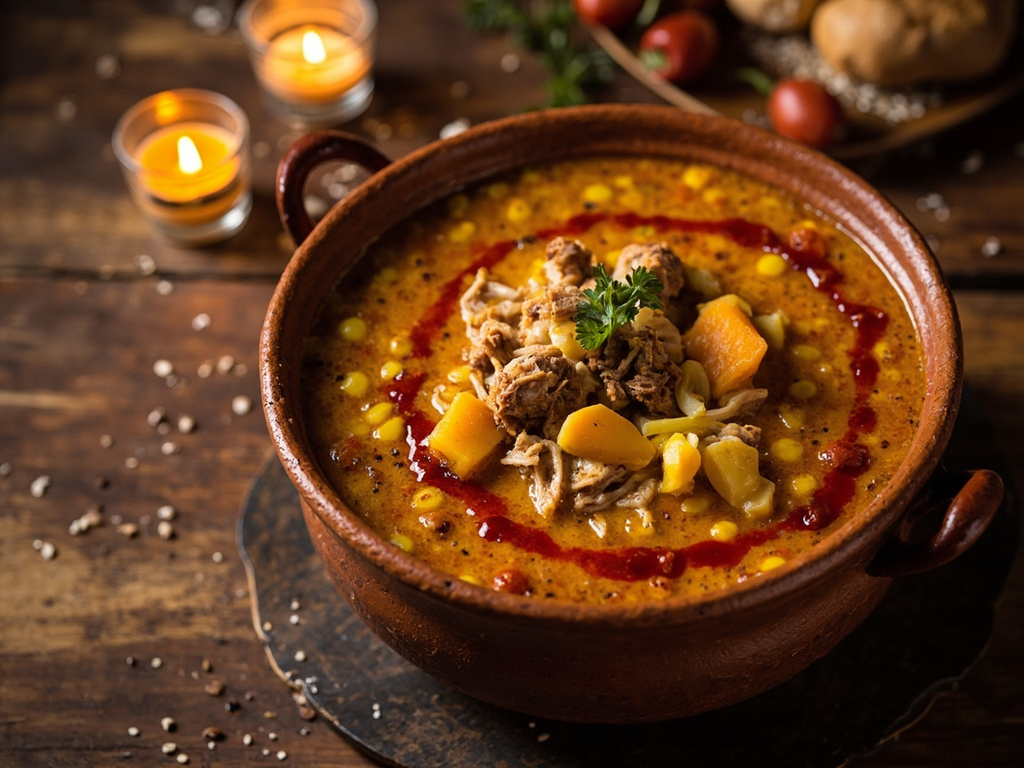
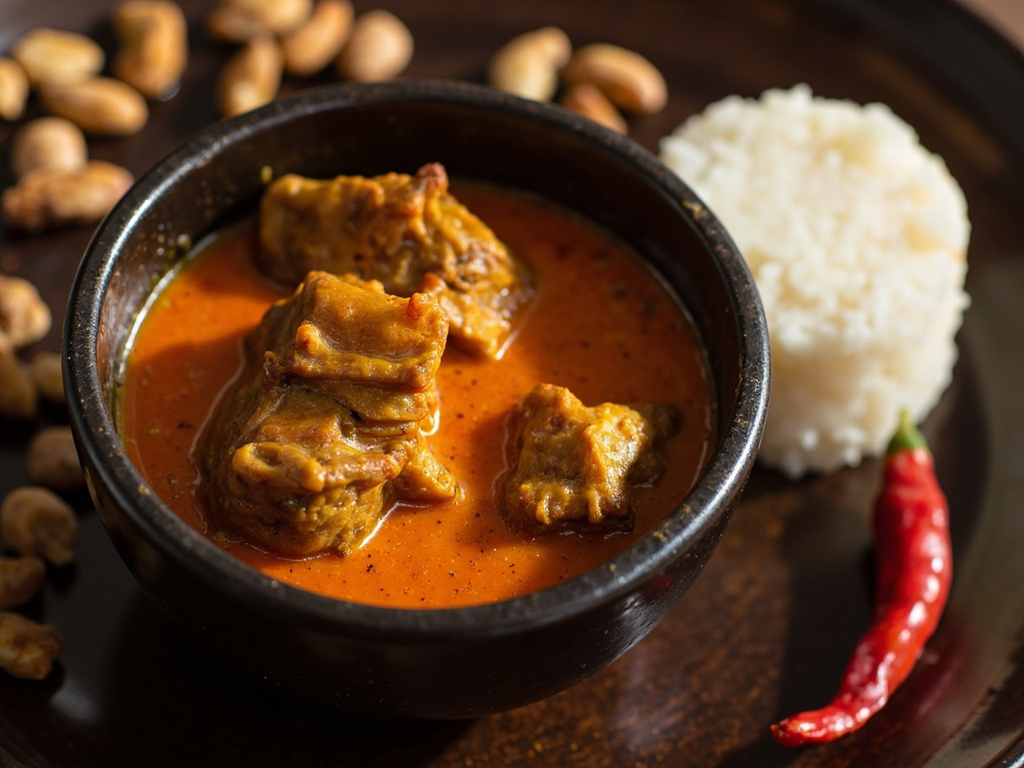
A dense, deep orange soup where roasted peanut paste coats a long-simmered guinea fowl, spiced with ginger and chili. It is eaten piping hot, dipping balls of pounded fufu into it.
Approach, stranger, and look upon the soup of my house. Among us, at Ejisu, when a chief crosses the threshold, we do not serve him the clear water of the poor: we pound the peanut until it weeps its oil, and we lay therein the guinea fowl that my people bring me in homage. Taste the broth first, then only swallow your fufu ball—he who chews fufu has not learned manners. The chili must wake your tongue without burning it, for a queen knows how to measure fire, at table as in war.
- •Guinea fowl (game bird or tribute poultry) — one whole bird, cut up (noble meat of the dish)
- •Roasted peanuts, pounded in a mortar — two generous handfuls (base of the soup)
- •Tomatoes and onions crushed on a stone — according to the pot (aromatic base)
- •Fresh ginger and forest chili — to taste (heat and fragrance)
- •Salt and spring water — as needed (seasoning and liquid)
Nkatenkwan — The Great Peanut Soup with Guinea Fowl
A dense, deep orange soup where roasted peanut paste coats a long-simmered guinea fowl, spiced with ginger and chili. It is eaten piping hot, dipping balls of pounded fufu into it.
Why this dish? Peanut soup with poultry was THE dish of honor for grand occasions at the court of Ejisu. Yaa Asantewaa's record notes that she was offered game and poultry as tribute, along with peanut sauces spiced with chili: this is exactly the table of an Ashanti queen mother receiving her chiefs.
Approach, stranger, and look upon the soup of my house. Among us, at Ejisu, when a chief crosses the threshold, we do not serve him the clear water of the poor: we pound the peanut until it weeps its oil, and we lay therein the guinea fowl that my people bring me in homage. Taste the broth first, then only swallow your fufu ball—he who chews fufu has not learned manners. The chili must wake your tongue without burning it, for a queen knows how to measure fire, at table as in war.
Ingredients (period version)
- Guinea fowl (game bird or tribute poultry) — one whole bird, cut up (noble meat of the dish)
- Roasted peanuts, pounded in a mortar — two generous handfuls (base of the soup)
- Tomatoes and onions crushed on a stone — according to the pot (aromatic base)
- Fresh ginger and forest chili — to taste (heat and fragrance)
- Salt and spring water — as needed (seasoning and liquid)
Ingredients
- Guinea fowl (or free-range chicken) — 1.2 kg, cut into pieces (meat)
- Pure peanut butter (100% peanuts) — 200 g (thickener and flavor)
- Ripe tomatoes — 4 (base)
- Onion — 1 large (base)
- Fresh ginger — 1 piece, 3 cm (fragrance)
- Fresh chili (scotch bonnet type) — ½ to 1, seeds removed (heat)
- Salt — to taste (seasoning)
- Water — 1 L (liquid)
Method
- Brown the guinea fowl pieces with chopped onion, grated ginger, and a little salt until colored.
- Blend the tomatoes and chili, pour over the meat, and let reduce for 10 minutes.
- Dissolve the peanut butter in a bowl of warm water until smooth, then add to the pot with the remaining water.
- Simmer on low heat for 40–50 minutes, stirring often: the orange oil should rise to the surface, a sign the soup is ready.
- Adjust salt and serve hot with fufu or rice.
How it was made : In those days, peanuts were roasted and then ground on a grinding stone, and the soup cooked for hours on a three-stone hearth. The appearance of red oil on the surface ("the soup has made its oil") served as a natural timer. Guinea fowl, a West African bird, and peanuts, adopted after Atlantic exchanges, were already pillars of Asante cuisine by the 19th century.
The contemporary twist : Serve in small shot glasses with a sprinkle of crushed, roasted peanuts on top for crunch—a "court tapas" version.
Sources : Fran Osseo-Asare, Food Culture in Sub-Saharan Africa, Greenwood Press, 2005 · Fran Osseo-Asare, A Good Soup Attracts Chairs: A First African Cookbook for American Kids, 1993
Yaa Asantewaa · Charactorium