 flip
flipKhinkali, the Large Dumplings of the Caucasus
Khinkali, the Large Dumplings of the Caucasus
Why this dish? Khinkali was Stalin's favorite dish; he had Georgian cooks brought in and demanded these Caucasian dumplings for his endless Politburo dinners. They are eaten by hand, by the top knot, first slurping the broth — a Georgian peasant gesture he never abandoned.
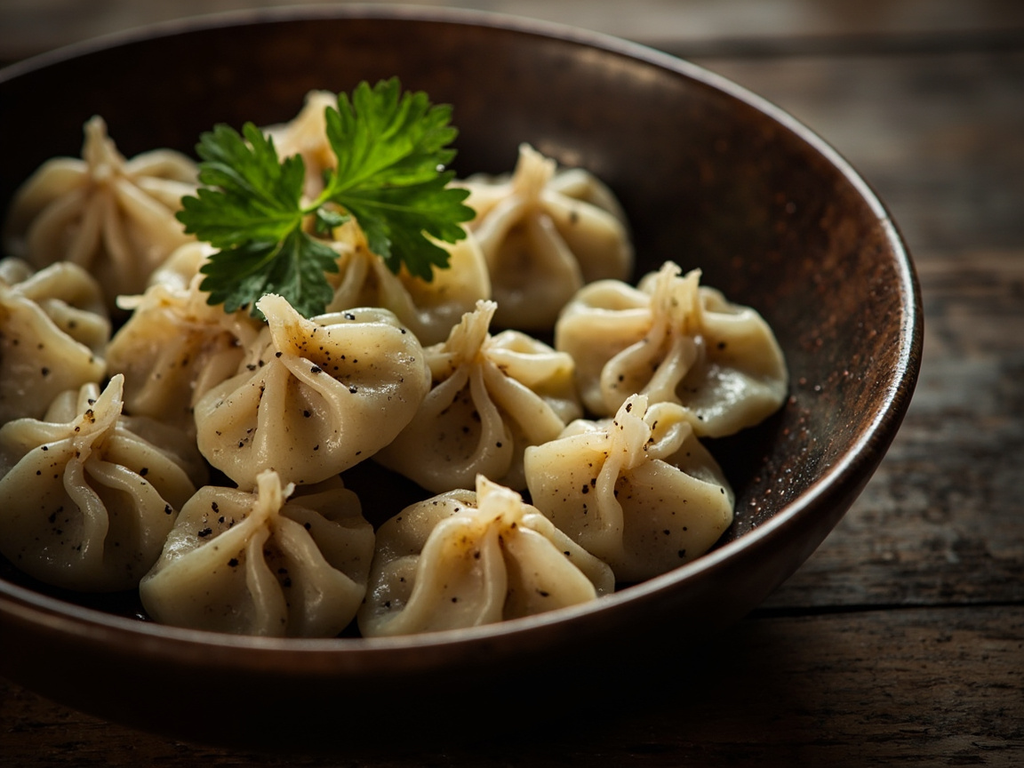
Large pleated dumplings shaped like a purse, filled with spiced meat and a hot broth trapped inside. You grab them by their little dough topknot, bite, slurp the broth, then devour — and line up the leftover tops in your plate to count how many you've eaten.
You want to know how to really eat this? Not with a fork, absolutely not — you take it by the topknot, with your fingers, like we did back home in Gori. You bite one side, drink the hot juice first, otherwise you've understood nothing. At my table, we counted the little tops left in the plate: he who left few wasn't hungry, and he who wasn't hungry, I watched closely. Eat, comrade, the night is long.
- •Wheat flour — a large bowl (dough)
- •Cold water and salt — by hand (dough)
- •Beef and pork, knife-minced — a good portion (filling)
- •Onion, garlic — in abundance (aromatics)
- •Fresh coriander, khmeli suneli, pepper — generous (spices)
- •Broth or water — a little (inner juice)
Khinkali, the Large Dumplings of the Caucasus
Large pleated dumplings shaped like a purse, filled with spiced meat and a hot broth trapped inside. You grab them by their little dough topknot, bite, slurp the broth, then devour — and line up the leftover tops in your plate to count how many you've eaten.
Why this dish? Khinkali was Stalin's favorite dish; he had Georgian cooks brought in and demanded these Caucasian dumplings for his endless Politburo dinners. They are eaten by hand, by the top knot, first slurping the broth — a Georgian peasant gesture he never abandoned.
You want to know how to really eat this? Not with a fork, absolutely not — you take it by the topknot, with your fingers, like we did back home in Gori. You bite one side, drink the hot juice first, otherwise you've understood nothing. At my table, we counted the little tops left in the plate: he who left few wasn't hungry, and he who wasn't hungry, I watched closely. Eat, comrade, the night is long.
Ingredients (period version)
- Wheat flour — a large bowl (dough)
- Cold water and salt — by hand (dough)
- Beef and pork, knife-minced — a good portion (filling)
- Onion, garlic — in abundance (aromatics)
- Fresh coriander, khmeli suneli, pepper — generous (spices)
- Broth or water — a little (inner juice)
Ingredients
- All-purpose flour — 300 g (dough)
- Cold water — 150 ml (dough)
- Salt — 1 tsp (dough)
- Ground beef — 200 g (filling)
- Ground pork — 150 g (filling)
- Onion — 1 large, very finely chopped (aromatic)
- Garlic — 2 cloves (aromatic)
- Fresh coriander, chopped — 1 small bunch (herb)
- Khmeli suneli — 1 tsp (signature spice)
- Cold beef broth — 80 ml (inner juice)
Method
- Knead flour, water, and salt into a firm, smooth dough; let rest 30 minutes under a cloth.
- Mix meats, onion, garlic, coriander, khmeli suneli, salt, and pepper, then gradually incorporate cold broth until a soft, juicy filling forms.
- Roll out dough thinly, cut 10 cm disks, place a large spoonful of filling in the center.
- Lift the edges in an accordion fold and pinch to form a tightly pleated topknot.
- Poach khinkali for 8-10 minutes in a large pot of salted simmering water until they float and swell.
- Drain, generously pepper, and serve immediately, piping hot.
How it was made : In the mountains of Khevsureti and Pshavi, khinkali was shepherd's food: meat chopped with a knife (never a grinder, to keep the juice), unleavened dough, boiled in water. The hard dough 'topknot' served as a handle and was left in the plate — it was impolite to eat it, and it allowed counting portions.
The contemporary twist : For a vegetarian supra, replace the meat with a filling of mushrooms and mashed potatoes with cheese (a 'kalakuri' city version) — and keep the topknot ritual.
Joseph Stalin · Charactorium