Imaginary interview with Michelangelo
by Charactorium · Michelangelo (1475 — 1564) · Visual Arts · 6 min read
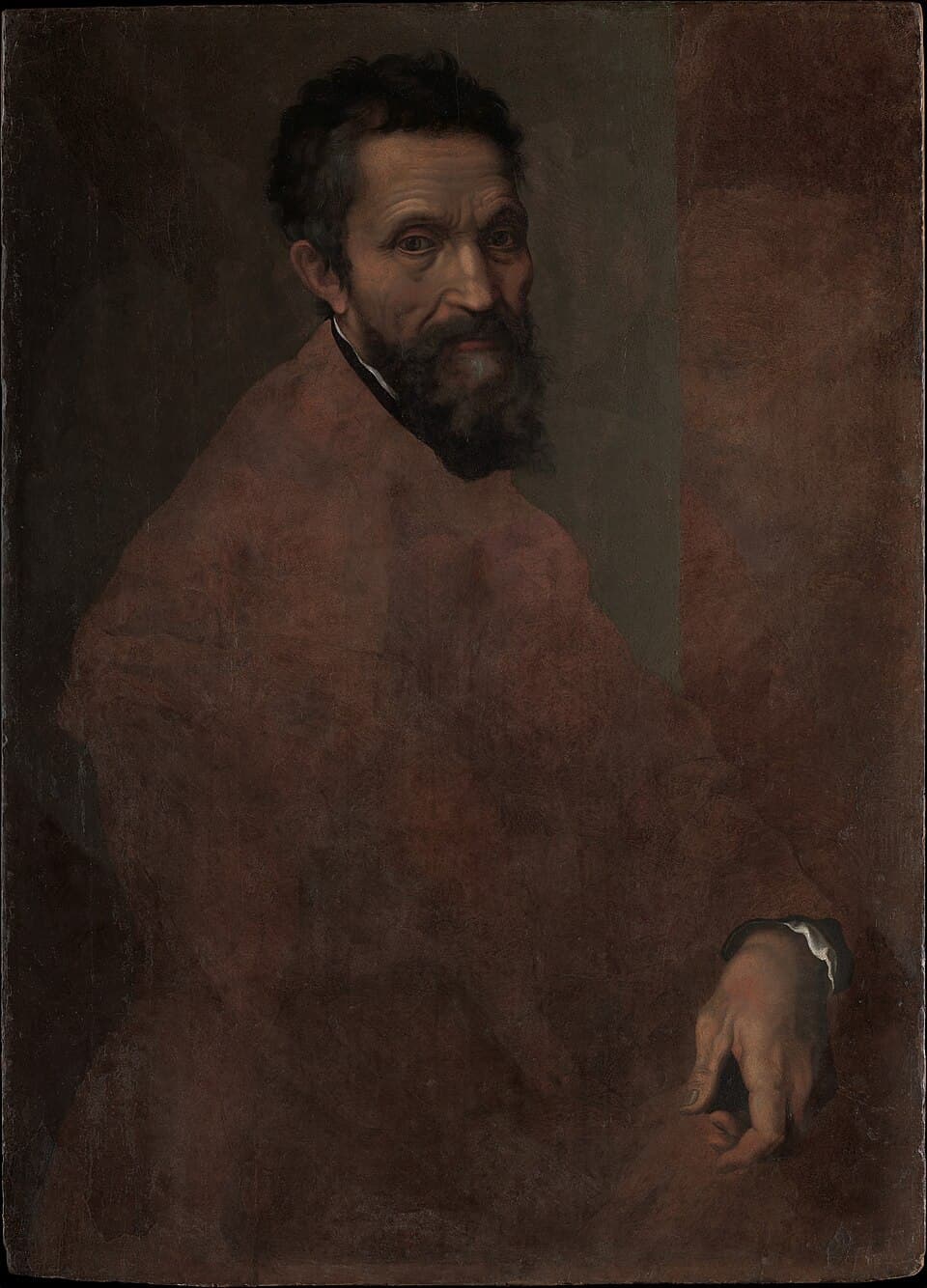
Rome, winter 1560. In a workshop cluttered with marble blocks and sketches, lit by a candle stuck on a cardboard hat, an old man of eighty-five rests his chisel for a moment. White dust covers his hands and beard; he consents to speak, in a low voice, of sixty years spent wresting figures from stone.
—You are celebrated as a painter, architect, poet. What do you call yourself?
Before God and before the stone, I am a sculptor, nothing else. When asked how I drew the David from the abandoned block that the masters of the Opera del Duomo had left to rot in a courtyard for twenty years, I always answer the same thing: I simply removed everything that was not David. The figure was already sleeping inside, imprisoned; my chisel only woke it. I raised that colossus between 1501 and 1504 — a naked, taut young man, caught the instant before the stone was hurled at Goliath. Florence saw in it its own pride as a Republic threatened by giants. I saw only an older truth: that the perfect form exists before the hand that frees it, and that there is no other trade in the world but to serve that liberation.
The figure was already sleeping in the stone; my chisel only woke it.
—Why do you insist so much on choosing your own marble?
Because no steward can read a block for me. I leave the workshop, I go up to Carrara, in the mountains of Tuscany, and I stay there for months sometimes, among the quarrymen and the white dust. They take me for a mad lord who prefers the company of stonecutters to that of cardinals. But it is there, nose against the wall, that I guess what the rock hides: I look for marble without veins, of pure whiteness, because the slightest hidden crack can break a shoulder or a knee years later. My chisel and mallet are worthless if the stone is treacherous. Choosing the block is already half the sculpting — everything else is only obstinacy and patience.
—That Virgin in your first Pietà seems strangely young. Was that a deliberate choice?
Younger than her own dead son, yes, and I was reproached for it. But think: perfect purity does not wither. A woman preserved from all stain keeps her body fresh far longer than others; could the mother of God age like the daughters of Eve? I wanted a Virgin of intact beauty, almost virginal even in the face, bearing on her knees the Christ whose every vein, every rib, I polished for nights on end until the marble became flesh. It was my first great Roman commission, around 1498, and I burned with the desire that no living sculptor could do the same. The pride of a young man, perhaps. But that pride I had carved from the sweetest stone of Carrara.
—Do you remember the night you carved your name on that work?
I was only twenty-four. One evening, I slipped into Saint Peter's basilica and overheard some Lombard passersby attributing my Pietà to a sculptor from their city, a certain Gobbo of Milan. Anger seized me. When night came, I returned with my lamp and tools, and I carved my name on the band that crosses the Virgin's chest: Michelangelus Bonarotus Florentinus faciebat. It was the first and last time I signed a work in my entire life. Later, I was ashamed of that outburst of pride — God alone truly signs what He creates. But at that moment, I could not bear to have my marble child torn from me and placed in foreign arms.
—Why did you initially refuse to paint the ceiling of the Sistine Chapel?
Because I was not a painter, and Julius II knew it well. In 1508, when he ordered me to cover the vault of his Sistine Chapel, I realized that my rivals at court — Bramante especially — had set a trap for me: to make me stumble on a wall, far from my marble, so that they could laugh at the sculptor who thought himself a fresco painter. I begged the pope to entrust the task to another. He would not hear of it; with that man, you did not argue twice. So I bowed my head. But I tell you: not a single one of those four years did I feel in my place up there. I painted in exile from myself, my heart remaining below, in the stone.
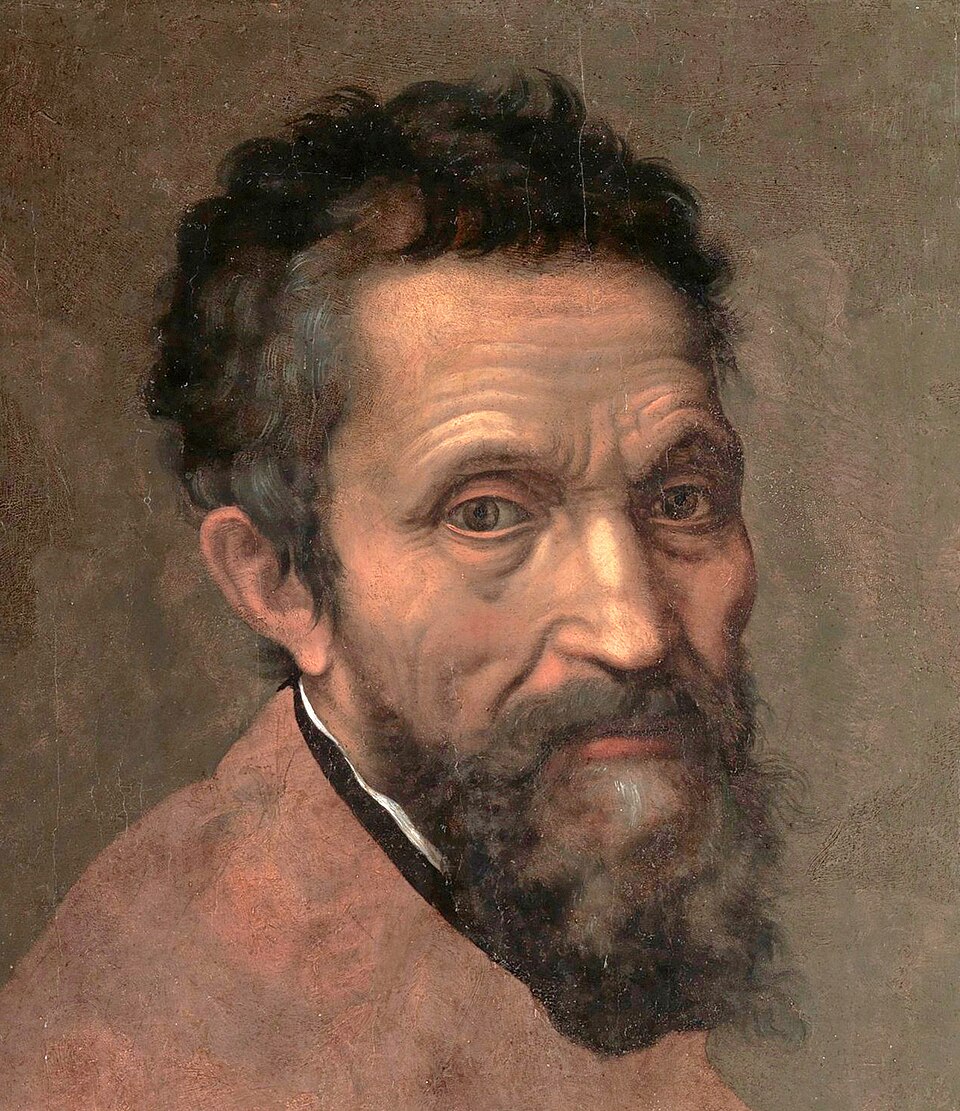
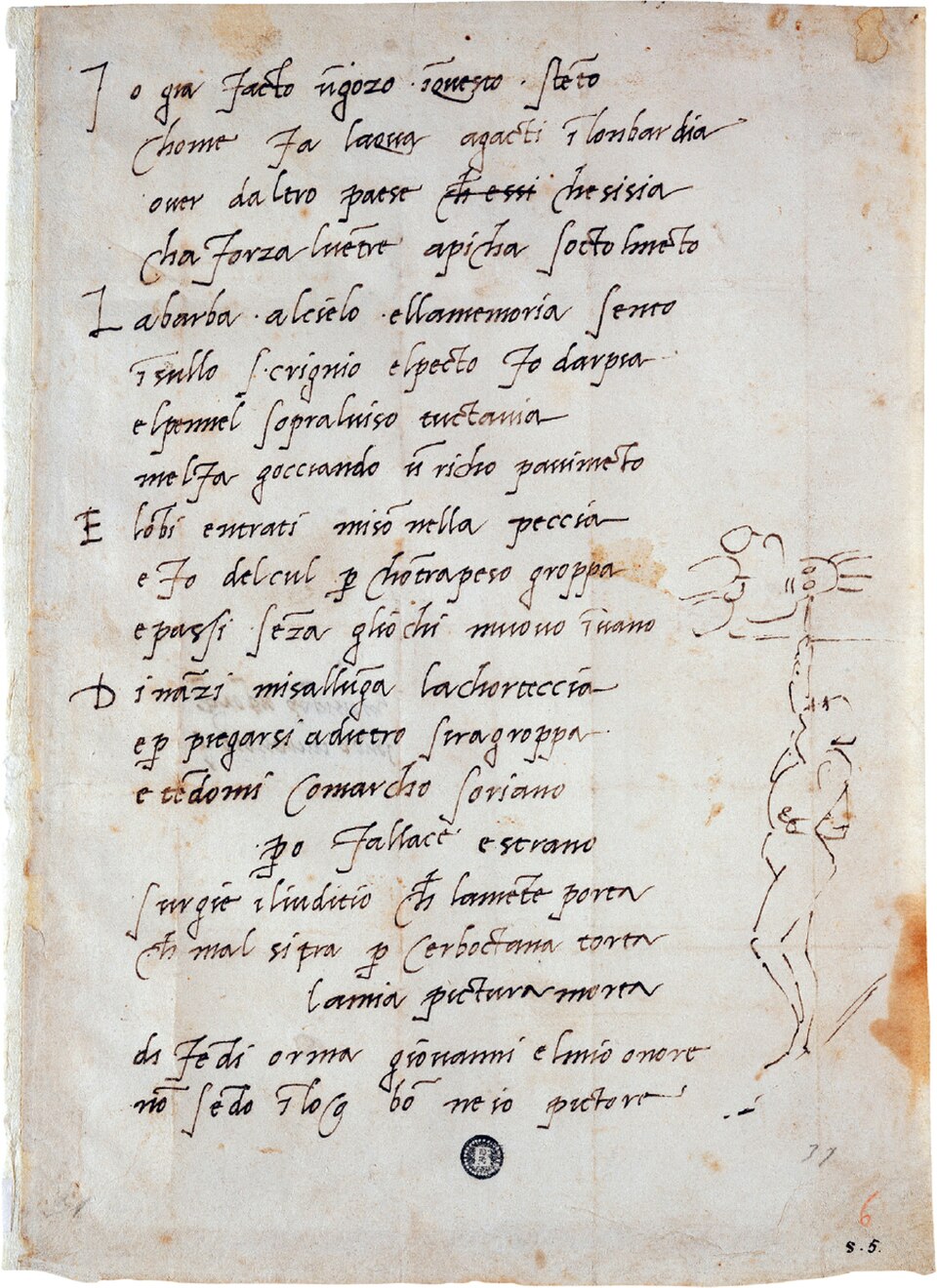
—How did you hold your body and hand up there under the vault?
Badly, and in pain. I first sent away Bramante's suspended scaffolding, which would have left gaping holes in my fresco, and I devised another, resting on corbels set into the wall. But nothing spared my body: four years with my neck bent back, chin stretched toward the sky, eyes streaming with plaster and colors that fell back onto my face. I painted a fresco, on the fresh plaster — the giornata of the day that had to be finished before it dried, with no chance for repentance, because the lime fixes the tint as it hardens. My belly had stuck under my chin; I wrote to my friends that I had become like the scrawny cats of Lombardy. And yet, the Creation of Adam, that finger that does not quite touch the other, was born there, in that pain.
The Creation of Adam was born there, in pain, with my neck bent back toward the sky.
—They say your life was singularly austere for a man so celebrated. Is that true?
It is true. I rise before dawn, impatient, and I work as long as the light allows. Eating seems a waste of time: a crust of bread, a little wine, some cheese, sometimes swallowed standing up, chisel still in hand. I never understood those lords who linger for hours at table while work waits. In Rome, I live modestly, far below what my commissions bring me, in a cramped room cluttered with sketches, tools, and blocks. I once wrote to my father Lodovico: I live here in great misery and extreme labor, without money, and I suffer a thousand ills. It was not a poor man's complaint — it was the truth of a man who never knew how to live otherwise than bent over his work.
—Your close ones report disconcerting habits. Are they exaggerated?
They hardly exaggerate. When I work at night — and I often work at night — I fix a candle to the brim of my cardboard hat, so that the light falls directly on my hands without hindering my movements. I long preferred the purest wax, so that it does not drip onto me as it melts. As for my leather boots, I keep them on for weeks without removing them; Vasari, who watches me like a curious Florentine, claims that when I finally take them off, the skin sometimes comes with them. It is because a man wholly absorbed in his work ceases to feel his own body. The marble, for its part, never reproaches me for forgetting to wash or sleep.
—At seventy-two, you took charge of Saint Peter's. What drove you to it?
Pope Paul III, in 1546, and my own conscience. I accepted the position of chief architect of Saint Peter's without pay, for the love of God and the Apostle. I was no longer young; but such a church does not need a young man, it needs a man who has nothing left to fear or gain. I took up Bramante's plans, trimmed their heaviness, and designed a dome that was to rise like a prayer into the sky of Rome, more than forty cubits wide. I knew well that I would never see it completed in my lifetime — it was finished long after my death. One does not build for one's own eyes; one builds for those who will lift theirs in a hundred years.
—At nearly ninety, you are still sculpting. What are you seeking in that last stone?
A final Pietà, which I rework endlessly and will not finish. In Milan, they will call it the Rondanini. It resembles nothing of my youth, smooth and proud of its virtuosity: here the Virgin and Christ merge into each other, barely rough-hewn, almost erased. I even broke an already carved arm to start over, thinner, more naked. The closer I come to death, the less I want to show my craft; I want to show the soul stripped of its flesh. My hands tremble, my eyes weaken, but the chisel still strikes, a few days before the end. I never believed that a work had to be finished to be true — sometimes the unfinished better speaks the truth of the man who fades away.
I never believed that a work had to be finished to be true.
—You have worked so much in marble and in fresco. Is there a boundary for you between painting and sculpting?
Deep down, no — and that is the business of my whole life. I once said to that young Portuguese, Francisco de Holanda, who recorded my words during our Roman conversations with Vittoria Colonna: painting for me is only valuable when it approaches relief, and relief is only good when it approaches painting. Look at my vault: those bodies I painted in the Sistine Chapel are nothing other than statues lying on plaster. And my David seems ready to breathe, like a painted figure that has finally taken on flesh. Drawing, what we call disegno, is the common root of the three arts — painting, sculpture, architecture. He who possesses it holds everything else in the hollow of his hand.
Sources
This imaginary interview was generated by artificial intelligence from sources documented in Michelangelo's profile. It dramatises what the figure might have said based on what we know about them, but does not constitute attested historical testimony. For primary sources and factual documentation, refer to the full profile.