Imaginary interview with Odysseus
by Charactorium · Odysseus · Mythology · 5 min read
On a beach in Ithaca, at dusk, a man with a face tanned by salt mends a net near a boat pulled ashore. He has placed his crown farther off, on a stone. He agrees to talk, provided he can keep his eyes on the sea.
—You are credited with a famous ruse before the walls of Troy. How did the idea of the horse come to you?
For ten years we had worn out our spears against Troy without breaching its gates. The strength of Achilles was not enough; something else was needed, what my people call mètis — the intelligence that goes around where the arm tires. I saw the wood, I saw the hollow belly of a great horse, and I saw our best warriors hidden inside while the fleet pretended to flee. The Trojans themselves dragged the offering inside their walls, thinking they were honoring the gods. When night came, we emerged from its flank as if born from a dream. I did not conquer Troy with my sword. I conquered it with timber and patience.
I did not conquer Troy with my sword; I conquered it with timber and patience.
—Many admire the warrior's strength. Why did you prefer cunning to dazzling bravery all your life?
Bravery blazes once, then the hero falls, and people sing of his death. Cunning, on the other hand, brings a man home. I have seen too many brave men feed the dust of the Trojan plain for the mere beauty of a gesture. When they call me the man of twists and turns, it is not flattery: it means I prefer to think where others strike. The wooden horse was not an act of courage; it was an act of thought. A god can topple the mightiest mortal with a flick of his hand; but the mind that knows how to wait, to dissemble, to turn the trap back on itself — that is what kept me alive while my comrades fell one by one.
Bravery blazes once; cunning, on the other hand, brings a man home.
—Let's talk about the Cyclops' cave. What would you say about that night, facing Polyphemus?
The cave stank of sour milk and the blood of the comrades he had already crushed against the rock. Polyphemus was a mountain with one eye, and none of us could have rolled away the stone that sealed his cave alone. So I poured him wine, lots of wine, and when he asked my name, I answered that I was called Nobody. Drunk, he collapsed. We hardened a stake in the fire and gouged out his single eye. He screamed that Nobody was blinding him; his brothers, outside the rock, thought it was a sickness sent by the gods and left him alone in his pain. A name that is not a name: that is sometimes the best weapon.
A name that is not a name: that is sometimes the best weapon.
—That victory cost you dearly, though. Why did you shout your real name at the defeated monster?
Pride, you see, is the crack through which the gods take us back. On the island, near Sicily, as my prow was already pulling away, I could not keep quiet. I wanted the Cyclops to know who had robbed him of his sight: Odysseus, son of Laertes, king of Ithaca. Foolish vanity. Polyphemus was the son of Poseidon, and he called upon his father against me like a curse. Cunning had saved me; my tongue condemned me to ten years at sea. That night I learned that it is not enough to win: you must know how to leave in silence.
Cunning had saved me; my tongue condemned me to ten years at sea.
—You mention Poseidon. How does one live when a god of the sea relentlessly pursues you?
One lives knowing that every calm is a lie. Poseidon wields the trident that raises the waves, and he has never forgotten his son's eye. Everywhere I sailed, his wrath preceded me: waves reared up like walls, winds that tore my sails, shipwrecks that swallowed my men by handfuls. I did not fight a visible enemy; I struggled against the water itself. The Greeks call this fate, that force which even heroes cannot bend. I learned not to curse the storm, but to bend like a reed, to wait until the god tires. For against a god, you do not win: you survive.
Against a god, you do not win: you survive.
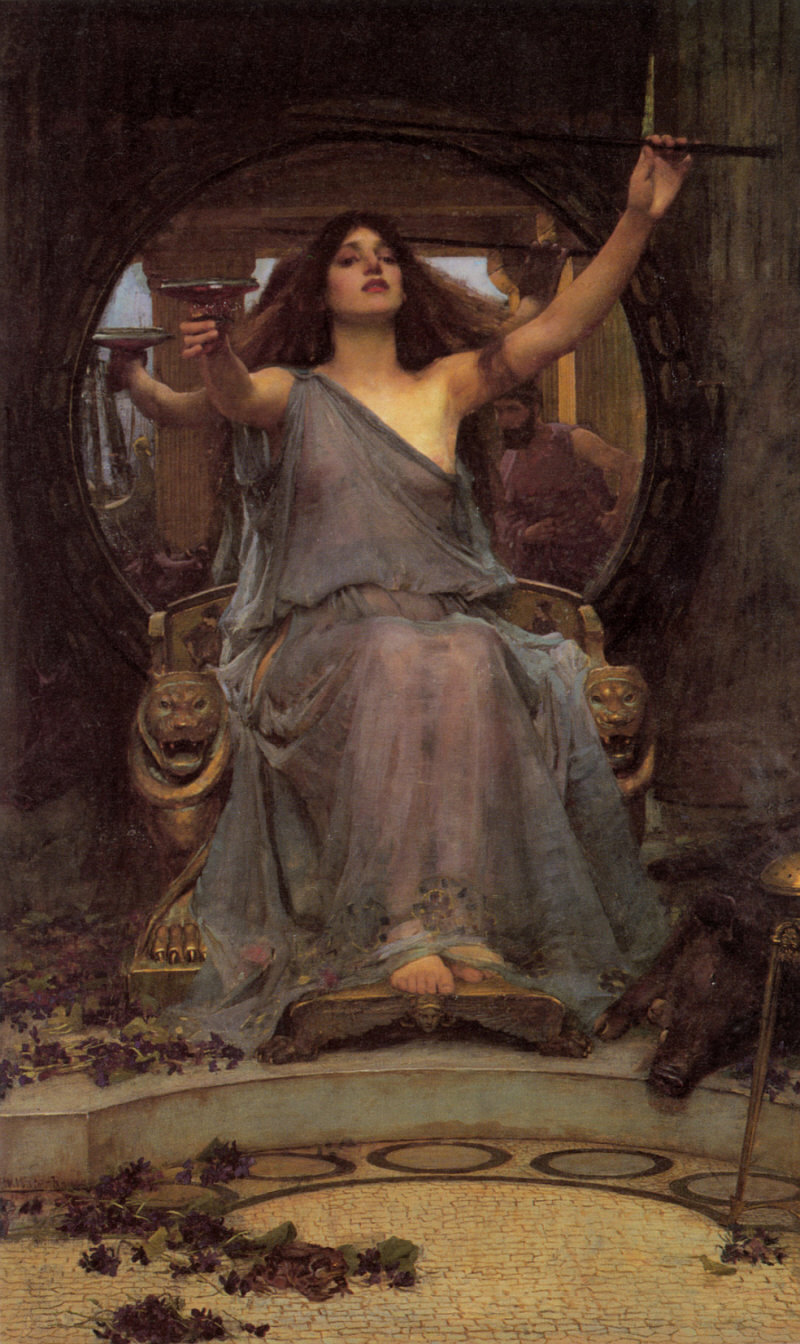
—Your return was a long wandering. Do you remember Circe, on her island?
My men entered her palace drawn by a song, and Circe turned them into pigs with a wave of her wand, their snouts still wet with human tears. The enchantress was not the only trial: before her, in the land of the Lotus Eaters, my comrades tasted the flower of forgetfulness and no longer wanted to leave — I had to drag them weeping to the rowing benches. At Circe's, I did not draw my sword first; I walked straight into her spell, protected by an herb a god had given me. She recognized in me a man whom no charm could bend. The whole Odyssey is like that: a succession of islands where one risks ceasing to be oneself.
A succession of islands where one risks ceasing to be oneself.
—And Calypso? They say she offered you much to keep you.
For seven years she kept me on Ogygia, the goddess with lovely braids. She offered me immortality, endless youth, her bed and her fragrant island. What mortal refuses never to die? I did. Every evening I sat on the shore and wept toward the horizon, toward where I sensed Ithaca. A goddess's cave is not worth the smoking roof of one's own home. It took Athena, my protector, pleading my case before Zeus for the sea to finally open for me. I built a raft with my own hands and set out again, preferring the possible death of a free man to the eternity of a prisoner.
A goddess's cave is not worth the smoking roof of one's own home.
—What kept you awake, through the Sirens, Charybdis, and all those traps?
The face of Penelope, and the smoke rising from the hearths of Ithaca. When the Sirens sang, I wanted to hear them without perishing: I plugged my rowers' ears with wax and had myself lashed to the mast, to taste their deadly song and still survive. Between Charybdis that swallows the sea and Scylla that snatches men, one had to choose the lesser disaster — a captain learns to count his dead in advance. What kept me going was not hope, too fragile, but a stubbornness harder than rock. I wanted to go home. Not to rule, not to triumph: to go home. It is a desire so simple that no monster could devour it.
I wanted to go home. Not to rule, not to triumph: to go home.
—Here you are back at last, but disguised as a beggar. Why this final ruse on your own threshold?
Because a palace full of enemies does not open to a king who announces himself. The suitors were devouring my herds, courting my wife, plotting the death of my son Telemachus. To present myself as a sovereign would have meant dying on my doorstep. So Athena clothed me in rags, hunched me like an old beggar, and I entered my own home to beg for my own bread. I saw those men laugh, insult me, waste my wine in my own cups. I took it all, my face lowered, counting. Patience, again: the same that had made me wait in the belly of the wooden horse. A beggar threatens no one; that is why he can observe everything.
A beggar threatens no one; that is why he can observe everything.
—And the contest of the bow? What did it really mean to you?
Penelope had promised her hand to whoever could string my old bow and shoot an arrow through twelve aligned axe heads. None of those braggarts could even bend it; they struggled, sweated, cursed. I, the wrinkled beggar in the corner of the hall, asked to try. Amid the laughter, I took the bow that I knew like my own hand, and I strung it effortlessly, like a bard tuning his lyre. The arrow flew straight through the twelve irons. Silence fell. This bow, no one but its master could bend: that is what it proved. Then I turned the point toward the suitors, and Ithaca found its king again.
I strung the bow effortlessly, like a bard tuning his lyre.
This imaginary interview was generated by artificial intelligence from sources documented in Odysseus's profile. It dramatises what the figure might have said based on what we know about them, but does not constitute attested historical testimony. For primary sources and factual documentation, refer to the full profile.