Imaginary dialogue between Alcinoos and Odysseus
by Charactorium · Odysseus · Mythology · 5 min read
It is in the great hall of the palace of Phaeacia, with its bronze walls and golden doors, that Alcinous detains his guest one last time before embarking him for Ithaca. The torches crackle, the wine in the farewell cup grows lukewarm in the hands, and the bard Demodocus has just set down his lyre. The king of the Phaeacians, who took in this stranger cast naked upon his shores, wants to hear once more, from the hero's own lips, the thread of his ten years of wandering. He questions him as a friend, without haste, as one holds back a traveler on the threshold.
—Stranger, before my ships take you home, tell me: how did a city that ten years of siege could not break fall by a wooden horse?
Alcinous, you who rule a people of sailors and not warriors, you know that a wall is not always brought down by battering it. For ten years our spears had shattered against the ramparts of Troy without gaining anything. Then I thought that the enemy must open his own gates to us. We built an enormous hollow horse, and I hid our best men inside while the fleet pretended to flee. The Trojans dragged it into their city as an offering. When night came, we emerged from its flanks. You see, it was not my strength that took Ilion — it was my mêtis, that cunning which the gods gave me as my portion.
It was not my strength that took Ilion — it was my mêtis, that cunning which the gods gave me as my portion.
—It is whispered in my court that you blinded a son of Poseidon. How could one man escape such a monster, and at what price?
The price I am still paying, and you know it better than anyone, you whose people are dear to that god. The Cyclops Polyphemus held us prisoners in his cave and devoured my companions one by one. I offered him my strong wine, and when he asked my name, I answered that I was called Nobody. Then we drove a burning stake into his single eye. He roared that Nobody was killing him — and his brothers, believing it was a disease sent by the gods, did not come. We fled under the bellies of his rams. But as I sailed away, I shouted my true name out of pride. That shout unleashed against me the rancor of Poseidon.
I shouted my true name out of pride. That shout unleashed against me the rancor of Poseidon.
—Since my maids found you on the shore, you have said little about the islands you crossed. What women, what perils held back your return for so long?
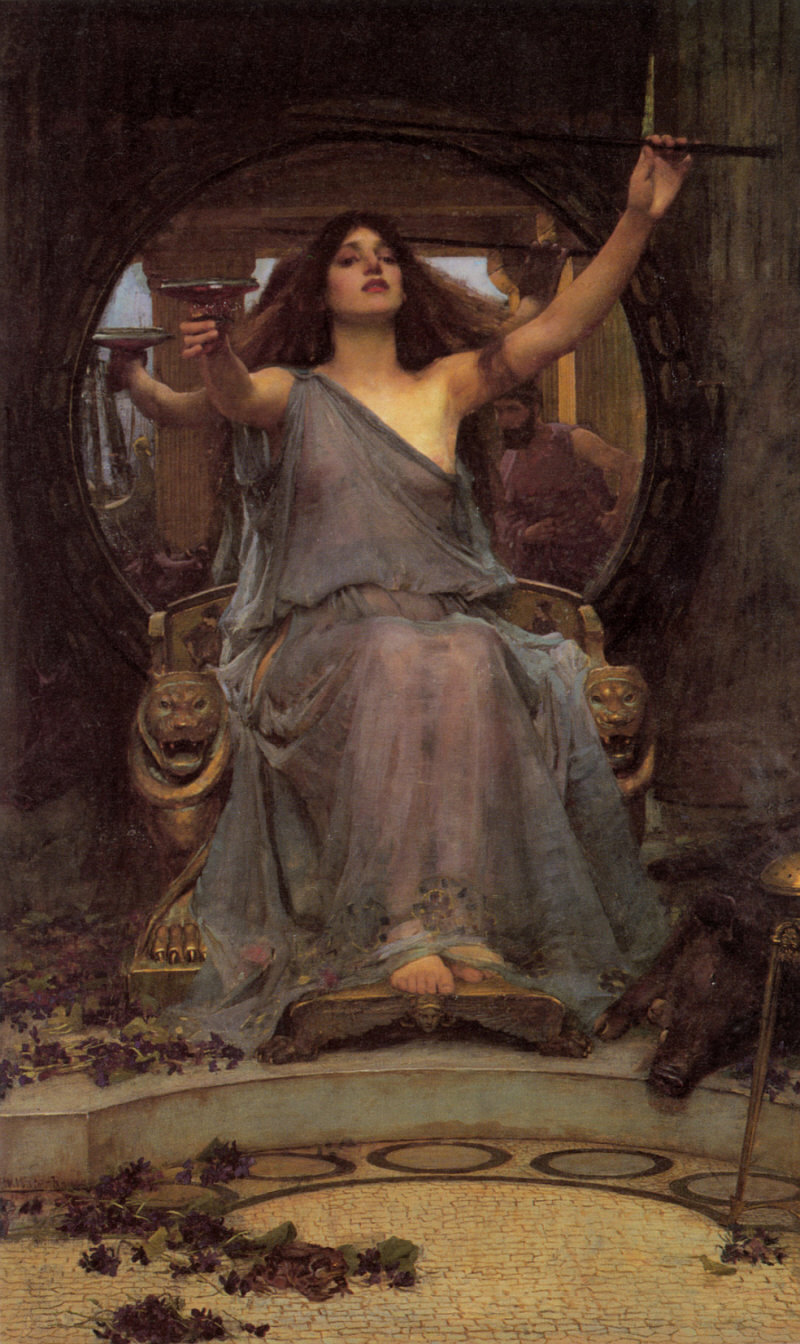
Alcinous, it is in your hall that I dare finally tell all, for here I feel safe. The sea cast me from shore to shore like a straw. In the land of the Lotus Eaters, my men tasted a fruit that erases the homeland from the heart — I had to drag them weeping to the ships. With Circe, the enchantress turned my companions into pigs before becoming my ally. I heard the song of the Sirens, lashed to the mast, and grazed the jaws of Charybdis and Scylla. And for seven years, the goddess Calypso held me on Ogygia, offering me immortality, which I refused. For no happy island was worth the harsh rock of Ithaca.
No happy island was worth the harsh rock of Ithaca.
—You say you refused a goddess's immortality. What man, I ask you, rejects the gods for a rock beaten by the waves?
A man who has a wife and a son, O king. Calypso was beautiful, her island knew neither death nor old age, and she promised I would live forever beside her. But every morning I sat on the shore, my gaze turned to the horizon, and I wept. What good is a life without end if it is spent far from one's own? I prefer Penelope, who will age and die; I prefer my rocky land where one struggles for bread. When Athena, my protector, pleaded my case before Zeus, the god ordered my release. I built a raft with my own hands, and I set out again — toward you, as it happened, toward your hospitable coast.
What good is a life without end if it is spent far from one's own?
—Yesterday, when Demodocus sang of the quarrel of the heroes, I saw you veil your face and weep. Why did the gods involve you so closely in their designs?
You have a keen eye, Alcinous — nothing escapes you under your roof. I wept because the bard sang of the dead I had known, and of the ruses that were mine. The gods did not spare me: Poseidon pursued me with his wrath across all seas, while Athena watched over me from the heights of Olympus. Thus a mortal finds himself torn between two divine wills, a plaything of a destiny he does not choose. I learned to bend without breaking, to outwit even adversity. For against the divinities, man never prevails by force; he survives by patience and by wit. That is what ten years of wandering taught me.
Against the divinities, man never prevails by force; he survives by patience and by wit.
—It is said that upon Achilles' death, you obtained his arms not by the sword but by speech. Is that your true weapon, stranger?
Speech, yes, is a weapon that few know how to wield. When Achilles fell, his magnificent arms remained masterless, and Ajax claimed them by right of strength. Before the assembly of Greeks, I did not brandish my spear — I spoke. I showed that exploits are worth nothing without the intelligence that orders them, that the strongest arm needs a head to guide it. The arms were given to me. Ajax could not bear the affront. But understand me well, O king: I did not triumph over a friend for pleasure. In this world, he who only knows how to strike eventually falls. He who knows how to persuade returns home.
The strongest arm needs a head to guide it.
—When my ships set you on your shore, what do you expect to find at Ithaca after twenty years? And how will you make yourself recognized by your own?
That is my greatest worry, Alcinous, and I confess it to you alone. Twenty years have passed since I left Ithaca for Troy. I am told that insolent suitors besiege my palace, devour my goods, and press Penelope to choose a new husband. I will not arrive as a king, with a crown on my brow — I will slip into my home disguised as a beggar, unrecognizable, to gauge who has remained faithful to me. The cunning that saved me from the Cyclops will serve me again under my own roof. For a king's return is not proclaimed: it is proven. And before reclaiming my throne, I want to know which hearts have waited for me.
A king's return is not proclaimed: it is proven.
—You speak of a bow to reconquer your house. How does this weapon say, better than a crown, who you truly are?
That bow, Alcinous, no one but me can string — that is the whole secret. It has lain in my palace since my departure, too stiff for hands softened by feasting. When I present myself as a beggar among the suitors, I can already guess how things will go: they will all try to string it, and they will all fail. Then the old wretch they despise will seize the weapon, bend it without effort, and send the arrow through the axe heads. In that instant, Nobody will become Odysseus again. The bow will recognize its master when the men could not. By it I will restore order to my house and give my son Telemachus his inheritance.
In that instant, Nobody will become Odysseus again.
—You who have used deception so much, do you not fear that the gods will eventually punish the man whose cunning knows no bounds?
You touch a tender spot, O king. Yes, I have deceived, and I bear the weight of it. My cry of pride before the Cyclops made Poseidon my enemy for ten years. I learned that mêtis is a precious but dangerous gift: he who thinks himself its master is lost. Yet I do not deny anything. Without the ruse of the horse, my comrades would have died for nothing beneath Troy. Without it, I would have fed the Cyclops with my flesh. Cunning is not a crime when it serves to survive and protect one's own. But it must know how to bow before the gods. That measure, I believe, is what they expected me to learn throughout my wanderings.
Mêtis is a precious but dangerous gift: he who thinks himself its master is lost.
—One last thing, my host, before departure: of all your trials, which one do you relive at night, when sleep abandons you?
The cave, Alcinous. Always the Cyclops' cave. I see my companions seized and crushed, I hear their cries in the dark, and I smell the blood on the stone. There I understood how little a man's life hangs by, and how the mind must stay alert when strength has fled. On your happy coast, surrounded by your kindness, these images seem distant — but they return. That is why I hasten my return: as long as I have not crossed my own threshold and held Penelope, I will remain that man cast from shore to shore. Take me home, friend, and you will have accomplished what no god was willing to grant me.
I understood how little a man's life hangs by.
This imaginary interview was generated by artificial intelligence from sources documented in Odysseus's profile. It dramatises what the figure might have said based on what we know about them, but does not constitute attested historical testimony. For primary sources and factual documentation, refer to the full profile.