 flip
flipKurt (Dried Fermented Cheese Balls)
Kurt (Dried Fermented Cheese Balls)
Why this dish? Kurt is inseparable from the nomadic life of the Turkish steppes that Yasawi knew intimately — his disciples traveled vast distances between Sayram, Yasi, and Bukhara. These dried cheese balls, lightweight and nearly indestructible, were the ideal provision for the itinerant dervish: nourishing and requiring neither fire nor utensils.
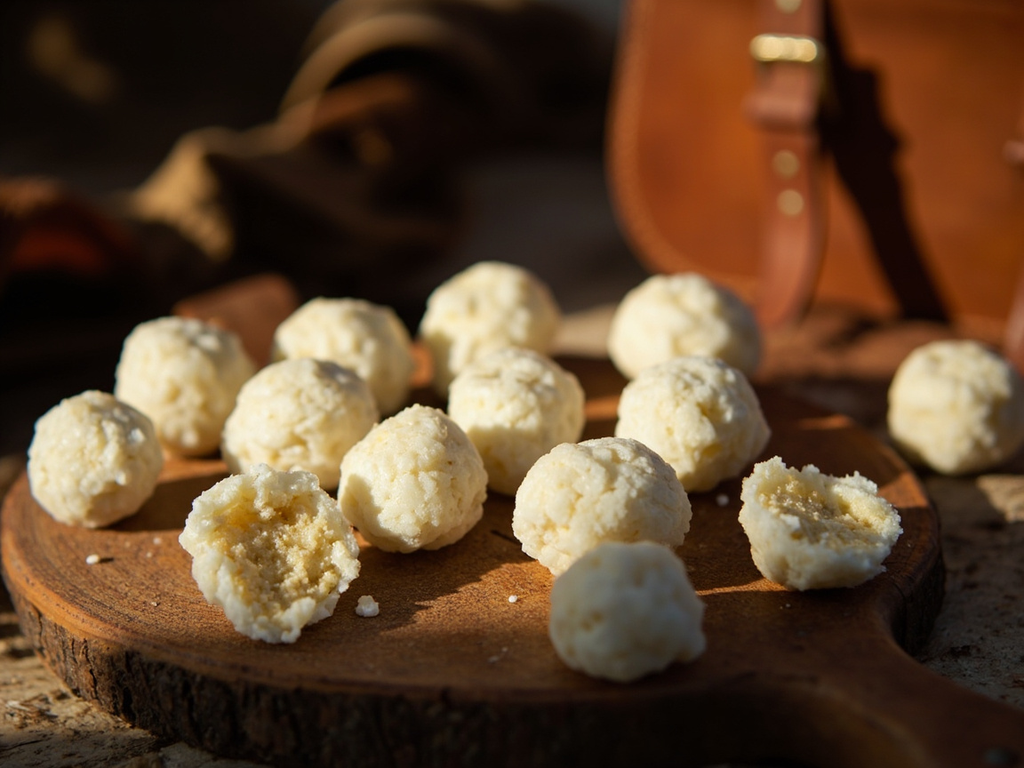
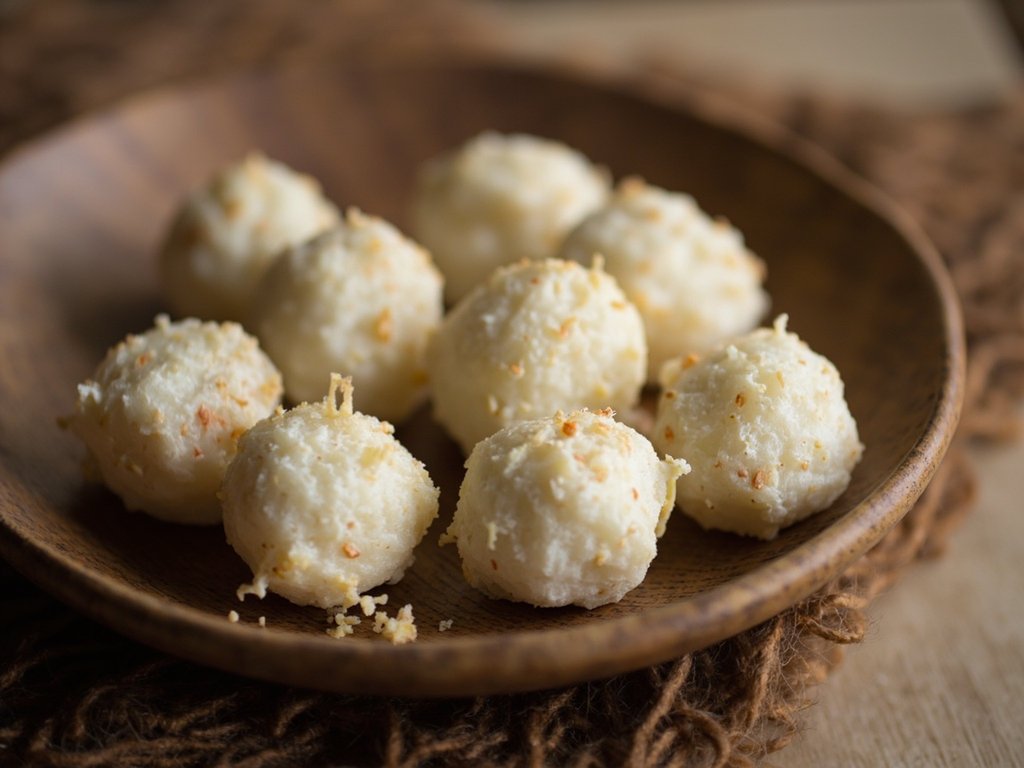
Small white hard balls obtained by sun-drying salted drained curdled milk. Their intensely salty and tangy flavor is released by sucking slowly or crumbling into a bowl of hot water for an instant milky broth. They keep for months.
The dervish who walks from Yasi to Bukhara carries only a bag of kurt and his trust in God. Our women press the soured milk in a cloth, salt the paste, and roll it into balls that they set on felt in the full sun. In ten days they become hard as steppe pebbles. When hunger takes me on the road, I slip one into my mouth — it melts slowly and soothes the body. It is a small thing, but he who knows to be content with little possesses all.
- •Sour mare's or ewe's milk (ayran/katyk) — A full bucket (Fermented base)
- •Rock salt — To taste (Preservation and flavor)
Kurt (Dried Fermented Cheese Balls)
Small white hard balls obtained by sun-drying salted drained curdled milk. Their intensely salty and tangy flavor is released by sucking slowly or crumbling into a bowl of hot water for an instant milky broth. They keep for months.
Why this dish? Kurt is inseparable from the nomadic life of the Turkish steppes that Yasawi knew intimately — his disciples traveled vast distances between Sayram, Yasi, and Bukhara. These dried cheese balls, lightweight and nearly indestructible, were the ideal provision for the itinerant dervish: nourishing and requiring neither fire nor utensils.
The dervish who walks from Yasi to Bukhara carries only a bag of kurt and his trust in God. Our women press the soured milk in a cloth, salt the paste, and roll it into balls that they set on felt in the full sun. In ten days they become hard as steppe pebbles. When hunger takes me on the road, I slip one into my mouth — it melts slowly and soothes the body. It is a small thing, but he who knows to be content with little possesses all.
Ingredients (period version)
- Sour mare's or ewe's milk (ayran/katyk) — A full bucket (Fermented base)
- Rock salt — To taste (Preservation and flavor)
Ingredients
- Plain full-fat yogurt (sheep or cow) — 1 kg (Fermented base)
- Fine salt — 1 tbsp (Preservation and flavor)
Method
- Pour the yogurt into a saucepan. Heat over low heat, stirring regularly for 20-30 minutes: the whey separates and the mass thickens.
- Pour the mixture into a clean cloth (muslin or thin towel) placed over a sieve above a bowl. Drain for 8-12 hours in the refrigerator.
- Retrieve the drained paste (it should be thick and compact). Incorporate the salt by kneading well.
- Form balls 2-3 cm in diameter by rolling between your palms. Place on a rack or baking sheet lined with parchment paper, spaced apart.
- Let dry for 3-5 days in an airy, dry place (or in an oven with the door ajar at 50°C for 8-10 hours to speed up). The kurt are ready when hard and dry to the touch.
- Store in an airtight jar. To consume: suck slowly as is, or crumble into hot water for a milky broth.
How it was made : Kurt is attested among Turkic and Mongol peoples since antiquity. Described by medieval travelers like William of Rubruck (1253), it formed with kumiss the dietary staple of steppe horsemen. The Turks dried it on felt stretched in the wind, sometimes on the yurt roof. Some variants were smoked.
The contemporary twist : Crumble a kurt into a bowl of hot vegetable broth for an instant soup with a distant parmesan flavor — the “stock cube” of the steppes.
Sources : Rubrouck, Guillaume de, Voyage dans l'Empire mongol, 1253 (trad. Kappler, 1985) · Mack, Glenn R., Food Culture in Russia and Central Asia, Greenwood Press, 2005
Ahmad Yasawi · Charactorium