 flip
flipGrafinn fiskr — 'buried' fish with dill and honey
Grafinn fiskr — 'buried' fish with dill and honey
Why this dish? The very name of this dish — graf, 'to bury' — evokes the sacred well and burial, echoes of Forseti's Fositesland where the venerated spring gushes. But above all, preserving fish with salt and time is an art of patience and right measure: exactly the virtues of a god who weighs long before deciding.
A fillet of fatty fish pressed under salt, honey, and dill, left to 'ripen' for two or three days in the cold until its flesh becomes firm, translucent, and flavorful. Ancestor of gravlax, it is the Nordic way of keeping fish without fire, by the sole alchemy of salt and time.
Salt and patience are my allies, as they are of every good judge. I lay the fillet under a blanket of salt, honey, and dill, I press it with a stone and entrust it to time: two nights, three nights, and the flesh becomes firm and clear without any flame having touched it. See how nothing good is rushed: what ripens slowly, be it fish or judgment, comes out better.
- •Fatty fish fillet (salmon, char) — a fine fillet (product to preserve)
- •Sea salt — generously (preserving agent)
- •Honey — to spread (sweetness and binder)
- •Wild dill — abundantly (aromatic)
Grafinn fiskr — 'buried' fish with dill and honey
A fillet of fatty fish pressed under salt, honey, and dill, left to 'ripen' for two or three days in the cold until its flesh becomes firm, translucent, and flavorful. Ancestor of gravlax, it is the Nordic way of keeping fish without fire, by the sole alchemy of salt and time.
Why this dish? The very name of this dish — graf, 'to bury' — evokes the sacred well and burial, echoes of Forseti's Fositesland where the venerated spring gushes. But above all, preserving fish with salt and time is an art of patience and right measure: exactly the virtues of a god who weighs long before deciding.
Salt and patience are my allies, as they are of every good judge. I lay the fillet under a blanket of salt, honey, and dill, I press it with a stone and entrust it to time: two nights, three nights, and the flesh becomes firm and clear without any flame having touched it. See how nothing good is rushed: what ripens slowly, be it fish or judgment, comes out better.
Ingredients (period version)
- Fatty fish fillet (salmon, char) — a fine fillet (product to preserve)
- Sea salt — generously (preserving agent)
- Honey — to spread (sweetness and binder)
- Wild dill — abundantly (aromatic)
Ingredients
- Very fresh salmon fillet with skin — 600 g (product to preserve)
- Coarse sea salt — 60 g (preserving agent)
- Sugar OR honey — 40 g honey (sweetness and salt balance)
- Fresh dill — 1 large bunch (aromatic)
Method
- Mix the salt and honey. Line a dish with some of the dill.
- Place the fillet skin side down, cover with the salt-honey mixture and the remaining dill.
- Cover with plastic wrap, place a board and a weight on top (a clean stone or a can).
- Refrigerate for 48 to 72 hours, turning the fillet once a day and discarding the released liquid.
- Rinse quickly, pat dry, then slice thinly on the bias, removing the skin. Serve with flatbread.
How it was made : The 'gravlax' method ('buried salmon') descends from a medieval Scandinavian practice where salted fish was buried in the sand above the tide line to lightly ferment and preserve it. The pressed salt version, milder, is its direct heir.
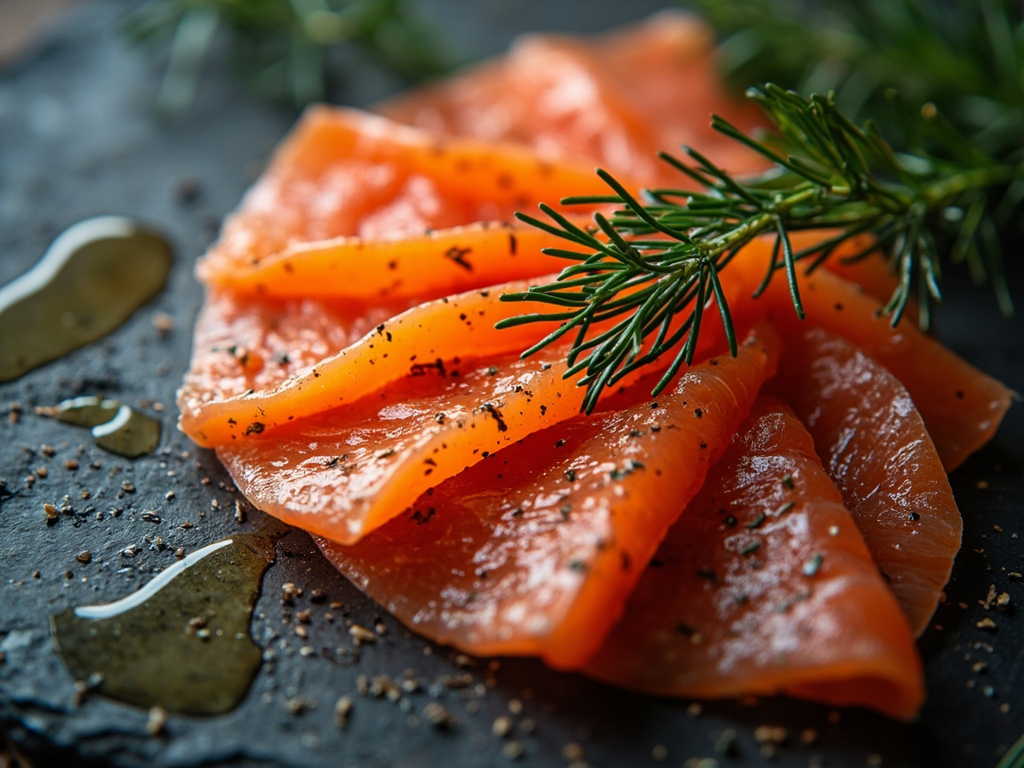
The contemporary twist : Sliced very thinly and arranged in a rosette on a slate, with a few dill sprigs and a drizzle of liquid honey: the 'gravlax of the gods' in a contemporary table version.
Sources : Etymology and history of gravlax ('buried salmon', medieval Scandinavia) · Daniel Serra & Hanna Tunberg, An Early Meal: A Viking Age Cookbook (2013)
Forseti · Charactorium