 flip
flipKurut
Kurut
Why this dish? The heroes of the Book of Dede Korkut constantly set out on raids, hunts, and distant expeditions across the steppe. Kurut — dried salted yogurt balls — is the quintessential travel provision of the Oghuz rider, compact and imperishable. Dede Korkut, the wandering sage who travels the land of the Oghuz from yurt to yurt carrying his tales, would have carried kurut in his pouch.
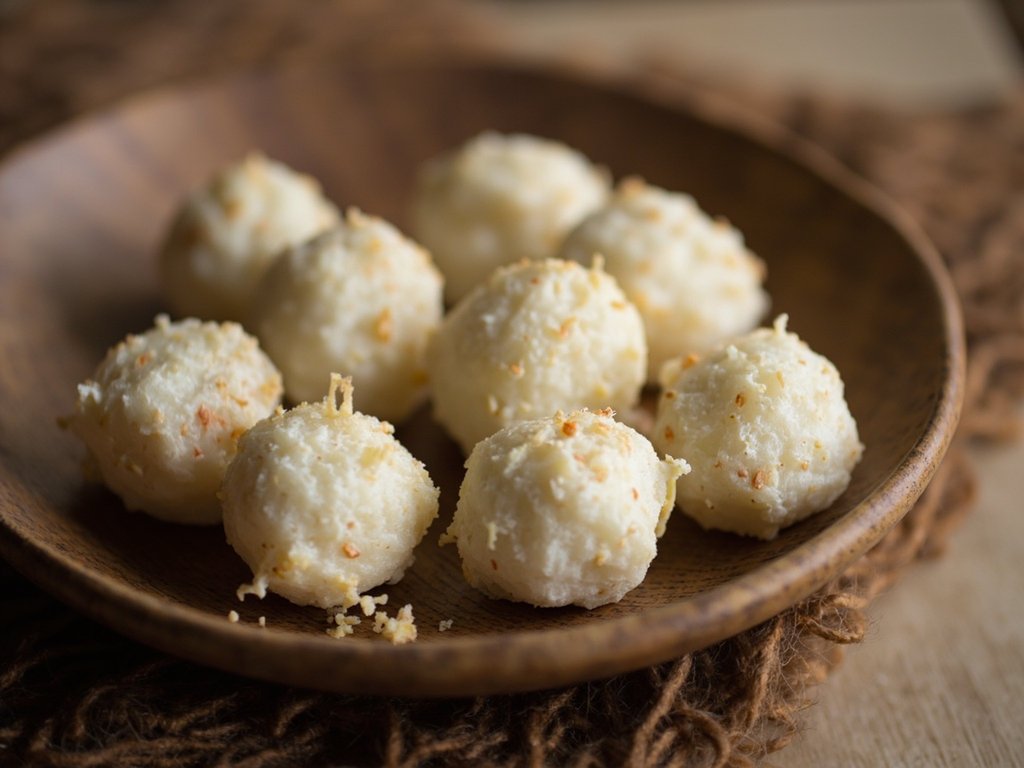
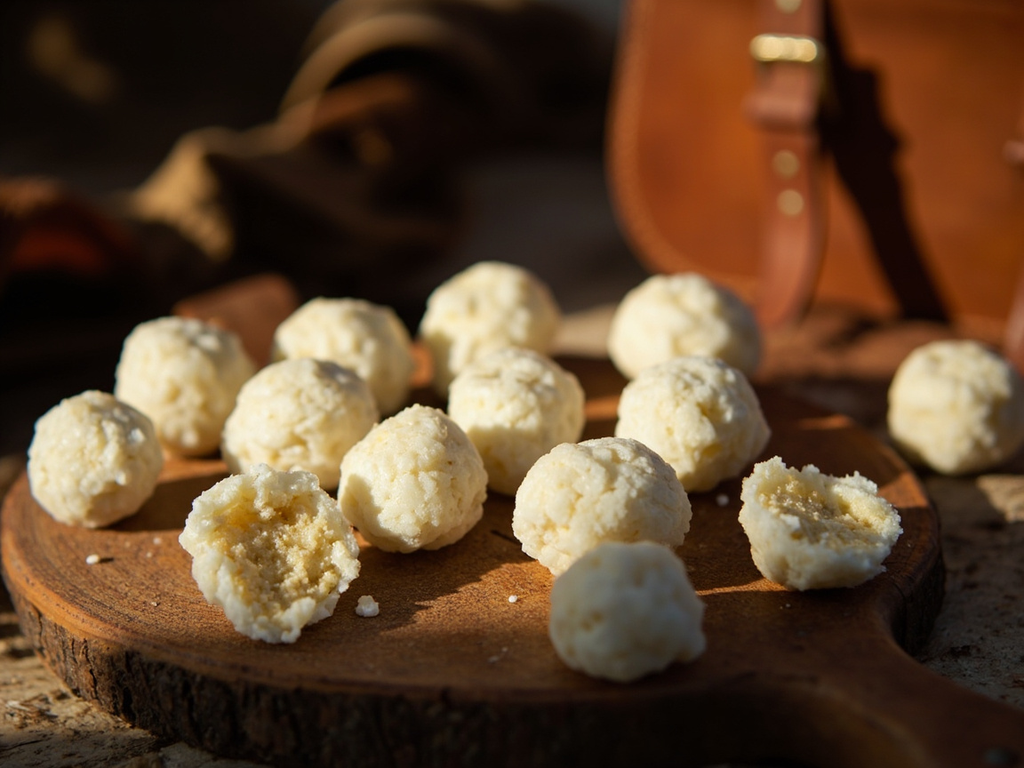
Small balls of salted yogurt, drained for a long time then dried in the sun and wind of the steppe until hard as pebbles. They keep for months and are nibbled as is or dissolved in hot water to make an instant soup on the road.
When I leave the khan's camp to go sing among the Bayandır or the Bayat, I carry neither cauldron nor servant. My kopuz on my back, my kurut in my saddlebag — that is all my luggage. My wife prepares it each summer: she takes the thickest yogurt, salts it well, presses it in a cloth, then rolls it into balls which she leaves to the wind on the roof of the yurt. After seven days, it is hard as a stone from the Seyhun. I crunch it while riding, or I melt it in hot water when night falls. An old man like me needs nothing else.
- •Very thick ewe's or mare's yogurt — a full container (base)
- •Rock salt — generously (preservative and flavor)
Kurut
Small balls of salted yogurt, drained for a long time then dried in the sun and wind of the steppe until hard as pebbles. They keep for months and are nibbled as is or dissolved in hot water to make an instant soup on the road.
Why this dish? The heroes of the Book of Dede Korkut constantly set out on raids, hunts, and distant expeditions across the steppe. Kurut — dried salted yogurt balls — is the quintessential travel provision of the Oghuz rider, compact and imperishable. Dede Korkut, the wandering sage who travels the land of the Oghuz from yurt to yurt carrying his tales, would have carried kurut in his pouch.
When I leave the khan's camp to go sing among the Bayandır or the Bayat, I carry neither cauldron nor servant. My kopuz on my back, my kurut in my saddlebag — that is all my luggage. My wife prepares it each summer: she takes the thickest yogurt, salts it well, presses it in a cloth, then rolls it into balls which she leaves to the wind on the roof of the yurt. After seven days, it is hard as a stone from the Seyhun. I crunch it while riding, or I melt it in hot water when night falls. An old man like me needs nothing else.
Ingredients (period version)
- Very thick ewe's or mare's yogurt — a full container (base)
- Rock salt — generously (preservative and flavor)
Ingredients
- Full-fat ewe's yogurt (or thick Greek yogurt) — 500 g (base)
- Fine salt — 1 heaped tsp (preservative and flavor)
- Cheesecloth or clean cotton cloth — 1 (draining)
Method
- Mix the yogurt and salt in a bowl.
- Pour into cheesecloth set over a sieve above a bowl. Gather the cloth and place a weight on top (a plate + a can). Let drain in the refrigerator for 12-24 hours, until a very thick, compact paste forms.
- Discard the whey (or save for soup). Take walnut-sized portions of the paste and roll into balls between your palms.
- Place the balls on a rack lined with parchment paper, spaced apart. Let dry in a dry, ventilated place for 3-7 days (or in the oven at 60°C with the door ajar for 6-8 hours to speed up).
- Kurut are ready when completely hard and dry. Store in an airtight jar at room temperature — they keep for several months.
- To eat: crunch as a snack, or crumble into hot water with a little butter for an instant soup.
How it was made : Kurut (also qurt, quroot, kashk) is attested throughout Central Asia since antiquity. Mahmud al-Kashgari (11th century) mentions it in his dictionary of Turkic languages (Dîvânu Lugâti't-Türk). It is the ideal survival ration for the nomadic rider: light, compact, rich in protein and salt, it does not spoil. Turkish and Mongol armies carried whole sacks of it on campaign.
The contemporary twist : Roll some balls in dried herbs (mint, wild thyme) before drying — a gourmet kurut for a traveler's aperitif.
Sources : Mahmud al-Kashgari, Dîvânu Lugâti't-Türk (Compendium of Turkic Languages), 11th century · Buell, Paul D. & Anderson, Eugene N., A Soup for the Qan, Brill, 2010 · Perry, Charles, 'The Taste for Layered Bread among the Nomadic Turks and the Central Asian Origins of Baklava', in A Taste of Thyme, I.B. Tauris, 2000
Dede Korkut · Charactorium