 flip
flipOgooué River Fish in Nyembwe Sauce
Ogooué River Fish in Nyembwe Sauce
Why this dish? The hospital was built on the banks of the Ogooué, a nourishing river from which fishermen caught capitaine catfish and silurus. Nyembwe sauce, made from palm nut pulp, is THE festive dish of Schweitzer's Gabon—the one offered on special days.
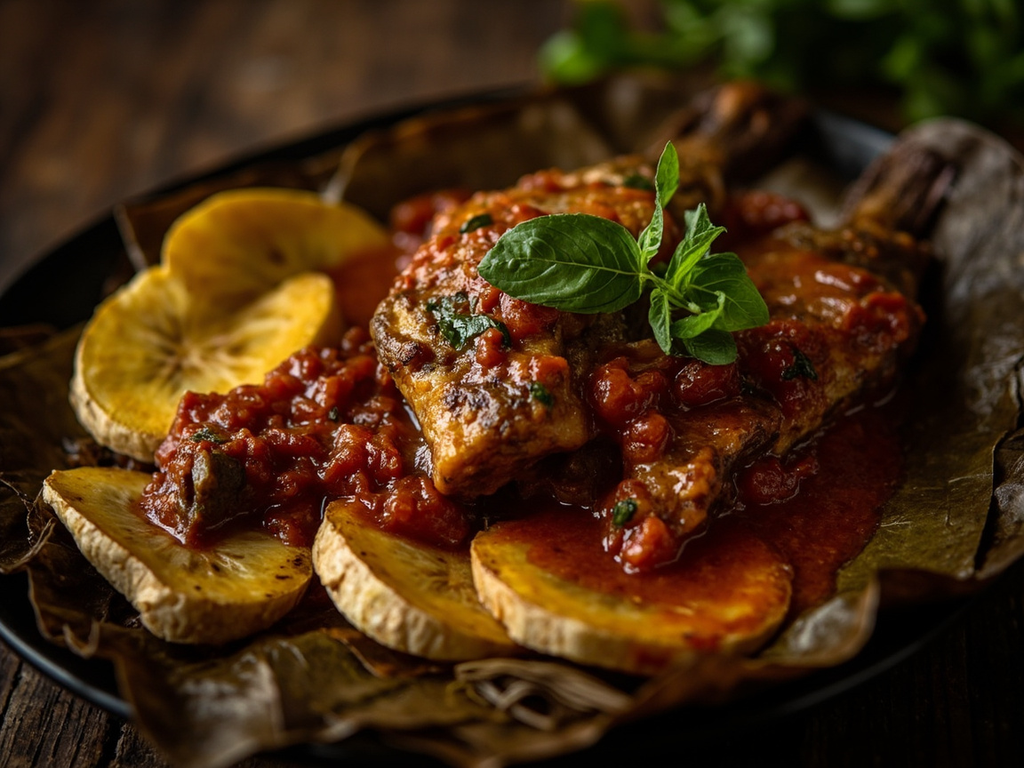
River fish simmered in a creamy sauce of palm nut pulp, spiced with onion, chili and aromatics. Brick-colored, deep flavor: the great shared dish for occasions.
The river flowed at the foot of the hospital, and sometimes a fine fish still alive was brought to me. I never took an animal life lightly—but when the gift was given, it was honored properly. The pulp of the palm nuts, long pounded, gave that thick sauce the color of terracotta, which was left to simmer for hours. It was the dish of great days, and even a tired old doctor found a moment of joy in it.
- •River fish (capitaine, silurus) — a fine fish (centerpiece)
- •Palm nut pulp (graine) — a good quantity, pounded (sauce base)
- •Onion — one or two (aromatic)
- •Fresh chili pepper — according to daring (heat)
- •Forest aromatics (African basil, scented bark) — a bunch (fragrance)
- •Salt — to taste (seasoning)
Ogooué River Fish in Nyembwe Sauce
River fish simmered in a creamy sauce of palm nut pulp, spiced with onion, chili and aromatics. Brick-colored, deep flavor: the great shared dish for occasions.
Why this dish? The hospital was built on the banks of the Ogooué, a nourishing river from which fishermen caught capitaine catfish and silurus. Nyembwe sauce, made from palm nut pulp, is THE festive dish of Schweitzer's Gabon—the one offered on special days.
The river flowed at the foot of the hospital, and sometimes a fine fish still alive was brought to me. I never took an animal life lightly—but when the gift was given, it was honored properly. The pulp of the palm nuts, long pounded, gave that thick sauce the color of terracotta, which was left to simmer for hours. It was the dish of great days, and even a tired old doctor found a moment of joy in it.
Ingredients (period version)
- River fish (capitaine, silurus) — a fine fish (centerpiece)
- Palm nut pulp (graine) — a good quantity, pounded (sauce base)
- Onion — one or two (aromatic)
- Fresh chili pepper — according to daring (heat)
- Forest aromatics (African basil, scented bark) — a bunch (fragrance)
- Salt — to taste (seasoning)
Ingredients
- Firm fish fillets or steaks (silurus, pollock, cod) — 600 g (centerpiece)
- Palm nut sauce / pulp (canned) — 400 g (sauce base)
- Onion — 2, sliced (aromatic)
- Tomato — 2, chopped (optional) (acidic binder)
- Chili (Scotch bonnet or mild to taste) — 1/2 to 1 (heat)
- Garlic — 2 cloves (aromatic)
- Basil (ideally African basil / nkumu) — a few leaves (fragrance)
- Salt, bouillon cube — to taste (seasoning)
Method
- Salt the fish and refrigerate while preparing the sauce.
- Sauté onion, garlic and chili in a little oil until fragrant.
- Add the palm nut pulp and tomato, then a large glass of water; mix well.
- Simmer over low heat for 25 to 30 minutes, stirring, until the sauce thickens and oil rises to the surface.
- Gently place the fish pieces in the sauce and poach for 10 to 12 minutes without stirring too much.
- Season with basil at the end, adjust salt, and serve with rice or plantain.
How it was made : Nyembwe is traditionally prepared by boiling palm nuts and pounding them to extract the pulp, separated from fibers and kernels. Everything was cooked over a wood fire in a cast-iron pot; the fish, freshly caught from the Ogooué, had no journey to make.
The contemporary twist : Present the fish napped in its brick-red sauce on a banana leaf, with a few golden plantain slices on the side.
Sources : Cuisine traditionnelle du Gabon — répertoire des plats à base de sauce nyembwe (graine de palme) · Albert Schweitzer, *À l'orée de la forêt vierge*, 1921
Albert Schweitzer · Charactorium