 flip
flipKulebyaka of fish (the grand reception dish)
Kulebyaka of fish (the grand reception dish)
Why this dish? Borodin, “hospitable, willingly shared his table with his many guests”: kulebyaka is the quintessential Russian reception dish, a fish pie in pastry proudly sliced before the diners. St. Petersburg, city of the Baltic and the Neva, lived on fish.
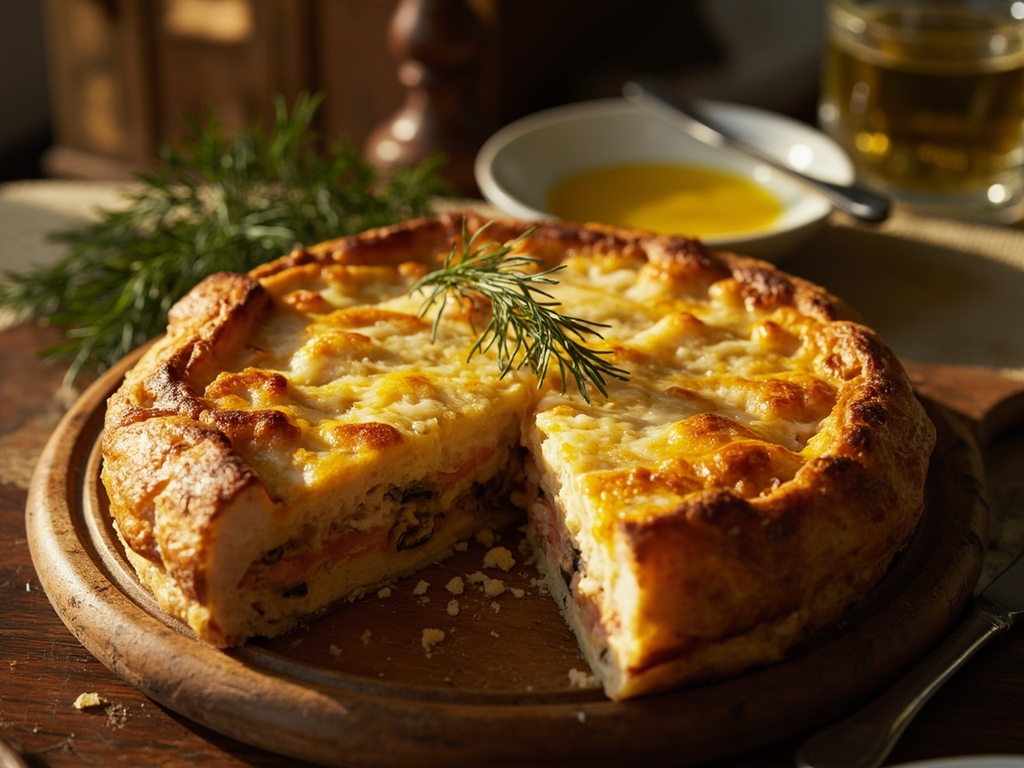
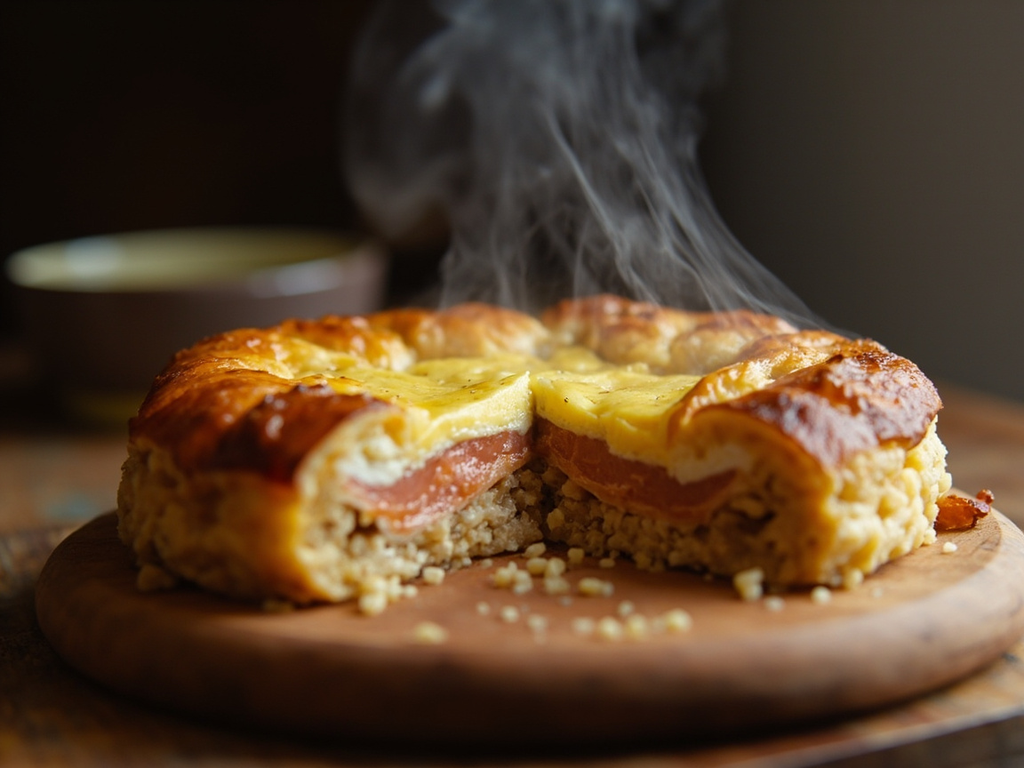
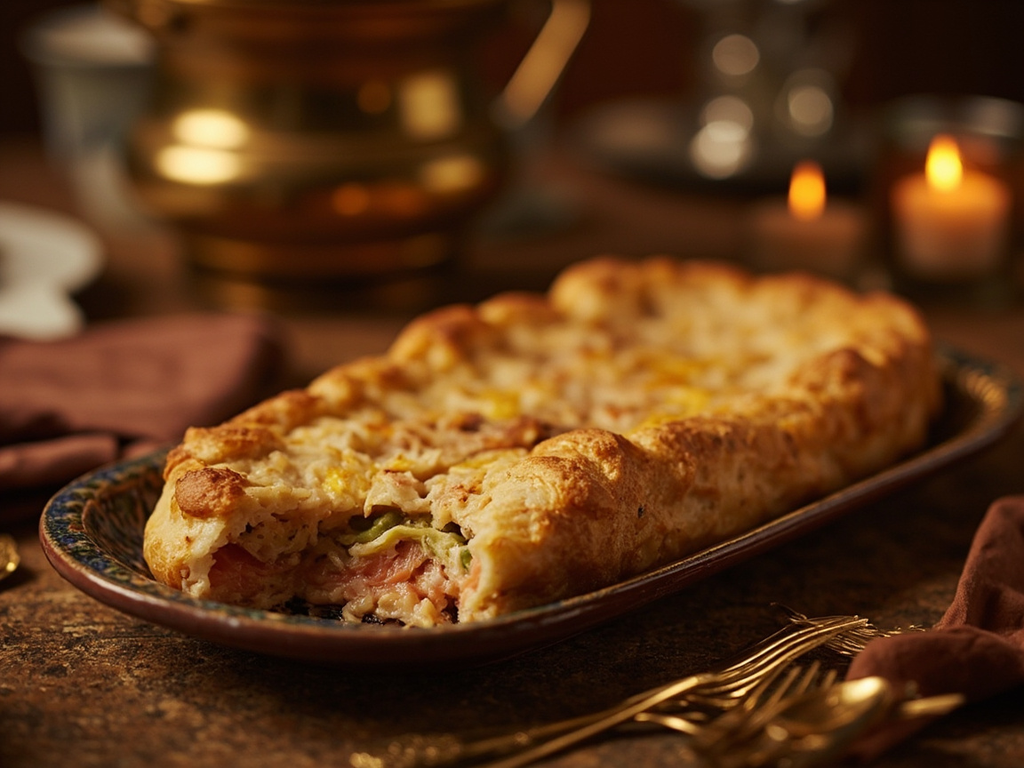
A large golden pastry pie, filled with fish, rice, hard-boiled eggs and herbs, sliced into generous portions. The spectacular dish of Russian festive tables.
Ah, for this one, we sit down properly! When Mussorgsky, Rimsky and the whole gang show up on a Sunday, it's the kulebyaka that reigns in the center — a tall golden crust that we open like raising the curtain of an opera, and the steam rising from the fish! I confess, I'm a better chemist than pastry chef, so it's often my dear Catherine who handles the dough; I mainly take care of asking for seconds. Cut generously, there's enough for everyone, and serve more tea afterwards.
- •Yeast dough or rich shortcrust pastry — enough to enclose (crust)
- •River fish or salmon — a nice fillet (main filling)
- •Buckwheat or rice — a bowlful cooked (binding filling)
- •Hard-boiled eggs — several (filling)
- •Onion and butter — as desired (aromatic fondue)
- •Dill — a bunch (flavor)
- •Egg for glaze — 1 (color)
Kulebyaka of fish (the grand reception dish)
A large golden pastry pie, filled with fish, rice, hard-boiled eggs and herbs, sliced into generous portions. The spectacular dish of Russian festive tables.
Why this dish? Borodin, “hospitable, willingly shared his table with his many guests”: kulebyaka is the quintessential Russian reception dish, a fish pie in pastry proudly sliced before the diners. St. Petersburg, city of the Baltic and the Neva, lived on fish.
Ah, for this one, we sit down properly! When Mussorgsky, Rimsky and the whole gang show up on a Sunday, it's the kulebyaka that reigns in the center — a tall golden crust that we open like raising the curtain of an opera, and the steam rising from the fish! I confess, I'm a better chemist than pastry chef, so it's often my dear Catherine who handles the dough; I mainly take care of asking for seconds. Cut generously, there's enough for everyone, and serve more tea afterwards.
Ingredients (period version)
- Yeast dough or rich shortcrust pastry — enough to enclose (crust)
- River fish or salmon — a nice fillet (main filling)
- Buckwheat or rice — a bowlful cooked (binding filling)
- Hard-boiled eggs — several (filling)
- Onion and butter — as desired (aromatic fondue)
- Dill — a bunch (flavor)
- Egg for glaze — 1 (color)
Ingredients
- Puff pastry (2 rolls) or yeast dough — 500 g (crust)
- Salmon or cod fillet, boneless — 500 g (main filling)
- Cooked rice — 200 g (cooked weight) (binding filling)
- Hard-boiled eggs — 3 (filling)
- Onion — 1 large (aromatic fondue)
- Butter — 40 g (fondue)
- Fresh dill — 1 bunch (flavor)
- Egg yolk — 1 (glaze)
Method
- Sweat the chopped onion in butter without browning, mix with cooked rice, add dill, salt and pepper.
- Roll out half the pastry into a rectangle on a baking sheet. Place half the rice, the fish fillet, sliced hard-boiled eggs, then the rest of the rice.
- Cover with the second pastry sheet, seal the edges, cut a steam vent in the center.
- Brush with egg yolk, decorate with pastry scraps.
- Bake in a hot oven (200 °C) for 35 to 40 minutes until golden brown.
- Let rest 10 minutes before slicing in front of the guests.
How it was made : Authentic kulebyaka was much more complex than today's version: up to twelve layers were stacked, separated by thin pancakes (*bliny*) to prevent the juices from soaking the pastry, and *vesiga* (dorsal marrow of sturgeon) was used as a noble filling. It was a prestige dish of wealthy tables.
The contemporary twist : Trace on the crust, with a knife tip, Borodin's two themes: a musical staff and a stylized chemical formula.
Sources : Elena Molokhovets, A Gift to Young Housewives (1861) · Pohlebin V., History of Russian Cuisine
Alexander Borodin · Charactorium