 flip
flipBotvinia with Noble Fish (Cold Kvas Soup)
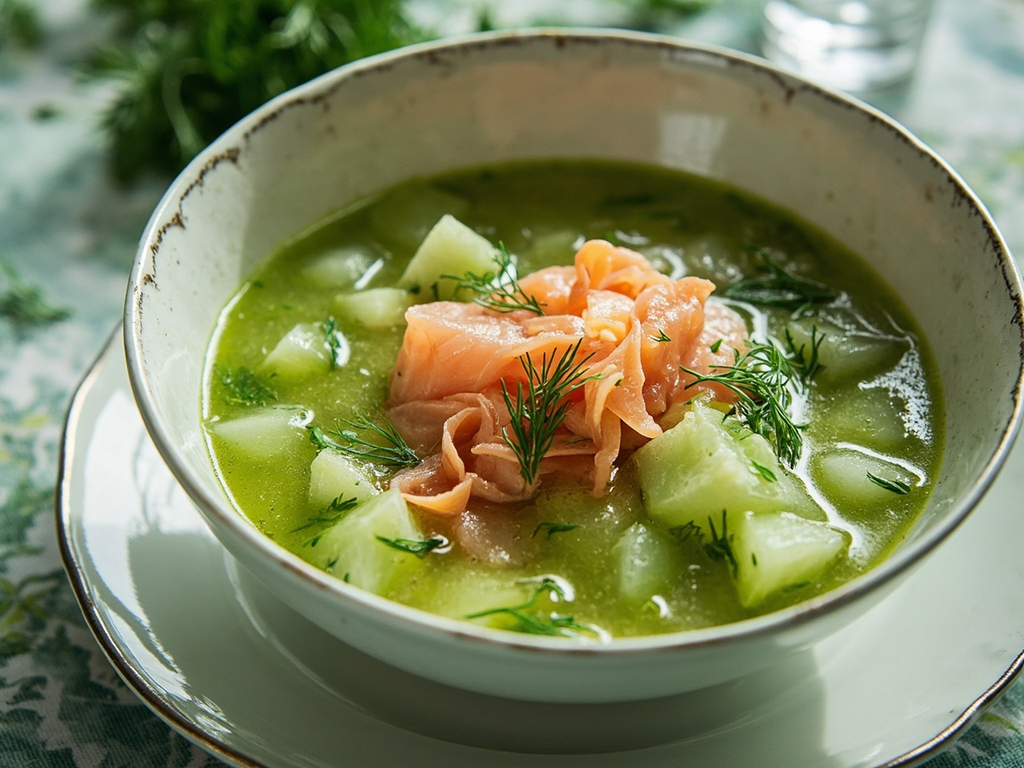
Botvinia with Noble Fish (Cold Kvas Soup)
Why this dish? Botvinia was the pride of summer tables in Saint Petersburg: a cold kvas soup, garnished with fish from the great rivers (sturgeon, salmon) that the imperial court received in abundance. A prestigious dish served at summer receptions during Alexander's reign.
Soup served cold: a tangy broth of rye kvas mixed with chopped spinach and sorrel, brightened with fresh cucumber, dill and horseradish, topped with pieces of poached fish. Refreshing, lively, terribly elegant.
When the July sun crushes the Neva, I cannot offer my guests a boiling soup. So here is botvinia, glory of our northern summers. Finely chop the sorrel and young leaves, wilt them just a little, and drown them in the sourest kvas from my cellar; on top, cucumber, dill, a hint of horseradish that stings the nose, and the fine cold sturgeon from the Volga. It is served so chilled that the crystal mists up. Here — taste, and tell me if France has anything finer in great heat.
- •Rye bread kvas, well soured — a large pitcher (acidic fermented broth)
- •Sorrel and spinach — two handfuls (base greens)
- •Poached sturgeon or salmon — fine pieces (noble garnish)
- •Fresh cucumber — one (freshness)
- •Grated horseradish — a little (pungency)
- •Dill and spring onion — in abundance (herbs)
Botvinia with Noble Fish (Cold Kvas Soup)
Soup served cold: a tangy broth of rye kvas mixed with chopped spinach and sorrel, brightened with fresh cucumber, dill and horseradish, topped with pieces of poached fish. Refreshing, lively, terribly elegant.
Why this dish? Botvinia was the pride of summer tables in Saint Petersburg: a cold kvas soup, garnished with fish from the great rivers (sturgeon, salmon) that the imperial court received in abundance. A prestigious dish served at summer receptions during Alexander's reign.
When the July sun crushes the Neva, I cannot offer my guests a boiling soup. So here is botvinia, glory of our northern summers. Finely chop the sorrel and young leaves, wilt them just a little, and drown them in the sourest kvas from my cellar; on top, cucumber, dill, a hint of horseradish that stings the nose, and the fine cold sturgeon from the Volga. It is served so chilled that the crystal mists up. Here — taste, and tell me if France has anything finer in great heat.
Ingredients (period version)
- Rye bread kvas, well soured — a large pitcher (acidic fermented broth)
- Sorrel and spinach — two handfuls (base greens)
- Poached sturgeon or salmon — fine pieces (noble garnish)
- Fresh cucumber — one (freshness)
- Grated horseradish — a little (pungency)
- Dill and spring onion — in abundance (herbs)
Ingredients
- Kvas (fermented rye drink, low sugar) — 750 ml (acidic fermented broth)
- Spinach — 150 g (base greens)
- Sorrel — 80 g (tangy greens)
- Poached salmon or trout fillet — 250 g (noble garnish)
- Cucumber — 1, small dice (freshness)
- Grated horseradish — 1 tsp (pungency)
- Chopped dill + chives — 1 small bunch (herbs)
- Hard-boiled egg — 2 (garnish (optional))
Method
- Blanch spinach and sorrel 1 minute, squeeze dry, chop finely.
- Poach fish in simmering water 6-8 minutes, cool, flake into large pieces.
- Mix greens into well-chilled kvas, season with salt, add horseradish.
- Add diced cucumber, dill and chives; adjust acidity with a squeeze of lemon if needed.
- Refrigerate at least 1 hour. Serve ice-cold, with fish and egg arranged on top, plus a few ice cubes.
How it was made : 'Botva' means tops: originally beet tops were used. Kvas, a slightly alcoholic fermented rye bread beer, served as the base for a whole family of cold soups (including okroshka). It was kept cool in ice cellars filled with packed snow in winter.
The contemporary twist : Plate the fish separately on a slate and pour the chilled soup tableside, 'service à la russe' style that Alexander's court helped popularize in Europe.
Sources : Elena Molokhovets, 'Podarok molodym khozyaikam' (1861) · William Pokhlyobkin, 'History of Russian Cuisine'
Alexander I · Charactorium