 flip
flipPotage Parmentier
Potage Parmentier
Why this dish? Evening soup was the immutable ritual of every bourgeois household. For Alice Guy, accustomed to long days of shooting at Gaumont and then directing at Solax, this velvety potato and leek soup — simple, nourishing, economical — embodies the ordinary meal you find upon returning home, one that doesn't change whether you're in Belleville or Fort Lee.
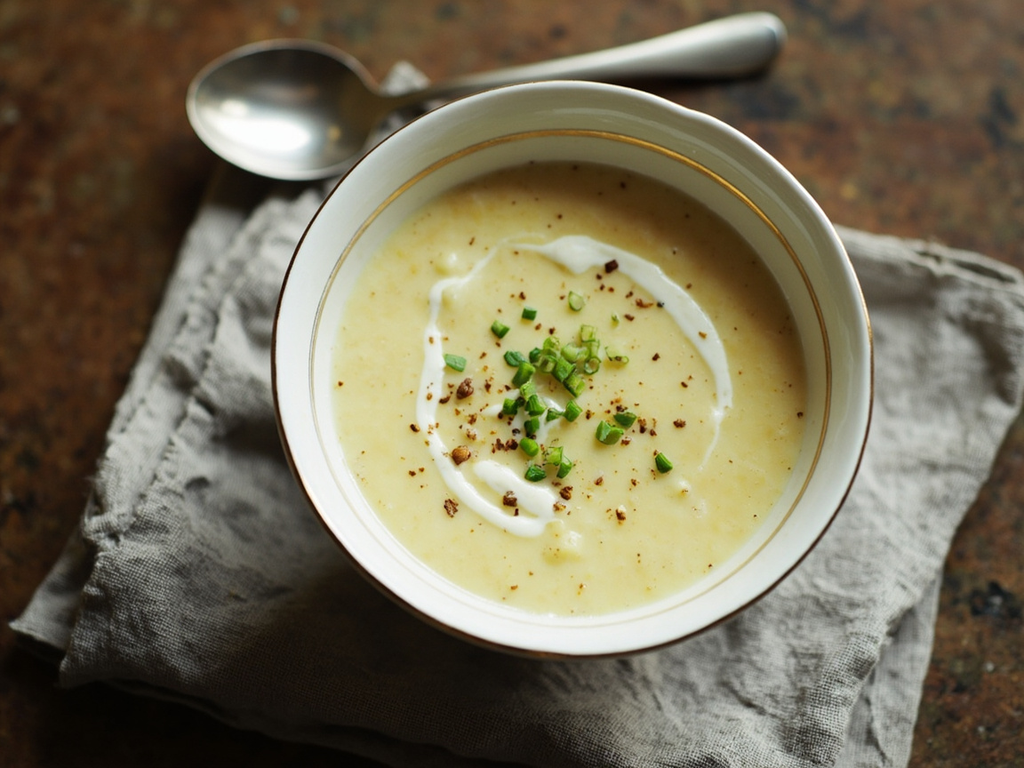
A smooth velouté of potatoes and leeks, bound with butter and softened with a dash of cream, served piping hot to open dinner. The quintessence of bourgeois soup: humble in its ingredients, meticulous in its execution.
You see, on a film set one never has time to dine properly, so in the evening I insisted on my soup. The secret, I confide to you, is to melt the leeks very gently in butter before adding the potatoes — never hurry, never color. Pass everything through a sieve until it's smooth as velvet, and finish with a knob of fresh butter off the heat. Even in New Jersey, believe me, it was this aroma that brought me back to the house in Saint-Mandé.
- •Floury potatoes — a good amount (base of the velouté)
- •Leek whites — a few (aromatic sweetness)
- •Fresh butter — a good knob (sweating vegetables and liaison)
- •Broth or salted water — enough to moisten (liquid)
- •Crème fraîche — a dash (final creaminess)
Potage Parmentier
A smooth velouté of potatoes and leeks, bound with butter and softened with a dash of cream, served piping hot to open dinner. The quintessence of bourgeois soup: humble in its ingredients, meticulous in its execution.
Why this dish? Evening soup was the immutable ritual of every bourgeois household. For Alice Guy, accustomed to long days of shooting at Gaumont and then directing at Solax, this velvety potato and leek soup — simple, nourishing, economical — embodies the ordinary meal you find upon returning home, one that doesn't change whether you're in Belleville or Fort Lee.
You see, on a film set one never has time to dine properly, so in the evening I insisted on my soup. The secret, I confide to you, is to melt the leeks very gently in butter before adding the potatoes — never hurry, never color. Pass everything through a sieve until it's smooth as velvet, and finish with a knob of fresh butter off the heat. Even in New Jersey, believe me, it was this aroma that brought me back to the house in Saint-Mandé.
Ingredients (period version)
- Floury potatoes — a good amount (base of the velouté)
- Leek whites — a few (aromatic sweetness)
- Fresh butter — a good knob (sweating vegetables and liaison)
- Broth or salted water — enough to moisten (liquid)
- Crème fraîche — a dash (final creaminess)
Ingredients
- Potatoes (e.g., Bintje) — 600 g (base of the velouté)
- Leek whites — 2 (approx. 250 g) (aromatic sweetness)
- Butter — 50 g (sweating and liaison)
- Chicken broth or water — 1 liter (liquid)
- Thick crème fraîche — 5 cl (final creaminess)
- Salt, pepper — to taste (seasoning)
Method
- Finely slice the leek whites and wash them thoroughly.
- Melt 30 g of butter in a saucepan and sweat the leeks over low heat without browning, 8 to 10 minutes.
- Add the peeled and chopped potatoes, then pour in the broth. Season with salt.
- Simmer for 25 to 30 minutes, until the potatoes are soft.
- Blend until smooth (or pass through a food mill and then a sieve for an authentic period velouté).
- Off the heat, stir in the cream and remaining butter. Adjust seasoning and serve piping hot.
How it was made : At the turn of the 20th century, evening soup was almost mandatory in bourgeois households. The potato, long scorned, had become established thanks to Parmentier in the previous century: his name remains attached to this soup. It was passed through a fine sieve by hand, lacking blenders, which required time and wrist strength.
The contemporary twist : A spoonful of hazelnut oil and a few croutons browned in demi-salt butter, as a nod to Alice Guy's journey between two continents.
Sources : Auguste Escoffier, Le Guide culinaire, 1903 · La Cuisinière bourgeoise (household manuals of the 19th-20th c.)
Alice Guy · Charactorium