 flip
flipTuwon dawa da miyar kuka — sorghum paste and baobab leaf sauce
Tuwon dawa da miyar kuka — sorghum paste and baobab leaf sauce
Why this dish? Millet and sorghum fed the court of Zazzau day in and day out; miyar kuka, thickened with baobab leaf powder and spiced with dawadawa, was the evening meal that sustained Amina's horsemen between campaigns.
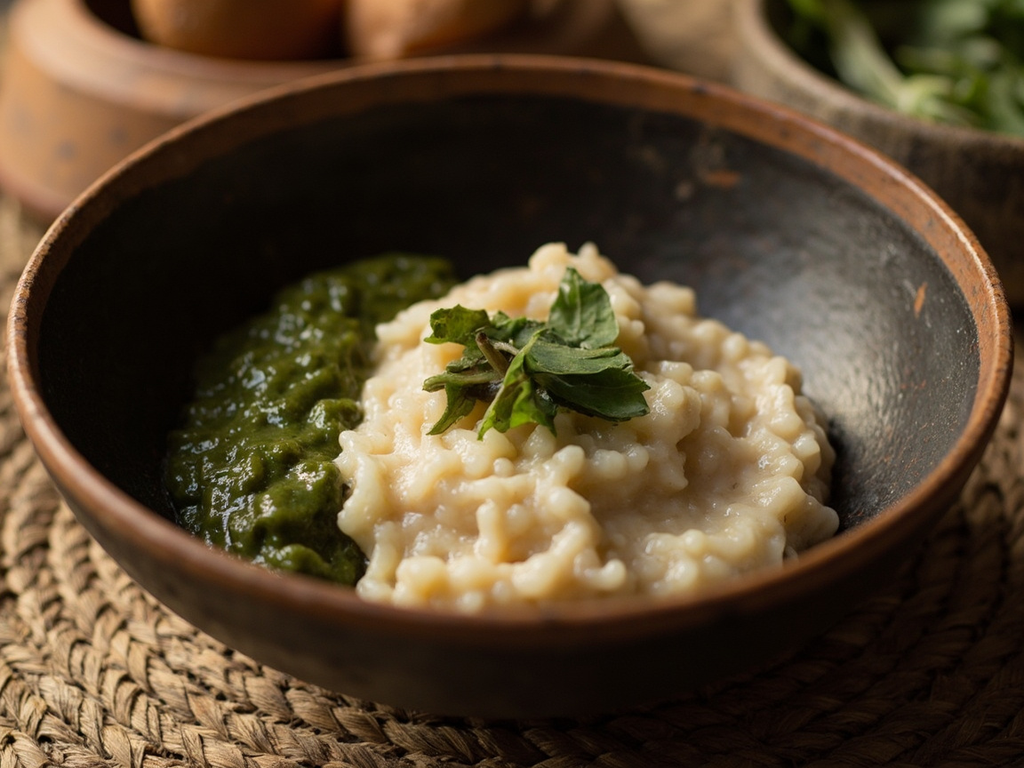
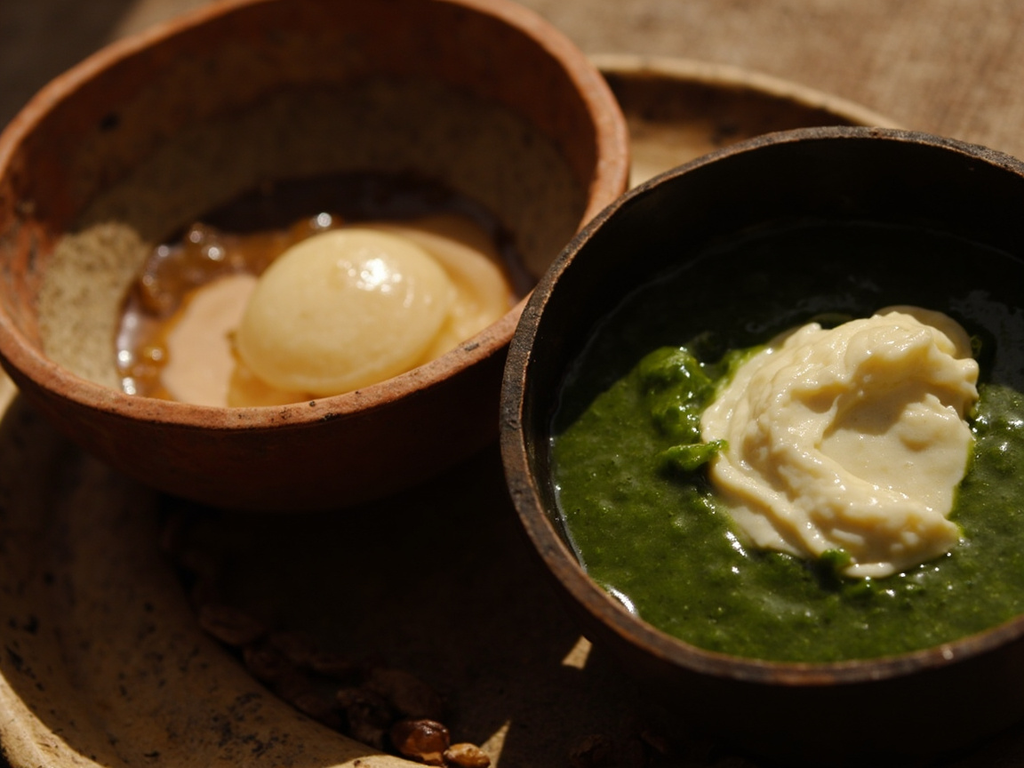
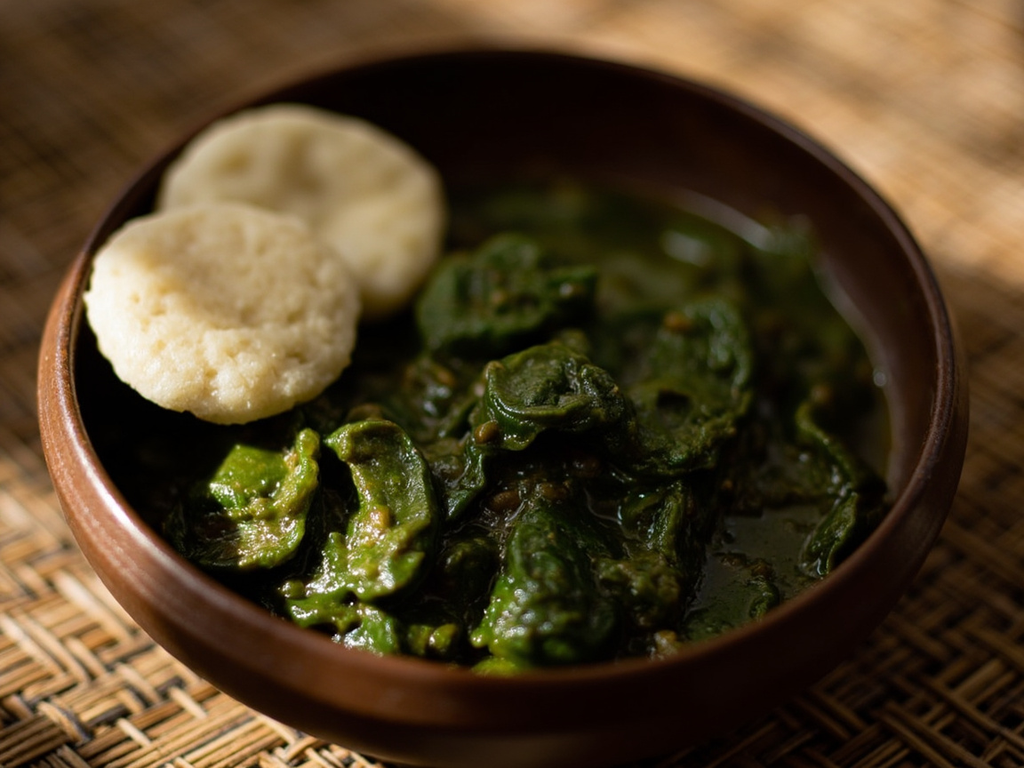
A smooth sorghum paste broken into dumplings to dip into a green, slimy, savory sauce of baobab leaves, naturally thickened and flavored with fermented locust bean. The staple dish of every Hausa household.
Come closer, and don't be picky. Before my horsemen saddled their horses, we served them this sorghum tuwo in the great court platter: you roll the dumpling with your right hand, hollow it with your thumb, and dip it into the kuka sauce. The secret is not in the meat — it is in the black locust cake crushed at the bottom of the mortar, for it gives strength to the taste. Eat your fill: no one goes to war on an empty stomach in Zazzau.
- •Sorghum flour (dawa) — two handfuls per diner (base, the tuwo)
- •Dried baobab leaves, pounded (kuka) — a good pinch per bowl (binder and body of the sauce)
- •Dawadawa (fermented locust bean) — one crushed cake (umami, signature)
- •Fresh okra — a handful (thickener)
- •Grains of Selim (grains of paradise, citta) — a few crushed seeds (heat)
- •Onion and ginger — to taste (aromatics)
- •Sahel rock salt — to taste (seasoning)
Tuwon dawa da miyar kuka — sorghum paste and baobab leaf sauce
A smooth sorghum paste broken into dumplings to dip into a green, slimy, savory sauce of baobab leaves, naturally thickened and flavored with fermented locust bean. The staple dish of every Hausa household.
Why this dish? Millet and sorghum fed the court of Zazzau day in and day out; miyar kuka, thickened with baobab leaf powder and spiced with dawadawa, was the evening meal that sustained Amina's horsemen between campaigns.
Come closer, and don't be picky. Before my horsemen saddled their horses, we served them this sorghum tuwo in the great court platter: you roll the dumpling with your right hand, hollow it with your thumb, and dip it into the kuka sauce. The secret is not in the meat — it is in the black locust cake crushed at the bottom of the mortar, for it gives strength to the taste. Eat your fill: no one goes to war on an empty stomach in Zazzau.
Ingredients (period version)
- Sorghum flour (dawa) — two handfuls per diner (base, the tuwo)
- Dried baobab leaves, pounded (kuka) — a good pinch per bowl (binder and body of the sauce)
- Dawadawa (fermented locust bean) — one crushed cake (umami, signature)
- Fresh okra — a handful (thickener)
- Grains of Selim (grains of paradise, citta) — a few crushed seeds (heat)
- Onion and ginger — to taste (aromatics)
- Sahel rock salt — to taste (seasoning)
Ingredients
- Sorghum flour (or millet flour) — 250 g (tuwo)
- Baobab leaf powder (kuka) — 3 tbsp (binder/sauce)
- Dawadawa or soumbala (fermented locust bean) — 2 tbsp crumbled (umami signature)
- Fresh okra — 150 g sliced (thickener)
- Grains of paradise (maniguette) — 1/2 tsp ground (heat)
- Onion — 1 (base)
- Fresh ginger — 1 piece 2 cm (aromatic)
- Salt — to taste (seasoning)
- Water — 1 litre (cooking)
Method
- For the tuwo: bring 500 ml water to a boil, dissolve 2 tbsp flour in a little cold water, pour into the hot water and whisk.
- Add the remaining flour in a rain, lower the heat and work with a wooden spatula until you get a firm, smooth paste without lumps. Cover and keep warm.
- For the miya: sauté the onion and ginger, add 800 ml water, crumbled dawadawa, grains of paradise, and salt.
- Whisk in the baobab powder in a rain to avoid lumps, then the sliced okra.
- Simmer for 15 min until a green, thickened, slightly slimy sauce forms.
- Serve the tuwo as a large ball next to the bowl of miya; pinch off pieces and dip with the right hand.
How it was made : In Hausa compounds, tuwo was beaten with a pestle in a large calabash, while the miya cooked on three stones over a wood fire. Baobab leaf powder and fermented locust bean, both dried, kept for months — a Sahelian cuisine designed for the dry season and long military marches.
The contemporary twist : Plate the tuwo ball smoothly in the center of a clay plate, drizzle with a streak of emerald miya, and sprinkle with a few toasted sesame seeds: Sahelian simplicity, photo-ready.
Sources : Heidi J. Nast, Concubines and Power: Five Hundred Years in a Northern Nigerian Palace, University of Minnesota Press, 2005 · J.E.G. Sutton, « Towards a Less Orthodox History of Hausaland », Journal of African History, 1979
Amina of Zazzau · Charactorium