 flip
flipMoretum, the Garlic Fresh Cheese of the Workshop
Moretum, the Garlic Fresh Cheese of the Workshop
Why this dish? A man who spends his days on construction sites, groma in hand and marble plan under his eyes, eats quickly and simply at midday: bread, oil, and this herb-crushed cheese that every Roman knows. This is the builder's meal between two surveys.
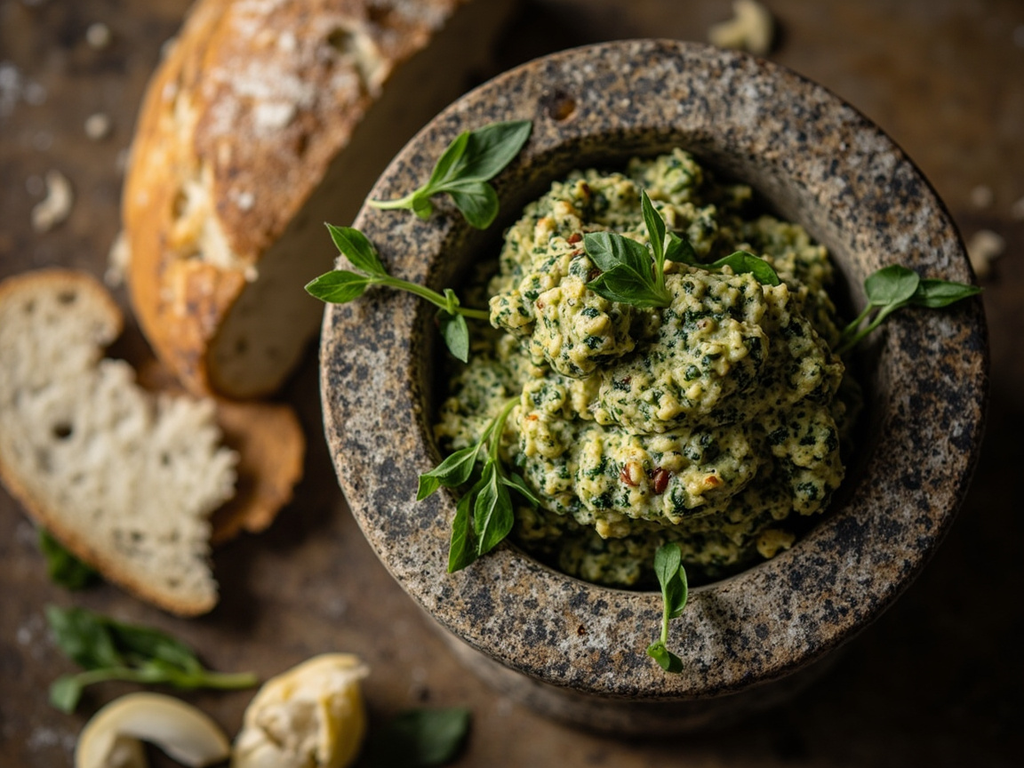
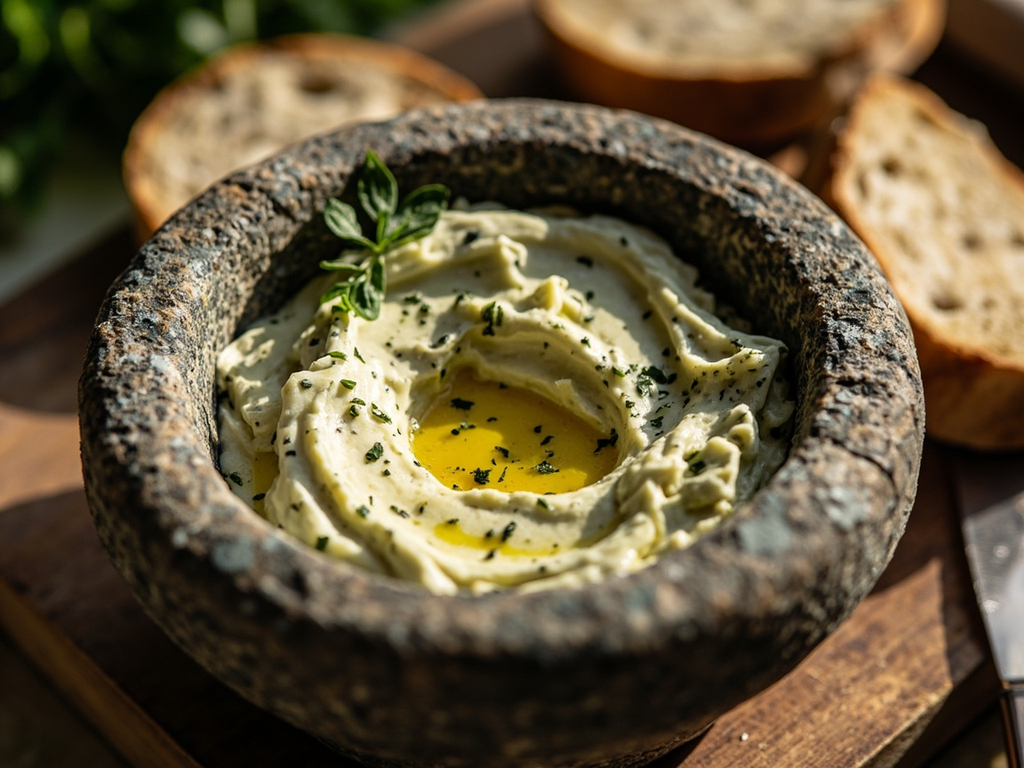
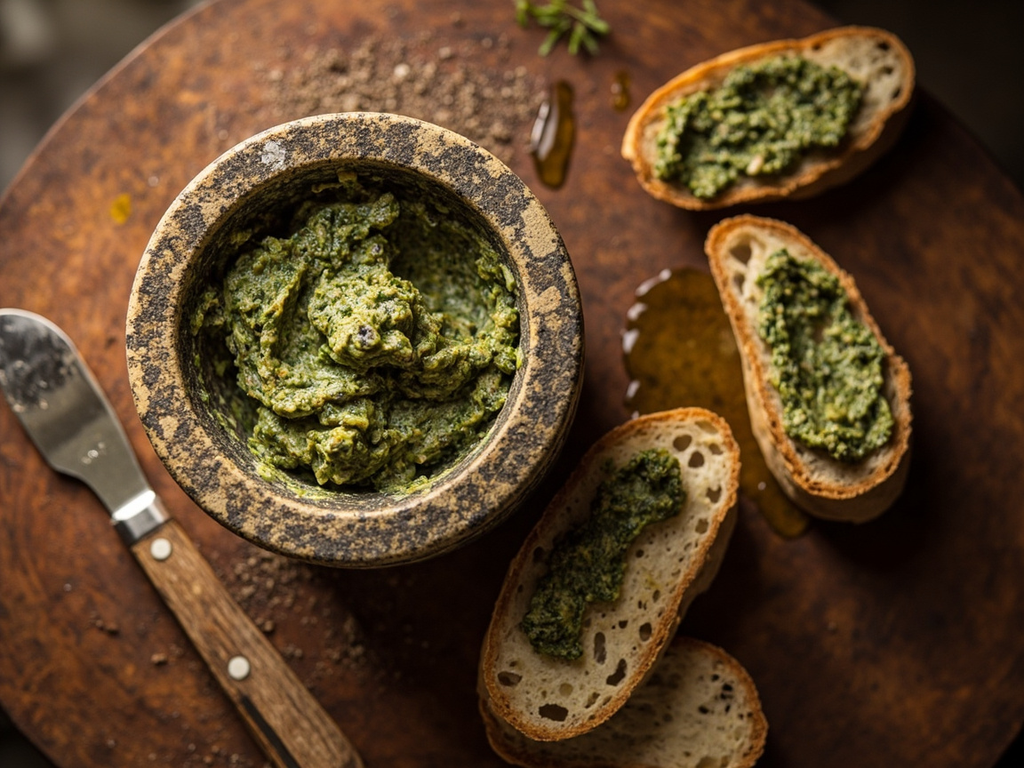
A creamy paste of fresh cheese pounded with garlic, green herbs, salt, and a drizzle of oil, spread on still-warm bread. Robust, fragrant, fortifying—the universal snack of working Rome.
Listen to me: a building stands by its foundations, a man by what he swallows standing up between two measurements. On my sites, I pound the cheese with garlic in the mortar, I pour the oil drop by drop as one pours lime mortar, until the paste takes and binds. A few leaves of coriander and rue, a pinch of salt, and I spread it all on the bread—there's my gustatio when the marble won't wait. The secret, you see, is in the patience of the pestle: you don't raise a vault in one blow, you don't bind a moretum in haste.
- •Fresh ewe's milk cheese — a good piece (base of the paste)
- •Garlic — several cloves (pungency)
- •Fresh coriander and rue, celery — a handful of herbs (green fragrance)
- •Olive oil — a drizzle (binder)
- •Wine vinegar — a few drops (brightness)
- •Salt — a pinch (seasoning)
Moretum, the Garlic Fresh Cheese of the Workshop
A creamy paste of fresh cheese pounded with garlic, green herbs, salt, and a drizzle of oil, spread on still-warm bread. Robust, fragrant, fortifying—the universal snack of working Rome.
Why this dish? A man who spends his days on construction sites, groma in hand and marble plan under his eyes, eats quickly and simply at midday: bread, oil, and this herb-crushed cheese that every Roman knows. This is the builder's meal between two surveys.
Listen to me: a building stands by its foundations, a man by what he swallows standing up between two measurements. On my sites, I pound the cheese with garlic in the mortar, I pour the oil drop by drop as one pours lime mortar, until the paste takes and binds. A few leaves of coriander and rue, a pinch of salt, and I spread it all on the bread—there's my gustatio when the marble won't wait. The secret, you see, is in the patience of the pestle: you don't raise a vault in one blow, you don't bind a moretum in haste.
Ingredients (period version)
- Fresh ewe's milk cheese — a good piece (base of the paste)
- Garlic — several cloves (pungency)
- Fresh coriander and rue, celery — a handful of herbs (green fragrance)
- Olive oil — a drizzle (binder)
- Wine vinegar — a few drops (brightness)
- Salt — a pinch (seasoning)
Ingredients
- Fresh ewe's milk cheese (or mild feta / ricotta) — 200 g (base of the paste)
- Garlic — 2 cloves (pungency)
- Fresh coriander + parsley + tender celery stalk — 3 tbsp chopped (green fragrance)
- Olive oil — 3 tbsp (binder)
- White wine vinegar — 1 tsp (brightness)
- Salt — 1 pinch (seasoning)
- Sourdough bread — 4 slices (support)
Method
- Peel the garlic and pound it in a mortar with a pinch of salt until you get a purée.
- Add the chopped herbs and crush them with the garlic to release the aromas.
- Incorporate the cheese and work the paste with the pestle.
- Pour the oil in a stream, then the vinegar, mixing until a smooth, homogeneous cream forms.
- Taste, adjust salt, and spread generously on warm bread.
How it was made : The moretum is so emblematic that a Latin poem (the Appendix Vergiliana) describes its preparation in the mortar, step by step. It was the food of the common people as well as the appetizer of the rich: cheese, garlic, garden herbs, and oil—nothing but basic Mediterranean products.
The contemporary twist : Serve it as a quenelle on a board, sprinkled with borage flowers, 'architect's table plan' style with a few bread croutons cut to the line.
Sources : Appendix Vergiliana, "Moretum" (Latin poem) · Cato the Elder, De Agri Cultura (cheese preparations)
Apollodorus of Damascus · Charactorium