 flip
flipRoast Capon with Agresto Sweet-and-Sour Sauce
Roast Capon with Agresto Sweet-and-Sour Sauce
Why this dish? Admitted to the Academy of Drawing in Florence and courted by patrons — the Medici, later the London court — Artemisia knew the tables where poultry and court sauces were served. Meat was the affair of the *giorni grassi* (fat days) of her card: a commission meal, a contract to sign.
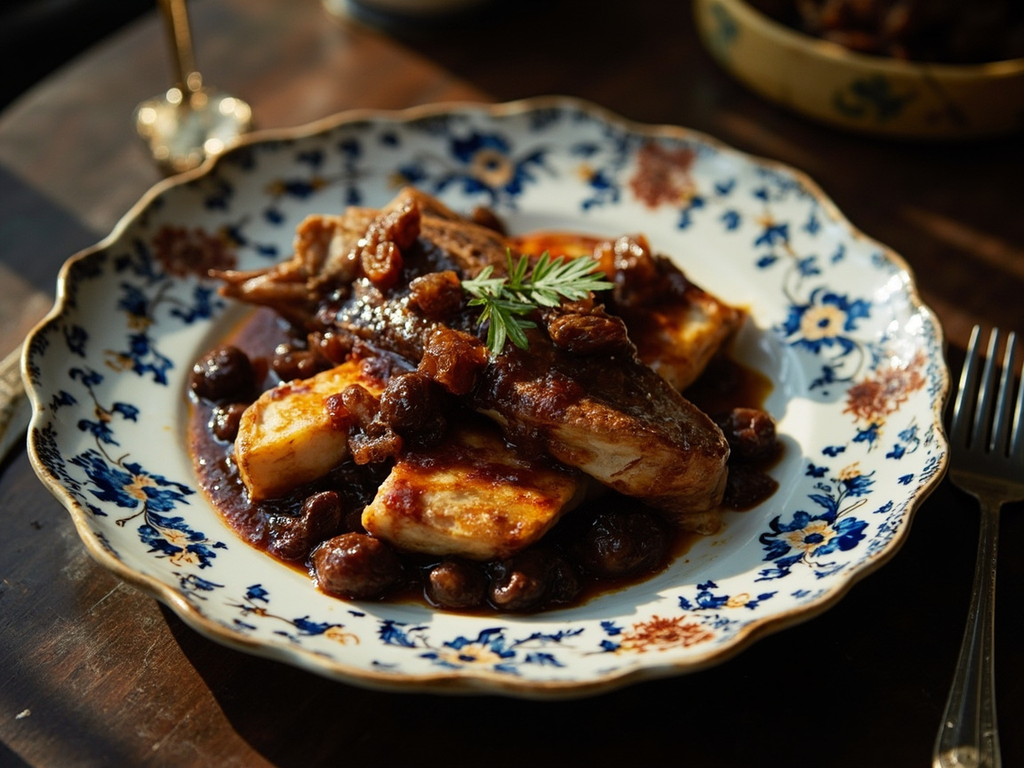
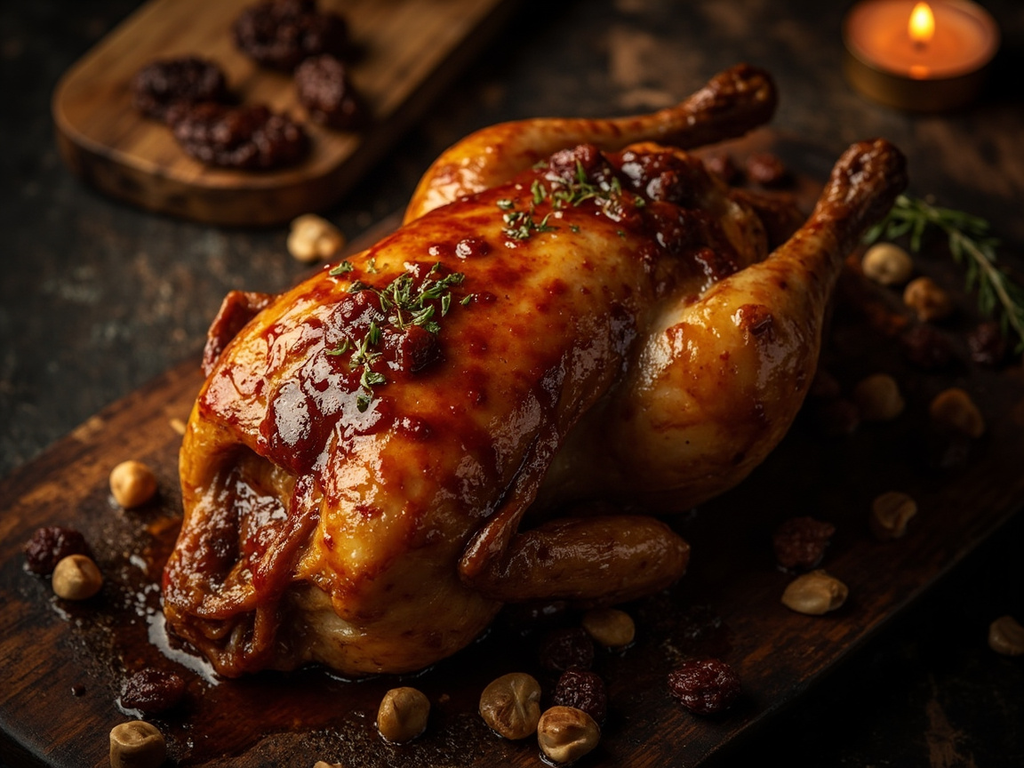
A golden-roasted capon, coated in a Baroque sauce where *agresto* (sour green grape juice) meets honey, raisins, and pine nuts. The sweet-and-sour par excellence: brilliant, contrasting, worthy of a cardinal's table.
When a patron invited me to his table to discuss a commission, they did not serve the poor man's *minestra*: they presented the capon, golden like the gold of my backgrounds. The sauce, you see, I want it like my painting — a held combat between two forces: the sour of the *agresto* that bites, and the sweet of the honey that soothes, neither one victorious. I would throw in the pine nuts and the Corinth raisins, and let it reduce until the sauce coated the spoon and gleamed by candlelight. Serve it over the still-steaming flesh, and let your guests know that a woman can command in the kitchen as at the brush.
- •Capon (or good free-range chicken) — one, whole (centerpiece)
- •Agresto (green grape juice) or verjuice — a glass (acidity)
- •Honey — two spoonfuls (sweetness)
- •Raisins (Corinth) — a handful (sweetness and chew)
- •Pine nuts — a handful (roundness, crunch)
- •Cinnamon and clove — a pinch (court spices)
- •Lard or olive oil — as needed (roasting)
- •Salt — to taste (seasoning)
Roast Capon with Agresto Sweet-and-Sour Sauce
A golden-roasted capon, coated in a Baroque sauce where *agresto* (sour green grape juice) meets honey, raisins, and pine nuts. The sweet-and-sour par excellence: brilliant, contrasting, worthy of a cardinal's table.
Why this dish? Admitted to the Academy of Drawing in Florence and courted by patrons — the Medici, later the London court — Artemisia knew the tables where poultry and court sauces were served. Meat was the affair of the *giorni grassi* (fat days) of her card: a commission meal, a contract to sign.
When a patron invited me to his table to discuss a commission, they did not serve the poor man's *minestra*: they presented the capon, golden like the gold of my backgrounds. The sauce, you see, I want it like my painting — a held combat between two forces: the sour of the *agresto* that bites, and the sweet of the honey that soothes, neither one victorious. I would throw in the pine nuts and the Corinth raisins, and let it reduce until the sauce coated the spoon and gleamed by candlelight. Serve it over the still-steaming flesh, and let your guests know that a woman can command in the kitchen as at the brush.
Ingredients (period version)
- Capon (or good free-range chicken) — one, whole (centerpiece)
- Agresto (green grape juice) or verjuice — a glass (acidity)
- Honey — two spoonfuls (sweetness)
- Raisins (Corinth) — a handful (sweetness and chew)
- Pine nuts — a handful (roundness, crunch)
- Cinnamon and clove — a pinch (court spices)
- Lard or olive oil — as needed (roasting)
- Salt — to taste (seasoning)
Ingredients
- Capon or large free-range chicken — 1 (about 2.5 kg) (centerpiece)
- Verjuice (or white grape juice + 1 tbsp wine vinegar) — 150 ml (acidity)
- Honey — 2 tbsp (sweetness)
- Raisins — 50 g (sweetness and chew)
- Pine nuts — 40 g (roundness, crunch)
- Cinnamon — 1/2 tsp (court spice)
- Ground clove — 1 pinch (court spice)
- Olive oil — 3 tbsp (roasting)
- Salt — to taste (seasoning)
Method
- Salt the capon inside and out, brush with oil, and roast in a 180°C oven for 1.5 to 2 hours depending on weight, basting with its juices.
- Meanwhile, soak the raisins in a little warm water.
- In a small saucepan, combine the verjuice, honey, drained raisins, cinnamon, and clove; reduce by half over low heat.
- Toast the pine nuts in a dry pan, then add them to the sauce.
- Taste and adjust the sweet-sour balance: more verjuice if too sweet, a little honey if too sharp.
- Carve the capon, coat with the boiling sauce, and serve immediately.
How it was made : Renaissance and Baroque cookbooks (Scappi, 1570) are full of sweet-and-sour sauces for poultry, based on *agresto* or verjuice, sugar or honey, spiced with dried fruits and nuts. The tomato, then an ornamental plant from the New World, never appeared on these tables: acidity came from green grapes and vinegar.
The contemporary twist : Present the bird on a dark board, mirror sauce poured at the last moment, a few golden pine nuts placed by hand: a Baroque still life on the plate.
Sources : Bartolomeo Scappi, Opera dell'arte del cucinare, Venice, 1570
Artemisia Gentileschi · Charactorium