 flip
flipRuwan tsamiya da zuma — Guinea sorrel infusion with honey, for welcome
Ruwan tsamiya da zuma — Guinea sorrel infusion with honey, for welcome
Why this dish? In the source, the kola nut (goro) is the ritual object offered during ceremonies. Inspired by this court hospitality, this red drink of Guinea sorrel and honey accompanied the kola extended to the guest: a gesture of welcome worthy of Bakwa's throne.
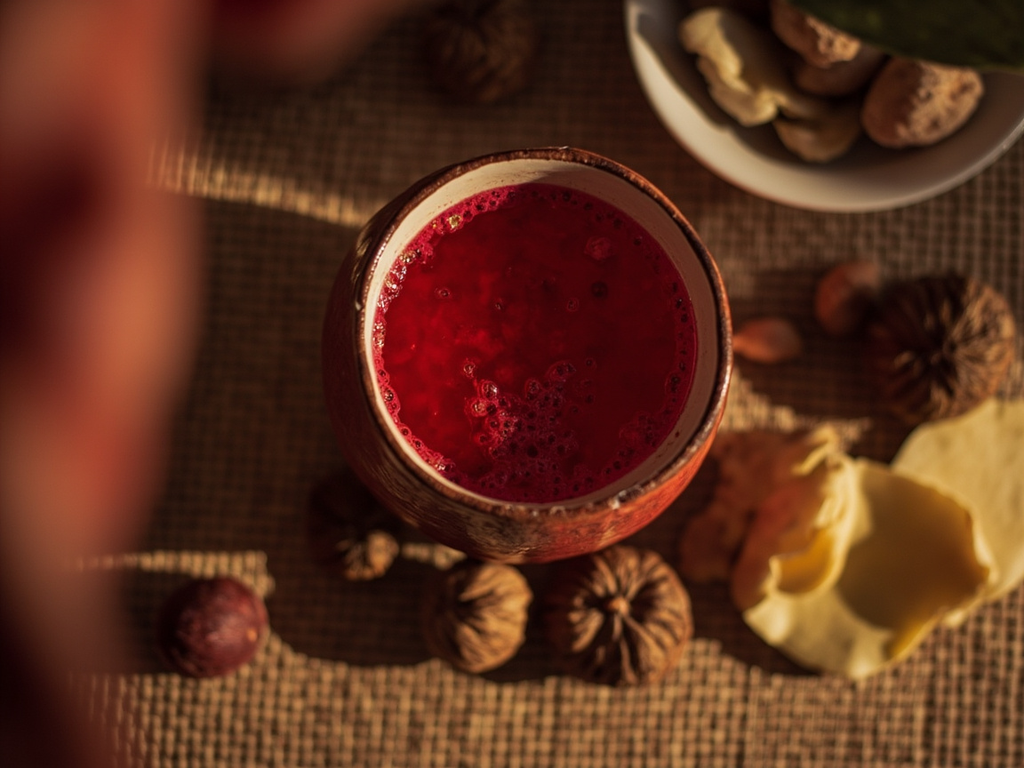
A deep red infusion of Guinea sorrel flowers (bissap), tangy and sweetened with honey, perfumed with ginger. Served cool as a sign of welcome, alongside shared kola.
When a stranger crosses the gate of Zaria, we do not leave him standing like a beggar. We offer him the kola — you take a piece, you chew it, it is the sign that peace is between us — and we pour this red water of sorrel, sweet with wild honey and lively as the morning. Drink, guest: as long as the calabash passes from hand to hand, no blood shall be shed under my roof. Such is the law of hospitality, older than my walls.
- •Dried Guinea sorrel flowers (tsamiya / bissap) — two handfuls (tangy red infusion)
- •Wild honey — to taste (sweetness)
- •Fresh ginger — a piece (flavoring)
- •Kola nuts (goro) — to offer, not infused (ritual welcome offering)
Ruwan tsamiya da zuma — Guinea sorrel infusion with honey, for welcome
A deep red infusion of Guinea sorrel flowers (bissap), tangy and sweetened with honey, perfumed with ginger. Served cool as a sign of welcome, alongside shared kola.
Why this dish? In the source, the kola nut (goro) is the ritual object offered during ceremonies. Inspired by this court hospitality, this red drink of Guinea sorrel and honey accompanied the kola extended to the guest: a gesture of welcome worthy of Bakwa's throne.
When a stranger crosses the gate of Zaria, we do not leave him standing like a beggar. We offer him the kola — you take a piece, you chew it, it is the sign that peace is between us — and we pour this red water of sorrel, sweet with wild honey and lively as the morning. Drink, guest: as long as the calabash passes from hand to hand, no blood shall be shed under my roof. Such is the law of hospitality, older than my walls.
Ingredients (period version)
- Dried Guinea sorrel flowers (tsamiya / bissap) — two handfuls (tangy red infusion)
- Wild honey — to taste (sweetness)
- Fresh ginger — a piece (flavoring)
- Kola nuts (goro) — to offer, not infused (ritual welcome offering)
Ingredients
- Dried hibiscus / Guinea sorrel flowers — 30 g (tangy red infusion)
- Honey — 3 to 4 tbsp (sweetness)
- Fresh ginger — 1 piece, 3 cm (flavoring)
- Water — 1.5 L (infusion)
- Kola nuts (optional, to present) — a few (welcome gesture)
Method
- Bring the water to a simmer with sliced ginger.
- Off the heat, add the sorrel flowers and steep for 15 to 20 minutes until a deep red color.
- Strain, then sweeten with honey while the infusion is still warm to dissolve well.
- Let cool and serve chilled in a calabash or pitcher.
- Present a few whole kola nuts alongside as a welcome gesture (to offer, not to cook).
How it was made : Guinea sorrel (Hibiscus sabdariffa) is an ancient African plant, whose calyces and leaves were used in drinks and soups long before any American influence. Kola, a sacred stimulant of West African trade, sealed pacts and welcomes; it was offered whole, not cooked. Wild honey was the only source of concentrated sweetness.
The contemporary twist : Serve over ice in a translucent glass to reveal the ruby color of the infusion, with a thin slice of ginger suspended: a 'court bissap' as beautiful as it is refreshing.
Bakwa Turunku · Charactorium