 flip
flipForban's Salmagundi (Salmagundi)
Forban's Salmagundi (Salmagundi)
Why this dish? Salmagundi is THE dish associated with Caribbean pirates: a great hodgepodge of everything a good prize could yield—meats, fish, eggs, pickled vegetables, anchovies, all drowned in oil and vinegar. For Teach's men, the day they captured a ship loaded with fresh provisions, they threw everything into one dish: it was a feast after weeks of weevily biscuit.
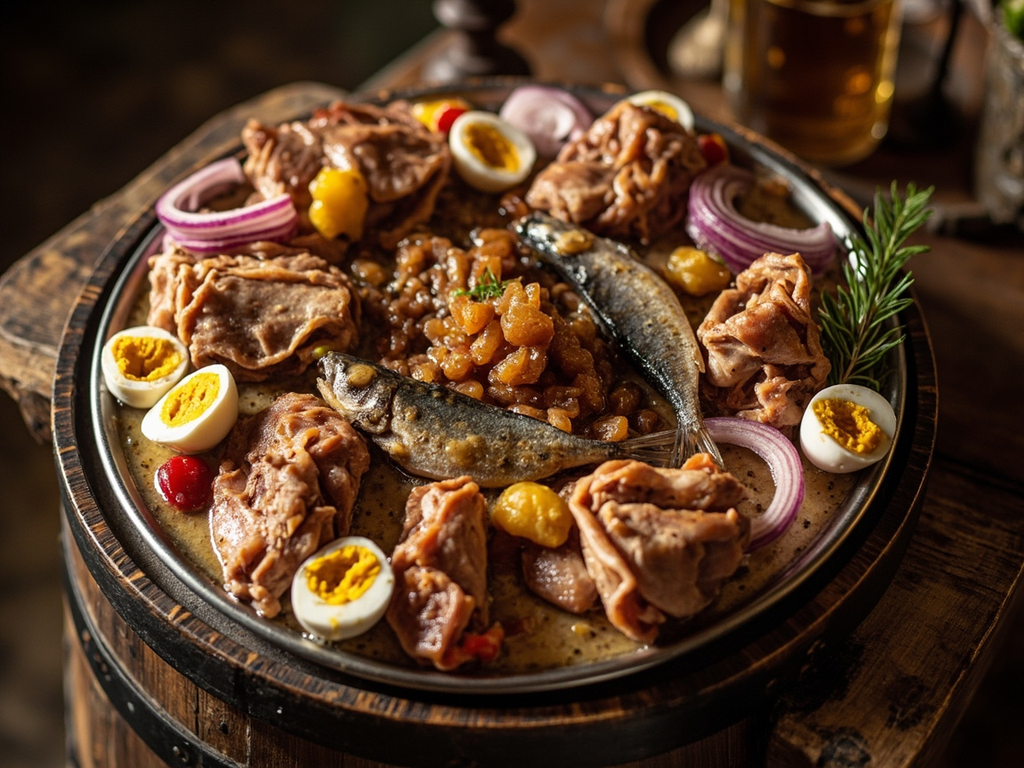
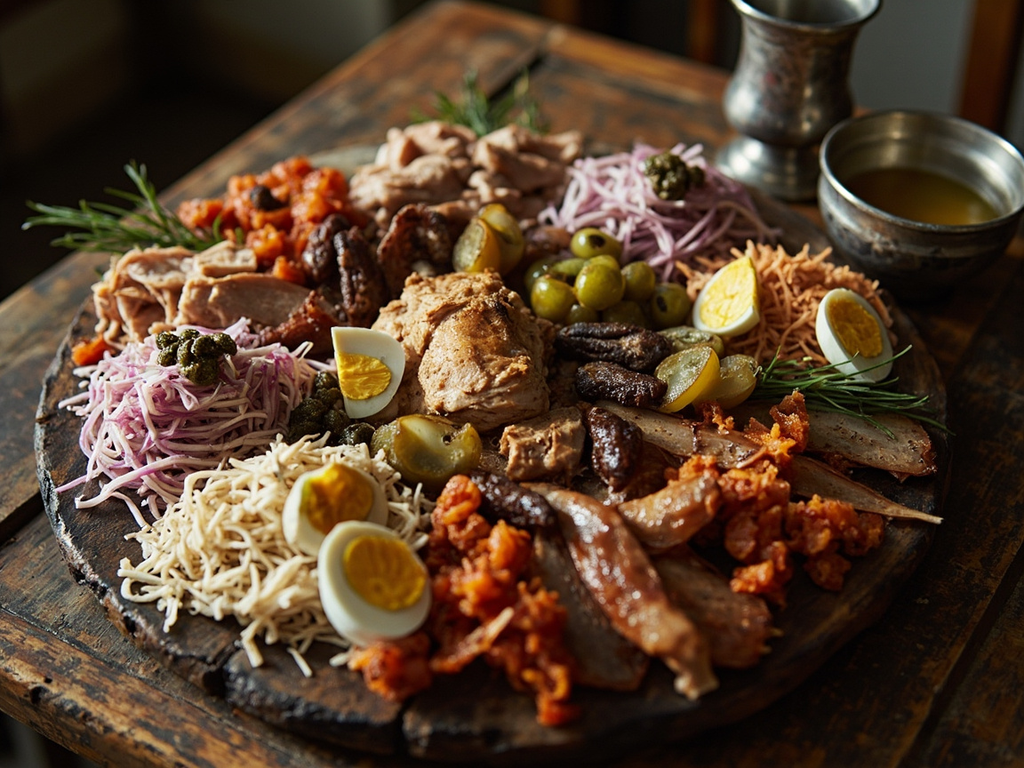
A huge, colorful composed salad: pieces of roasted or salted meats and fish, hard-boiled eggs, onions, pickled fruits, herbs, all dressed with a bold vinaigrette of oil, vinegar, and spices. You used whatever you had—hence the name, which became synonymous with a joyful mishmash.
Listen up, mate: when we hooked a fat merchantman and found her holds full, we didn't fuss with manners. We chopped up everything edible—chicken, herring, hard egg, onion, caper—and into the great dish it went, drowned in oil and good vinegar. After six weeks gnawing on weevily biscuit, a man's got the right to fill his belly to the brim. Eat, and drink your rum: tomorrow we set sail again, and God knows what'll be in our mess bowl.
- •Roasted or salted meats (chicken, salt beef) — whatever's at hand (protein base)
- •Fish or smoked herring — a few pieces (sea umami)
- •Salted anchovies — a handful (salty accent)
- •Hard-boiled eggs — several (garnish)
- •Onions and capers — to taste (bite)
- •Pickled fruits or vegetables — according to prize (acidity)
- •Olive oil and vinegar — generous (binding)
- •Jamaica pepper, salt — pinches (seasoning)
Forban's Salmagundi (Salmagundi)
A huge, colorful composed salad: pieces of roasted or salted meats and fish, hard-boiled eggs, onions, pickled fruits, herbs, all dressed with a bold vinaigrette of oil, vinegar, and spices. You used whatever you had—hence the name, which became synonymous with a joyful mishmash.
Why this dish? Salmagundi is THE dish associated with Caribbean pirates: a great hodgepodge of everything a good prize could yield—meats, fish, eggs, pickled vegetables, anchovies, all drowned in oil and vinegar. For Teach's men, the day they captured a ship loaded with fresh provisions, they threw everything into one dish: it was a feast after weeks of weevily biscuit.
Listen up, mate: when we hooked a fat merchantman and found her holds full, we didn't fuss with manners. We chopped up everything edible—chicken, herring, hard egg, onion, caper—and into the great dish it went, drowned in oil and good vinegar. After six weeks gnawing on weevily biscuit, a man's got the right to fill his belly to the brim. Eat, and drink your rum: tomorrow we set sail again, and God knows what'll be in our mess bowl.
Ingredients (period version)
- Roasted or salted meats (chicken, salt beef) — whatever's at hand (protein base)
- Fish or smoked herring — a few pieces (sea umami)
- Salted anchovies — a handful (salty accent)
- Hard-boiled eggs — several (garnish)
- Onions and capers — to taste (bite)
- Pickled fruits or vegetables — according to prize (acidity)
- Olive oil and vinegar — generous (binding)
- Jamaica pepper, salt — pinches (seasoning)
Ingredients
- Roasted chicken breast — 2 (protein base)
- Smoked herring or mackerel fillets — 150 g (sea umami)
- Anchovy fillets in oil — 6 (salty accent)
- Hard-boiled eggs — 4 (garnish)
- Red onion, thinly sliced — 1 (bite)
- Capers and gherkins — 2 tbsp each (acidity)
- Pickled apples or grapes / candied lemon — 1 handful (sweet-sour contrast)
- Olive oil — 5 tbsp (binding)
- Wine vinegar — 3 tbsp (acidity)
- Ground allspice, salt — 1 pinch each (seasoning)
Method
- Shred the roasted chicken and flake the smoked fish.
- Peel and quarter the hard-boiled eggs.
- Thinly slice the red onion; drain capers, gherkins, and pickled fruits.
- On a large platter, arrange meats, fish, eggs, and vegetables in colorful layers.
- Whisk oil, vinegar, allspice, and salt, then drizzle over everything.
- Scatter anchovies on top and serve immediately, to share at the center of the table.
How it was made : Salmagundi appears in several English cookbooks and accounts from the early 18th century (sometimes spelled "Salmagundy"). Onboard, it was never codified: it was the way to turn fresh plunder from a prize into a single hearty dish, at a time when sea food was grim. Legend later tied it to pirates.
The contemporary twist : Served on a large wooden board as a "sharing platter," each ingredient in distinct mounds like a marine tapas board—a nod to the black flag: call it "Jolly Roger's Jumble."
Blackbeard · Charactorium