 flip
flipIyan and Egusi Stew (Pounded Yam, Pumpkin Seed Soup)
Iyan and Egusi Stew (Pounded Yam, Pumpkin Seed Soup)
Why this dish? Okri readily says his food blends "the flavors of West Africa, like yam-based dishes." Iyan, pounded yam pounded to a paste, is THE staple dish of Nigerian childhood in Minna and Lagos: the repetitive motion of the pestle, the shared bowl, the green egusi soup. It is the ordinary daily table, the one that nourishes before the Booker Prizes.
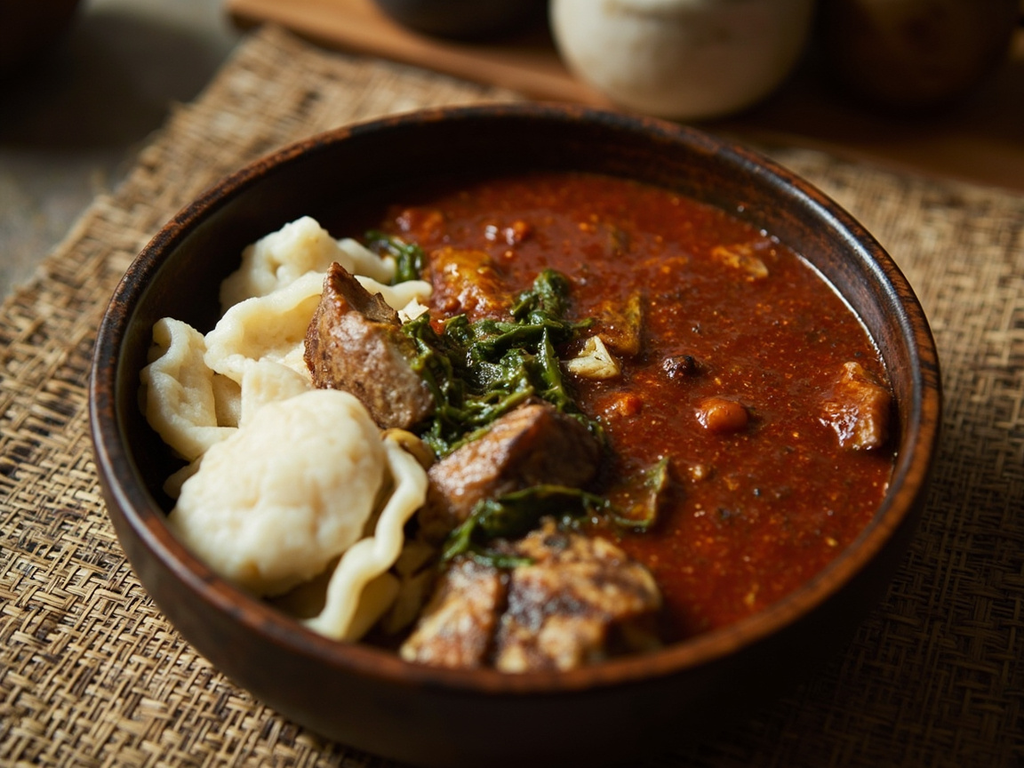
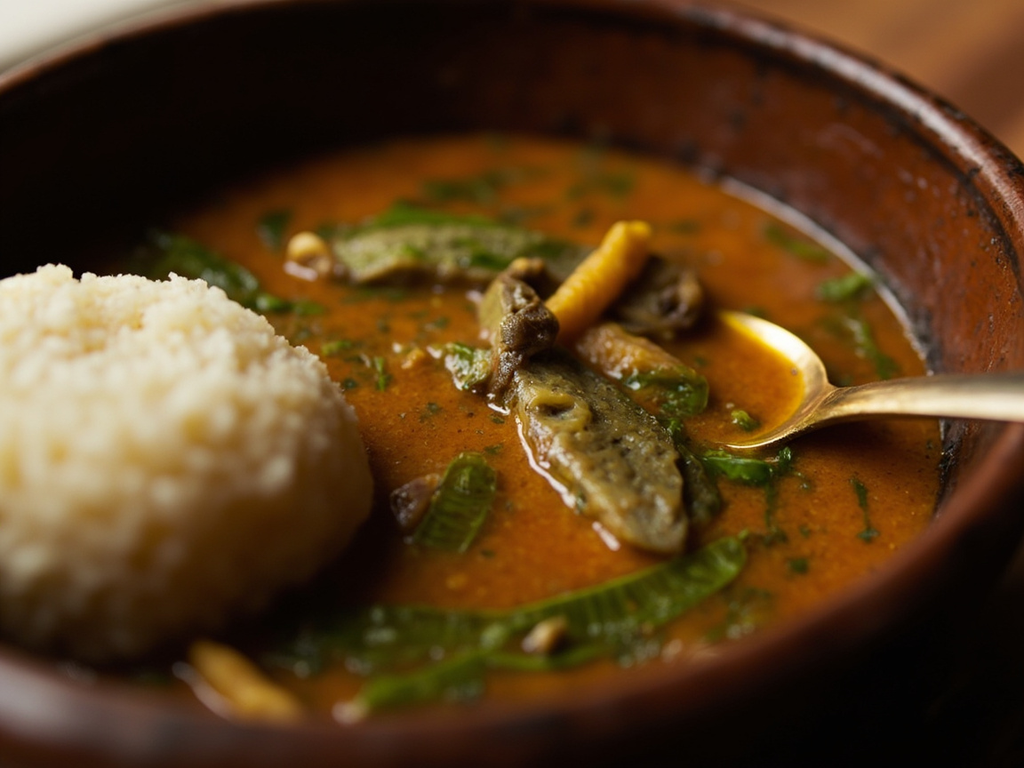
A white yam paste, smooth and elastic, rolled into a bite and dipped into a thick soup of ground pumpkin seeds, simmered in palm oil with green leaves. The staple is soft and neutral; the soup is round, fatty, and spicy.
Listen: among us, yam is not just a tuber, it is a presence. As a child in Minna, I watched women lift the pestle in a rhythm that made the courtyard vibrate, and the paste turned white like a blank page. You do not cut iyan with a knife—you pinch it between three fingers, hollow it, plunge it into the green egusi soup until it soaks. Eat with the right hand, slowly: a meal, like a story, cannot be rushed. The palm oil gives it its twilight color, and suddenly you understand that the road of hunger first passes through a shared table.
- •White yam — one large tuber (starchy base)
- •Ground pumpkin seeds (egusi) — two generous handfuls (thickener and body of the soup)
- •Red palm oil — a few ladles (fat and color)
- •Bitter green leaves (ugu / local spinach) — one bunch (greens)
- •Dried shrimp and smoked fish — a handful (smoky umami)
- •Fresh chili, onion, salt, fermented locust beans (iru/ogiri) — to taste (seasoning)
Iyan and Egusi Stew (Pounded Yam, Pumpkin Seed Soup)
A white yam paste, smooth and elastic, rolled into a bite and dipped into a thick soup of ground pumpkin seeds, simmered in palm oil with green leaves. The staple is soft and neutral; the soup is round, fatty, and spicy.
Why this dish? Okri readily says his food blends "the flavors of West Africa, like yam-based dishes." Iyan, pounded yam pounded to a paste, is THE staple dish of Nigerian childhood in Minna and Lagos: the repetitive motion of the pestle, the shared bowl, the green egusi soup. It is the ordinary daily table, the one that nourishes before the Booker Prizes.
Listen: among us, yam is not just a tuber, it is a presence. As a child in Minna, I watched women lift the pestle in a rhythm that made the courtyard vibrate, and the paste turned white like a blank page. You do not cut iyan with a knife—you pinch it between three fingers, hollow it, plunge it into the green egusi soup until it soaks. Eat with the right hand, slowly: a meal, like a story, cannot be rushed. The palm oil gives it its twilight color, and suddenly you understand that the road of hunger first passes through a shared table.
Ingredients (period version)
- White yam — one large tuber (starchy base)
- Ground pumpkin seeds (egusi) — two generous handfuls (thickener and body of the soup)
- Red palm oil — a few ladles (fat and color)
- Bitter green leaves (ugu / local spinach) — one bunch (greens)
- Dried shrimp and smoked fish — a handful (smoky umami)
- Fresh chili, onion, salt, fermented locust beans (iru/ogiri) — to taste (seasoning)
Ingredients
- White yam (or instant yam flour 'poundo') — 800 g (staple)
- Ground egusi seeds (African grocery) — 200 g (thickener)
- Red palm oil — 60 ml (fat and color)
- Spinach or ugu leaves — 200 g (greens)
- Ground dried shrimp — 2 tbsp (umami)
- Flaked smoked fish — 150 g (smoky umami)
- Onion, 1 scotch bonnet chili, 1 stock cube, salt — to taste (seasoning)
Method
- Peel the yam, cut into large chunks, and boil for 20–25 minutes until very tender.
- For the traditional staple: pound the hot yam in a mortar until smooth and elastic (or mash very finely, or use 'poundo' yam flour according to package instructions).
- For the soup: heat the palm oil, sauté the onion, add dried shrimp, smoked fish, and a little water.
- Mix the ground egusi with a little water to form a paste, drop it by spoonfuls into the sauce, and let it set without stirring too much for 10 minutes (the egusi should form soft lumps).
- Add the chili, stock cube, salt, then stir in the green leaves; simmer for 5 minutes.
- Serve the iyan staple alongside the egusi soup, and eat by pinching pieces of the staple to dip.
How it was made : Back then, no instant flour: the boiled yam was pounded by two people in a large wooden mortar, a rhythmic motion that could last a quarter of an hour. The egusi (seeds of a gourd grown for its seeds, not its flesh) was dried, shelled, and ground on a stone. Fermented locust beans (iru, ogiri) provided umami depth before the arrival of industrial stock cubes.
The contemporary twist : Serve the egusi soup in a small steaming bowl and the yam base shaped into a neat quenelle: a 'gastro' nod to an everyday dish.
Ben Okri · Charactorium