 flip
flipCabbage pirog — large Sunday puff pastry pie
Cabbage pirog — large Sunday puff pastry pie
Why this dish? Meals at the Peredelkino dacha were "convivial but without luxury": for guests and holidays, a large *pirog* was brought out, this Russian pie shared by hand around the table. Pasternak entertained poet friends and neighbors there; the *pirog*, meant to be broken together, is the dish of Russian hospitality.
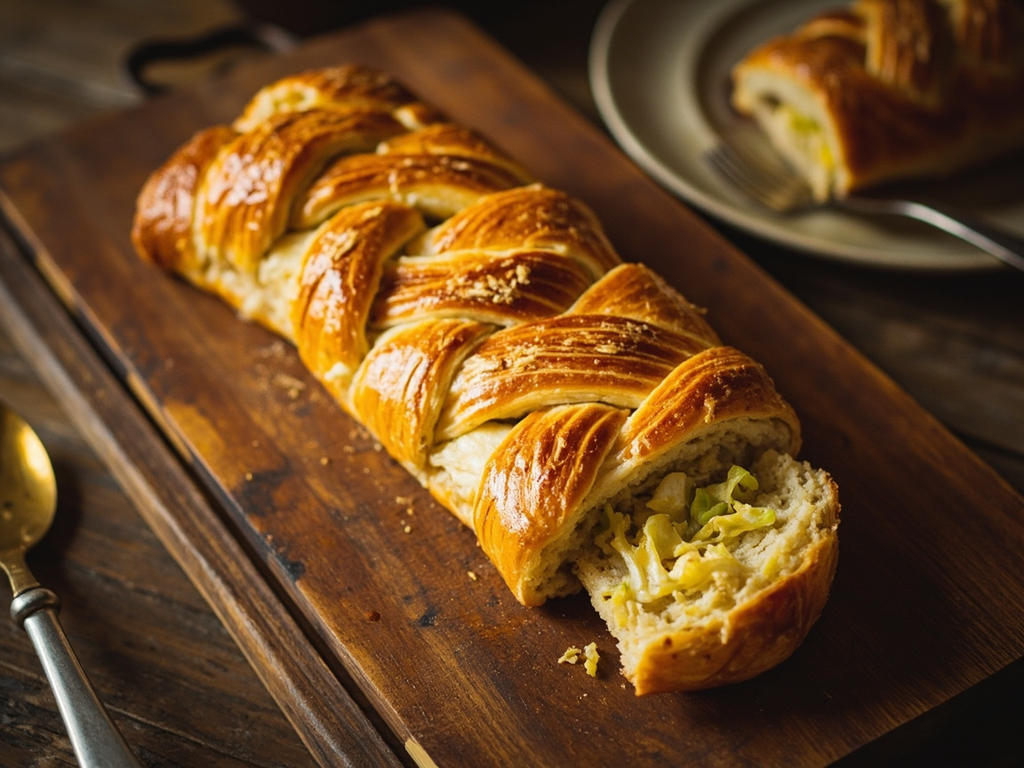
A large rectangular yeast-dough pie filled with cabbage melted golden in butter and hard-boiled eggs. It is cut into generous pieces, golden crust on top, soft filling inside.
When we expected company at Peredelkino, the house smelled of rising dough from morning on. The pirog, you don't cut it like a city cake: you set it in the middle, hot, and each person tears off a piece, like passing a conversation around. The cabbage must melt long in butter until it becomes almost sweet, almost tender like a confession. Believe me, a shared pie is worth all the official banquets I've been subjected to.
- •Wheat flour — a lot (yeast dough)
- •Sourdough or yeast — a little (leavening)
- •Milk, butter, egg — according to dough (richness of dough)
- •Fresh cabbage — one head (filling)
- •Hard-boiled eggs — three or four (filling)
- •Butter — generously (to melt the cabbage)
- •Dill, salt, pepper — to taste (seasoning)
Cabbage pirog — large Sunday puff pastry pie
A large rectangular yeast-dough pie filled with cabbage melted golden in butter and hard-boiled eggs. It is cut into generous pieces, golden crust on top, soft filling inside.
Why this dish? Meals at the Peredelkino dacha were "convivial but without luxury": for guests and holidays, a large *pirog* was brought out, this Russian pie shared by hand around the table. Pasternak entertained poet friends and neighbors there; the *pirog*, meant to be broken together, is the dish of Russian hospitality.
When we expected company at Peredelkino, the house smelled of rising dough from morning on. The pirog, you don't cut it like a city cake: you set it in the middle, hot, and each person tears off a piece, like passing a conversation around. The cabbage must melt long in butter until it becomes almost sweet, almost tender like a confession. Believe me, a shared pie is worth all the official banquets I've been subjected to.
Ingredients (period version)
- Wheat flour — a lot (yeast dough)
- Sourdough or yeast — a little (leavening)
- Milk, butter, egg — according to dough (richness of dough)
- Fresh cabbage — one head (filling)
- Hard-boiled eggs — three or four (filling)
- Butter — generously (to melt the cabbage)
- Dill, salt, pepper — to taste (seasoning)
Ingredients
- All-purpose flour — 500 g (yeast dough)
- Active dry yeast — 7 g (leavening)
- Warm milk — 250 ml (dough)
- Butter — 80 g (dough) + 60 g (cabbage) (richness and cooking)
- Egg — 1 (dough) + 1 yolk for glazing (binder and glaze)
- Green cabbage — 700 g shredded (filling)
- Hard-boiled eggs — 3 (filling)
- Dill, salt, pepper — to taste (seasoning)
Method
- Dissolve the yeast in warm milk; knead with flour, egg, melted butter and a pinch of salt into a supple dough. Let it double in size for 1 h 30 min.
- Melt the shredded cabbage in butter over low heat for 30 min, until tender and lightly golden; season with salt, pepper, add the chopped hard-boiled eggs and dill. Let cool.
- Roll out two-thirds of the dough on a baking sheet, spread the filling, cover with the remaining dough and seal the edges by pinching.
- Brush with egg yolk, make two steam vents, let rest 20 min.
- Bake at 190°C for 35-40 min until deep golden. Serve warm, cut into large slices.
How it was made : The *pirog* (from *пир*, "feast") was baked in the Russian oven and its filling changed according to season and budget: cabbage and eggs on ordinary days, fish (kulebyaka) or meat on special occasions. Its elongated shape allowed it to be shared by hand, without utensils — a gesture of hospitality par excellence.
The contemporary twist : Braid a strip of dough on top for a "bound manuscript" effect, a nod to Doctor Zhivago's notebook.
Sources : V. Pokhlebkin, *Национальные кухни наших народов* · Elena Molokhovets, *Подарок молодым хозяйкам*, 1861
Boris Pasternak · Charactorium