 flip
flipBuckwheat blinis with herring and smetana
Buckwheat blinis with herring and smetana
Why this dish? Coming from a bourgeois Moscow family, Elsa grew up with blinis, the emblematic dish of Russian celebrations and Maslenitsa week. As a novelist in Paris, she perpetuated these zakouski at receptions shared with Aragon and the literary world, where the Russian table amazed and delighted French guests.
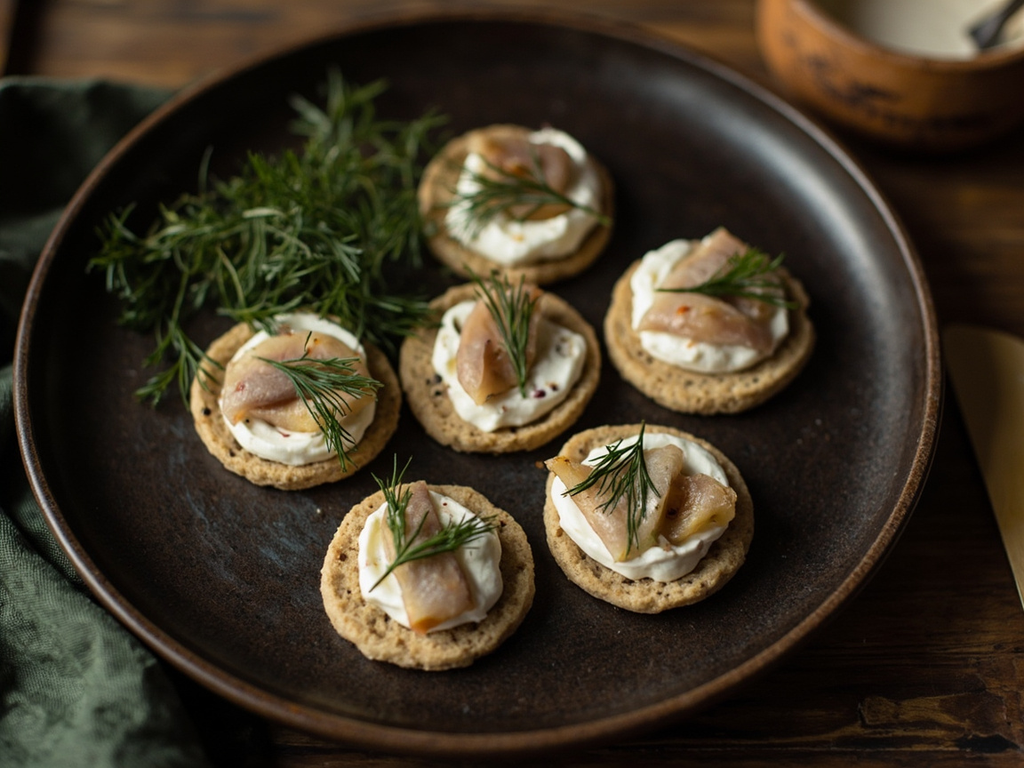
Small thick, fluffy pancakes made with buckwheat flour, leavened with yeast, golden-brown from the pan and served warm, crowned with a ribbon of smetana, a sliver of pickled herring, and a sprig of dill. They are placed in the center of the table to share.
At home in Moscow, the blini was not a crêpe you fold absentmindedly: it was a ceremony, round and golden like a little sun you ate to chase away winter. I made sure the buckwheat batter rested and swelled under a cloth, for a hurried batter makes a sad blini, and I never tolerated a sad blini at my table. We topped it with sour cream, a bit of herring, a touch of dill—and we drank something stronger than water with it, believe me. In Paris, my French friends laughed to see me so serious over my frying pan, but they always asked for more.
- •Buckwheat flour — two good handfuls (rustic base, nutty flavor typical of Russia)
- •Wheat flour — one handful (softens the batter)
- •Baker's yeast — a piece the size of a hazelnut (leavens the batter)
- •Milk — a large bowl (liquid for the batter)
- •Eggs — two (binder and fluffiness)
- •Smetana (sour cream) — to taste (signature topping)
- •Pickled herring — a few fillets (savory zakouska)
- •Fresh dill — a small bunch (herbaceous flavor)
Buckwheat blinis with herring and smetana
Small thick, fluffy pancakes made with buckwheat flour, leavened with yeast, golden-brown from the pan and served warm, crowned with a ribbon of smetana, a sliver of pickled herring, and a sprig of dill. They are placed in the center of the table to share.
Why this dish? Coming from a bourgeois Moscow family, Elsa grew up with blinis, the emblematic dish of Russian celebrations and Maslenitsa week. As a novelist in Paris, she perpetuated these zakouski at receptions shared with Aragon and the literary world, where the Russian table amazed and delighted French guests.
At home in Moscow, the blini was not a crêpe you fold absentmindedly: it was a ceremony, round and golden like a little sun you ate to chase away winter. I made sure the buckwheat batter rested and swelled under a cloth, for a hurried batter makes a sad blini, and I never tolerated a sad blini at my table. We topped it with sour cream, a bit of herring, a touch of dill—and we drank something stronger than water with it, believe me. In Paris, my French friends laughed to see me so serious over my frying pan, but they always asked for more.
Ingredients (period version)
- Buckwheat flour — two good handfuls (rustic base, nutty flavor typical of Russia)
- Wheat flour — one handful (softens the batter)
- Baker's yeast — a piece the size of a hazelnut (leavens the batter)
- Milk — a large bowl (liquid for the batter)
- Eggs — two (binder and fluffiness)
- Smetana (sour cream) — to taste (signature topping)
- Pickled herring — a few fillets (savory zakouska)
- Fresh dill — a small bunch (herbaceous flavor)
Ingredients
- Buckwheat flour — 100 g (base, nutty flavor)
- All-purpose wheat flour (T55) — 100 g (flexibility)
- Fresh baker's yeast — 10 g (or 4 g dry) (leavens the batter)
- Warm milk — 30 cl (liquid)
- Eggs — 2 (yolks + separately beaten whites) (airy fluffiness)
- Salt — 1 pinch (seasoning)
- Thick crème fraîche or sour cream — 20 cl (signature topping)
- Mild smoked or pickled herring fillets — 150 g (savory topping)
- Fresh dill — 1 bunch (flavor)
- Butter — for the pan (cooking)
Method
- Dissolve the yeast in warm milk, add both flours and salt, whisk into a smooth batter, cover with a cloth and let rise for 1 hour 30 minutes in a warm place until the batter doubles and bubbles.
- Fold in the egg yolks, then gently fold in the stiffly beaten egg whites to keep the batter airy.
- Cook small thick pancakes (8-10 cm) in a well-buttered hot pan, 1 to 2 minutes per side, until golden and fluffy.
- Serve warm, stacked under a cloth; top each with a spoonful of sour cream, a piece of herring, and a sprig of dill.
- Place in the center of the table with other zakouski, to share.
How it was made : The yeast-leavened buckwheat blini is the ancient and noble form of the dish, predating industrial crêpes. In Russia, dozens were devoured during Maslenitsa, the butter week before Lent, accompanied by herring, fish roe, or simply melted butter. Smetana, a fermented cream more acidic and thicker than French crème fraîche, was essential.
The contemporary twist : Arrange the blinis as small bites on a wooden board with a trio of toppings (herring, smetana-dill, and a touch of grated beet) for a very photogenic 'Russian hour' aperitif.
Sources : Elena Molokhovets, A Gift to Young Housewives (Подарок молодым хозяйкам), 1861, reference collection of Russian domestic cuisine · Lesley Chamberlain, The Food and Cooking of Russia, 1982
Elsa Triolet · Charactorium