 flip
flipTea-marbled eggs (chá yè dàn)
Tea-marbled eggs (chá yè dàn)
Why this dish? The tea egg is the quintessential portable snack of 20th-century China: sold in markets, simmering in a fragrant pot, taken on trips or between classes. For the always-busy student and later physicist Wu — from Nanjing to Berkeley — it is the nomadic food that fits in one hand.
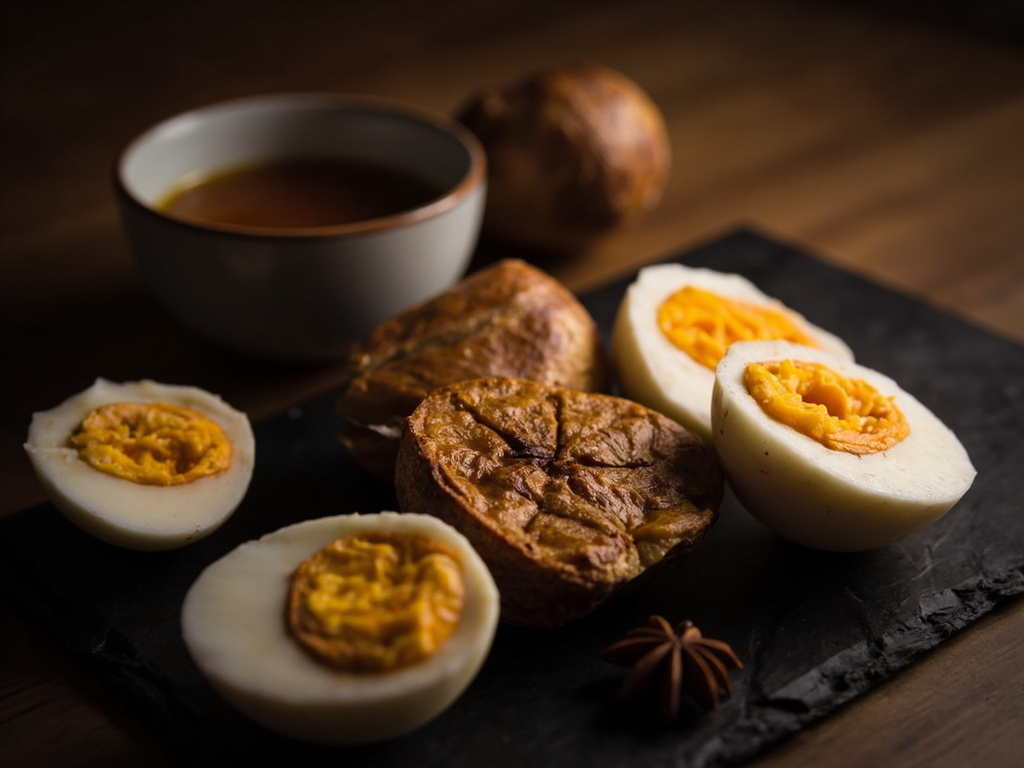
Hard-boiled eggs, cracked, then re-simmered in a broth of black tea, soy sauce, and spices, which etches a fine brown marbling on the white. Fragrant, savory, ready to go.
Quand on court d'un laboratoire à l'autre, on apprend à emporter son repas dans sa poche : voici l'œuf au thé. Le geste qui compte, c'est de fêler délicatement la coquille après cuisson — sans la retirer — pour que le thé et la sauce dessinent ces fines veines brunes ; le motif naît tout seul, comme les figures que trace une particule. Je les laissais mijoter le soir et les emportais au matin, encore tièdes. Croyez-moi, rien ne soutient mieux une longue journée de mesures.
- •Chicken eggs — half a dozen (base)
- •Strong black tea — a good pinch (color, aroma, marbling)
- •Soy sauce — a little (saltiness and tint)
- •Star anise, cinnamon, ginger — a few pieces (spices)
- •Salt — to taste (seasoning)
Tea-marbled eggs (chá yè dàn)
Hard-boiled eggs, cracked, then re-simmered in a broth of black tea, soy sauce, and spices, which etches a fine brown marbling on the white. Fragrant, savory, ready to go.
Why this dish? The tea egg is the quintessential portable snack of 20th-century China: sold in markets, simmering in a fragrant pot, taken on trips or between classes. For the always-busy student and later physicist Wu — from Nanjing to Berkeley — it is the nomadic food that fits in one hand.
Quand on court d'un laboratoire à l'autre, on apprend à emporter son repas dans sa poche : voici l'œuf au thé. Le geste qui compte, c'est de fêler délicatement la coquille après cuisson — sans la retirer — pour que le thé et la sauce dessinent ces fines veines brunes ; le motif naît tout seul, comme les figures que trace une particule. Je les laissais mijoter le soir et les emportais au matin, encore tièdes. Croyez-moi, rien ne soutient mieux une longue journée de mesures.
Ingredients (period version)
- Chicken eggs — half a dozen (base)
- Strong black tea — a good pinch (color, aroma, marbling)
- Soy sauce — a little (saltiness and tint)
- Star anise, cinnamon, ginger — a few pieces (spices)
- Salt — to taste (seasoning)
Ingredients
- Eggs — 6 (base)
- Loose black tea (or 3 tea bags) — 2 tbsp (marbling and aroma)
- Soy sauce — 4 tbsp (saltiness and color)
- Star anise — 2 stars (spice)
- Cinnamon stick — 1 (spice)
- Ginger — 3 slices (spice)
- Salt — 1 tsp (seasoning)
- Water — 750 ml (broth)
Method
- Hard-boil the eggs (8-9 min), then cool them under cold water.
- Gently tap each shell with the back of a spoon to crack it all over without removing it.
- Prepare the broth: water, tea, soy sauce, star anise, cinnamon, ginger, and salt; bring to a simmer.
- Add the cracked eggs and let them simmer, covered, over low heat for 30 minutes.
- Turn off the heat and let them steep for at least 2 hours (ideally overnight in the fridge) to intensify the marbling and flavor.
- Peel just before eating to reveal the brown veins.
How it was made : In Chinese markets, tea eggs simmered constantly in large metal pots, sold warm by the piece. The technique of cracking the shell, attested for a long time, transforms a simple hard-boiled egg into something both tasty and beautifully veined.
The contemporary twist : Slice them in half and line them up on a slate: the marbling evokes the field lines of a magnet — parity violation to bite into.
Chien-Shiung Wu · Charactorium