 flip
flipJì shí: Steamed Millet and Mallow Soup
Jì shí: Steamed Millet and Mallow Soup
Why this dish? Millet (稷) was the sovereign grain of northern China and mallow (葵) the 'queen of vegetables' in antiquity. This is the simple everyday fare that Confucius praised: 'eating coarse grain, drinking water, with a bent arm for a pillow—joy is also to be found therein' (Analects, VII). The daily life of a scholar of the state of Lu.
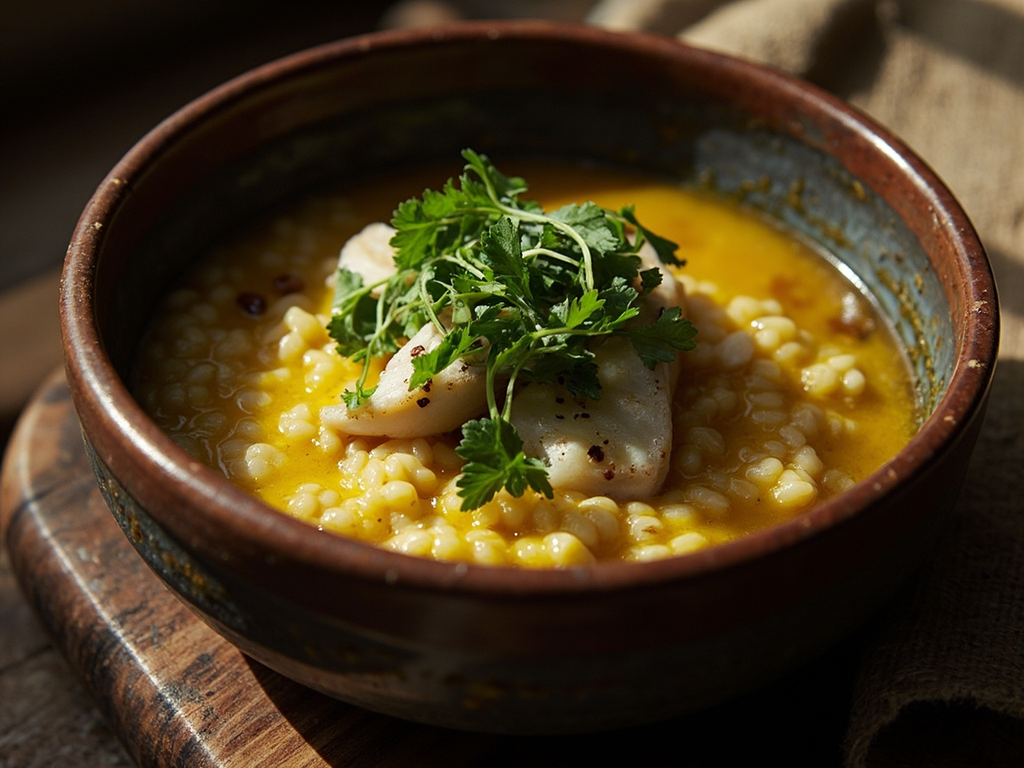
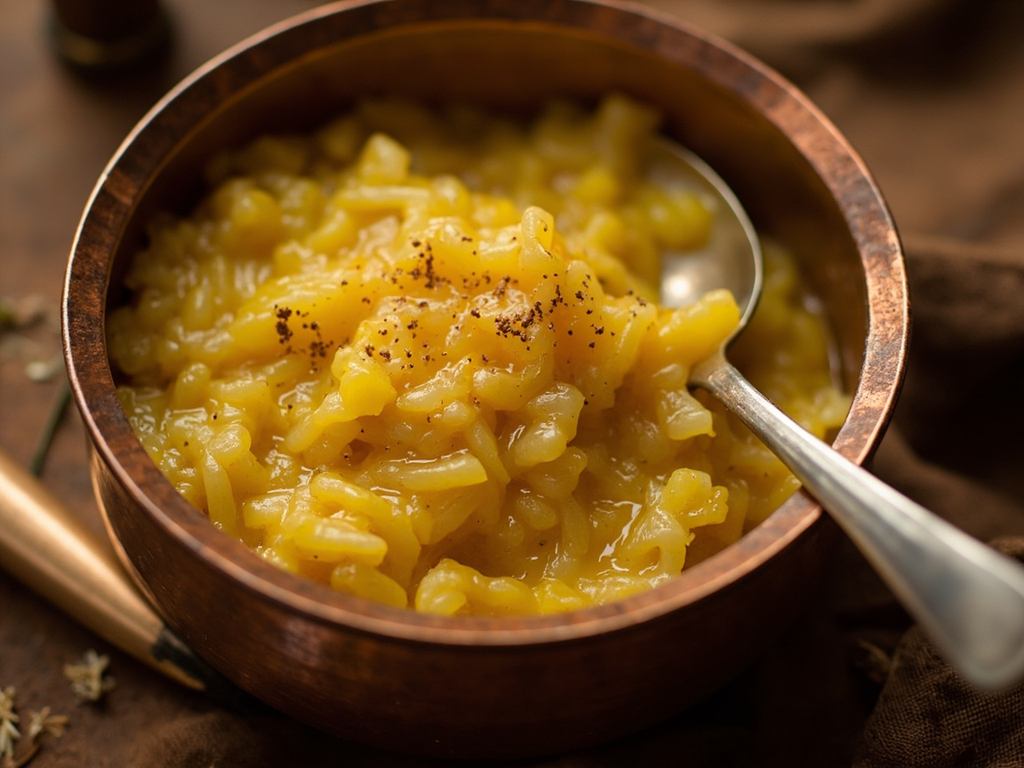
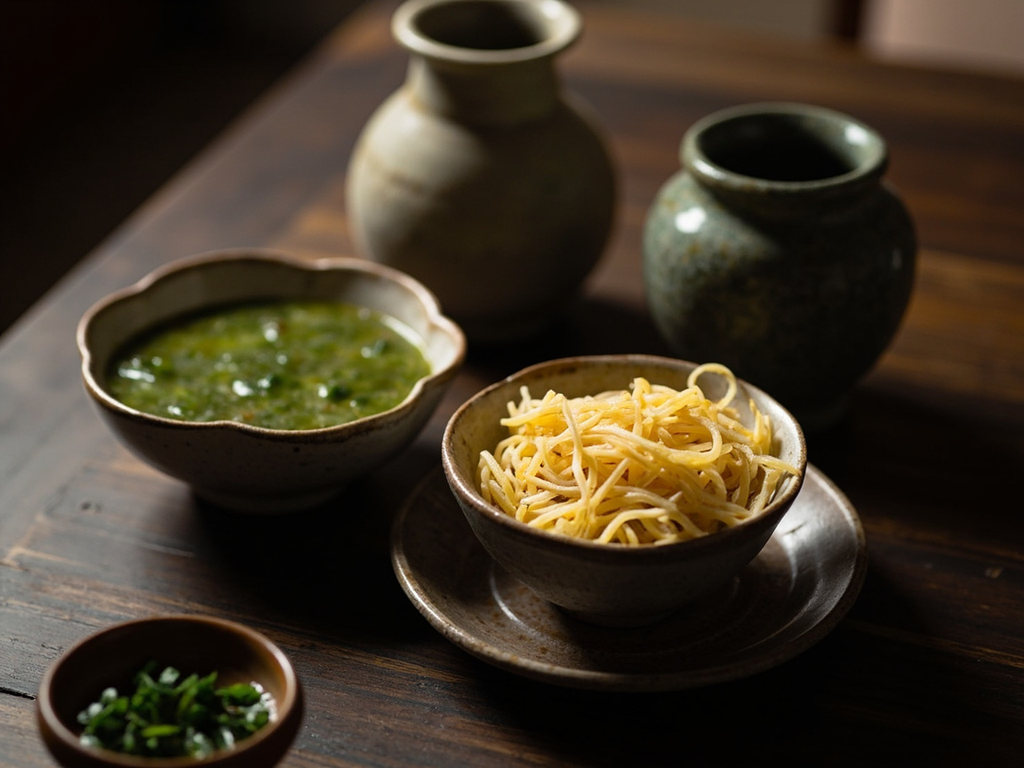
A bowl of yellow millet steamed until fluffy, set beside a thick soup of mallow leaves thickened with millet, scented with scallion and ginger. The grain is the heart of the meal; the soup, its faithful companion.
Learn this first: the whitest rice never tires me, nor the most finely sliced meat. But when the grain is honest and the soup hot, the heart of the gentleman is content. I want my millet cooked just right—neither hard nor spoiled—and my vegetables taken in their season, never out of it. Eat with measure, sit straight on your mat, and let ginger never leave your table: thus the spirit remains clear.
- •Field millet (稷, panic or common millet) — one bowl per guest (base grain, the fàn)
- •Mallow leaves (葵) — one armful (soup vegetable)
- •Chinese scallion — a few stalks (aromatic)
- •Fresh ginger (薑) — one finger (aromatic, never absent from his table)
- •Salt — a pinch (seasoning)
Jì shí: Steamed Millet and Mallow Soup
A bowl of yellow millet steamed until fluffy, set beside a thick soup of mallow leaves thickened with millet, scented with scallion and ginger. The grain is the heart of the meal; the soup, its faithful companion.
Why this dish? Millet (稷) was the sovereign grain of northern China and mallow (葵) the 'queen of vegetables' in antiquity. This is the simple everyday fare that Confucius praised: 'eating coarse grain, drinking water, with a bent arm for a pillow—joy is also to be found therein' (Analects, VII). The daily life of a scholar of the state of Lu.
Learn this first: the whitest rice never tires me, nor the most finely sliced meat. But when the grain is honest and the soup hot, the heart of the gentleman is content. I want my millet cooked just right—neither hard nor spoiled—and my vegetables taken in their season, never out of it. Eat with measure, sit straight on your mat, and let ginger never leave your table: thus the spirit remains clear.
Ingredients (period version)
- Field millet (稷, panic or common millet) — one bowl per guest (base grain, the fàn)
- Mallow leaves (葵) — one armful (soup vegetable)
- Chinese scallion — a few stalks (aromatic)
- Fresh ginger (薑) — one finger (aromatic, never absent from his table)
- Salt — a pinch (seasoning)
Ingredients
- Hulled millet — 200 g (base grain)
- Mallow leaves, or substitute spinach / chard / amaranth greens — 300 g (soup vegetable)
- Spring onion (scallion) — 2 stalks, sliced (aromatic)
- Fresh ginger — 1 piece (3 cm), grated (aromatic)
- Water — 700 ml (soup base)
- Salt — 1 tsp (seasoning)
Method
- Rinse the millet, cover with water, and let soak for 20 minutes.
- Steam the millet (in a basket or steamer over a pot) for 25 to 30 minutes, until tender and fluffy; keep warm.
- Bring 700 ml of water to a simmer with the grated ginger and a little salt.
- Add the washed and roughly chopped mallow leaves, cook for 5 minutes until wilted.
- Thicken the soup by stirring in 2 tablespoons of cooked millet, mashed; sprinkle with scallion.
- Serve the bowl of millet and the soup side by side: alternate a bite of grain with a spoonful of soup.
How it was made : Under the Zhou, grains were steamed (technique of the 甑 zèng, a clay steamer) rather than boiled as today. Mallow, grown in every garden, remained the most consumed green vegetable in China until cabbage (白菜) supplanted it many centuries later. The soup 羹 was often thickened with a little grain.
The contemporary twist : Press the millet into a small bowl and invert onto the plate to form a dome, then pour the green soup around it: a yin-yang of golden grain and tender leaf.
Sources : Entretiens de Confucius (Lunyu), books VII and X 'Xiang Dang' · K. C. Chang (ed.), Food in Chinese Culture: Anthropological and Historical Perspectives, Yale University Press, 1977
Confucius · Charactorium