Libum, the Cheesecake of the Household Gods
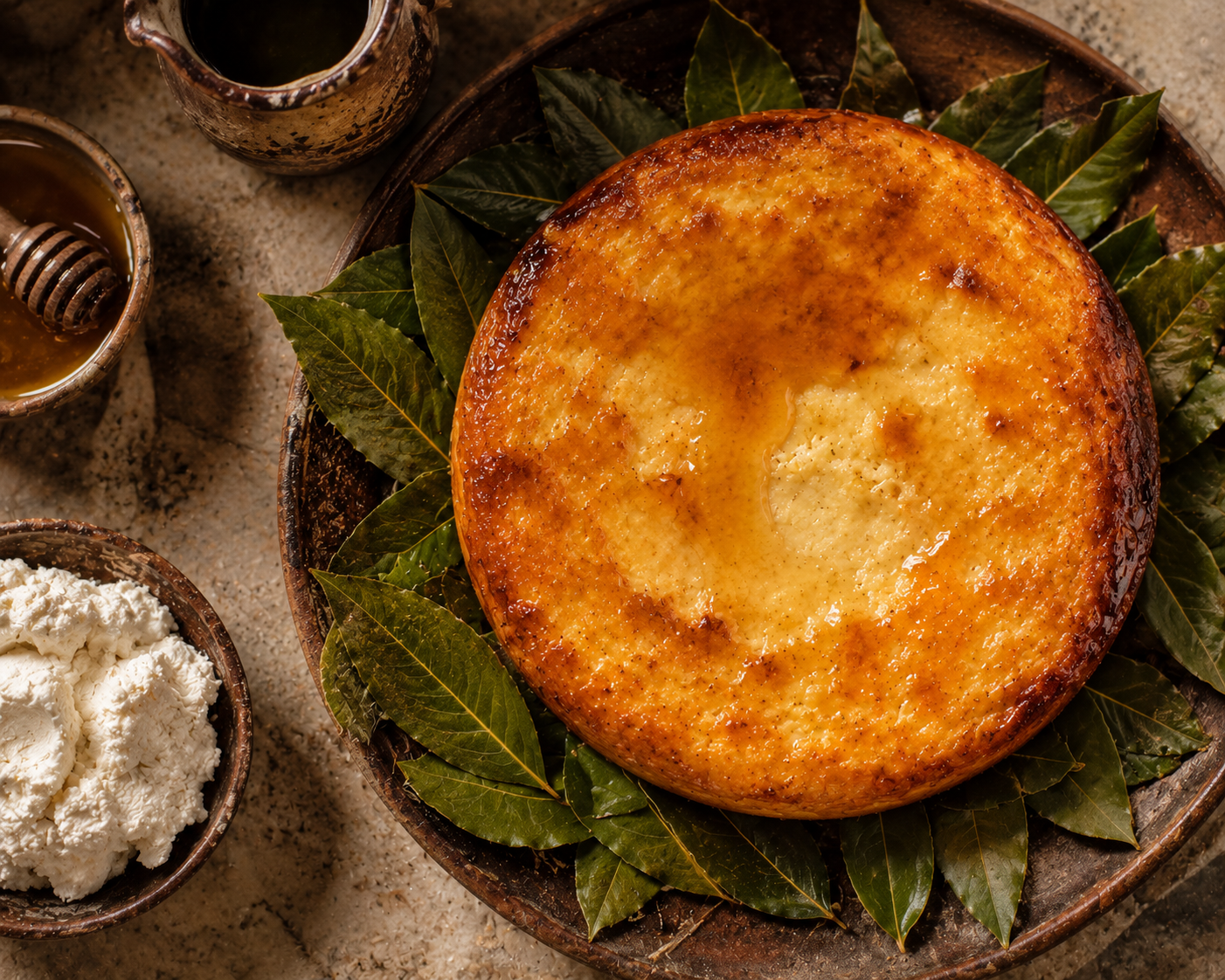
A small, soft bread-cake mixing fresh cheese, flour, and egg, baked on bay leaves and drizzled with warm honey. Tender and fragrant, it was offered to the household gods before being shared.
A small, soft bread-cake mixing fresh cheese, flour, and egg, baked on bay leaves and drizzled with warm honey. Tender and fragrant, it was offered to the household gods before being shared.
Before the cross appeared to me in the sky, I knew, like every Roman, the altars of the hearth. There, one presented to the guardian gods a humble cake: cheese kneaded with flour and egg, placed on bay leaves and gently baked, then bathed in warm honey. I entrust it to you not as a rite to revive, but as a memory of the world into which I was born. Eat it, and touch the piety of my ancestors.
- •Fresh cheese — two parts (base)
- •Wheat (spelt) flour — one part (binder)
- •Egg — one (binder)
- •Bay leaves — a few (support and aroma)
- •Honey — for drizzling (sweetness)
Libum, the Cheesecake of the Household Gods
A small, soft bread-cake mixing fresh cheese, flour, and egg, baked on bay leaves and drizzled with warm honey. Tender and fragrant, it was offered to the household gods before being shared.
Why this dish? Constantine grew up in traditional Roman piety before the famous vision that turned him toward Christianity. Libum, a small cake of cheese and flour baked on bay leaves and offered to the Lares (household gods), evokes the domestic religion of his youth—the world he would transform.
Before the cross appeared to me in the sky, I knew, like every Roman, the altars of the hearth. There, one presented to the guardian gods a humble cake: cheese kneaded with flour and egg, placed on bay leaves and gently baked, then bathed in warm honey. I entrust it to you not as a rite to revive, but as a memory of the world into which I was born. Eat it, and touch the piety of my ancestors.
Ingredients (period version)
- Fresh cheese — two parts (base)
- Wheat (spelt) flour — one part (binder)
- Egg — one (binder)
- Bay leaves — a few (support and aroma)
- Honey — for drizzling (sweetness)
Ingredients
- Ricotta (or well-drained fresh cheese) — 250 g (base)
- Spelt or wheat flour — 120 g (binder)
- Egg — 1 (binder)
- Bay leaves — 6 to 8 (support and aroma)
- Honey — 4 tablespoons (glaze)
Method
- Mash the fresh cheese in a bowl until smooth.
- Incorporate the flour, then the egg, to form a soft dough.
- Shape small domes and place each on a bay leaf.
- Cover and bake at a low temperature (160°C) for about 35 to 40 minutes, until golden.
- Warm the honey and drizzle over the warm cakes before serving.
How it was made : The recipe for libum has come down to us from Cato the Elder (De agri cultura): cheese, flour, and egg, baked under a hot cover on bay leaves. It was a ritual offering to the Lares and Penates of the household, then consumed by the family. It is presented here as a historical evocation, not a reproduction of a sacred rite.
The contemporary twist : Serve warm like an ancient cheesecake, with a thread of honey and a few crushed walnuts.
Sources : Cato the Elder, De agri cultura (libum recipe)
Constantine I · Charactorium