 flip
flipMoretum, garlic, herb and cheese paste of the Megalesia
Moretum, garlic, herb and cheese paste of the Megalesia
Why this dish? During the Megalesia, the April games in honor of Cybele, Romans would host each other and exchange simple dishes; the moretum, a peasant paste of garlic and cheese ground in a mortar, was one of these popular festive foods associated with the Great Mother and her season of renewal.
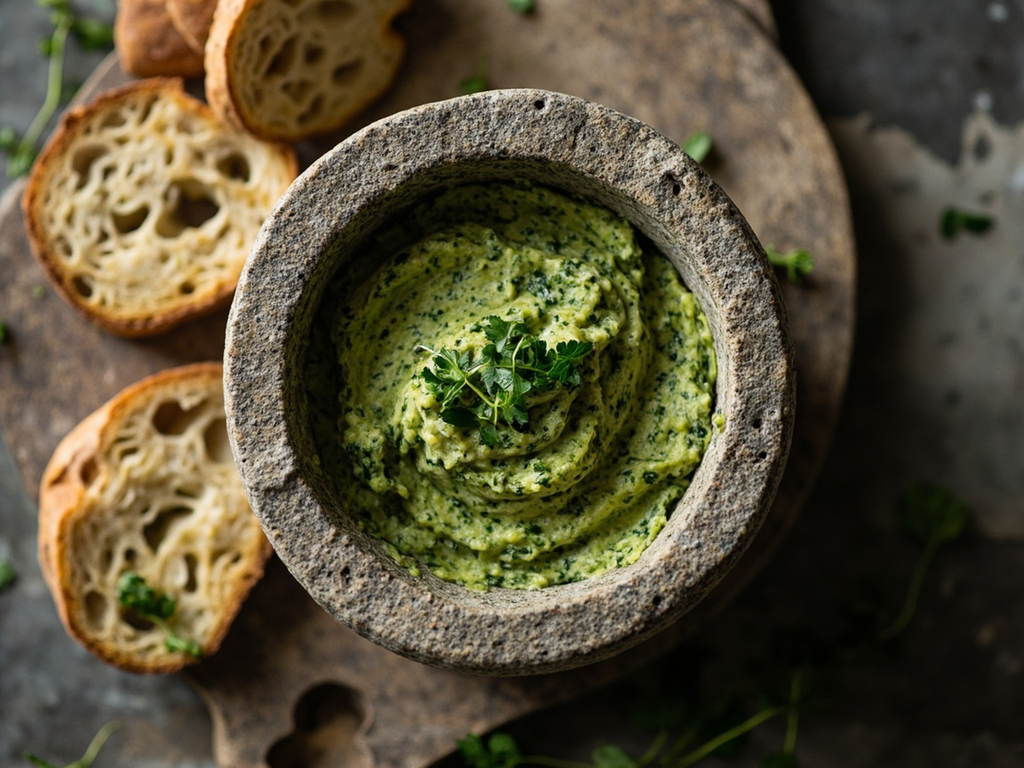
A green, pungent paste made by pounding together garlic, dry cheese, fresh herbs, salt, oil, and vinegar, to spread on warm bread. Robust, tangy, fragrant — the frank taste of the Roman countryside.
When my month of April returns and the tympanons sound on the Palatine, the humble honor me in their own way: they take a head of garlic, yesterday's cheese, garden herbs, and grind it all in the mortar until a thousand colors become one — that is the very image of my world, where everything mingles and is reborn. Add a drop of vinegar to wake the tongue, a drizzle of oil to soften. Spread on still-warm bread, and you will feast as my faithful did on the days of the Megalesia.
- •Garlic cloves — four (pungent base)
- •Dry salted cheese (pecorino) — a good piece (body and salt)
- •Fresh herbs (coriander, celery, rue as touch) — a large handful (freshness and aroma)
- •Olive oil — a drizzle (binder)
- •Vinegar — a few drops (acidity)
- •Salt — a pinch (seasoning)
Moretum, garlic, herb and cheese paste of the Megalesia
A green, pungent paste made by pounding together garlic, dry cheese, fresh herbs, salt, oil, and vinegar, to spread on warm bread. Robust, tangy, fragrant — the frank taste of the Roman countryside.
Why this dish? During the Megalesia, the April games in honor of Cybele, Romans would host each other and exchange simple dishes; the moretum, a peasant paste of garlic and cheese ground in a mortar, was one of these popular festive foods associated with the Great Mother and her season of renewal.
When my month of April returns and the tympanons sound on the Palatine, the humble honor me in their own way: they take a head of garlic, yesterday's cheese, garden herbs, and grind it all in the mortar until a thousand colors become one — that is the very image of my world, where everything mingles and is reborn. Add a drop of vinegar to wake the tongue, a drizzle of oil to soften. Spread on still-warm bread, and you will feast as my faithful did on the days of the Megalesia.
Ingredients (period version)
- Garlic cloves — four (pungent base)
- Dry salted cheese (pecorino) — a good piece (body and salt)
- Fresh herbs (coriander, celery, rue as touch) — a large handful (freshness and aroma)
- Olive oil — a drizzle (binder)
- Vinegar — a few drops (acidity)
- Salt — a pinch (seasoning)
Ingredients
- Dry pecorino — 150 g (salty body)
- Garlic — 3 to 4 cloves (pungent base)
- Coriander and celery leaves — 1 bunch (freshness)
- Olive oil — 3 tablespoons (binder)
- Wine vinegar — 1 teaspoon (acidity)
- Salt — 1 pinch (seasoning)
- Rustic bread — for serving (support)
Method
- Pound the peeled garlic with a pinch of salt in a mortar (or chop very finely).
- Add the grated cheese and crush to amalgamate.
- Incorporate the chopped herbs and continue pounding until a green, homogeneous paste forms.
- Emulsify with olive oil drizzled in, then brighten with vinegar. Taste and adjust salt.
- Spread on warm bread, or serve as a ball in the center of the table to share.
How it was made : An ancient Latin poem, the Moretum (appended to the Appendix Vergiliana), describes minute by minute a peasant grinding garlic, cheese, salt, herbs, oil, and vinegar in a mortar at dawn — hence the distant ancestor of 'pesto'. It was a commoner's food, but one willingly shared during spring festivals.
The contemporary twist : Rolled into quenelles on a slate board with spelt breadsticks, the moretum presents itself as an appetizer 'Roman pesto'.
Sources : Appendix Vergiliana, Moretum (Latin poem describing the recipe) · Ovid, Fasti, IV (Megalesia in honor of Cybele)
Cybele · Charactorium