 flip
flipGoma-dōfu — sesame “tofu” with kuzu
Goma-dōfu — sesame “tofu” with kuzu
Why this dish? Goma-dōfu originated in Zen monasteries as a refined dish offered to visitors and masters: neither soy tofu nor animal product, but a sesame cream bound with kuzu starch. It embodies Dōgen's ideal — drawing the greatest delicacy from almost nothing.
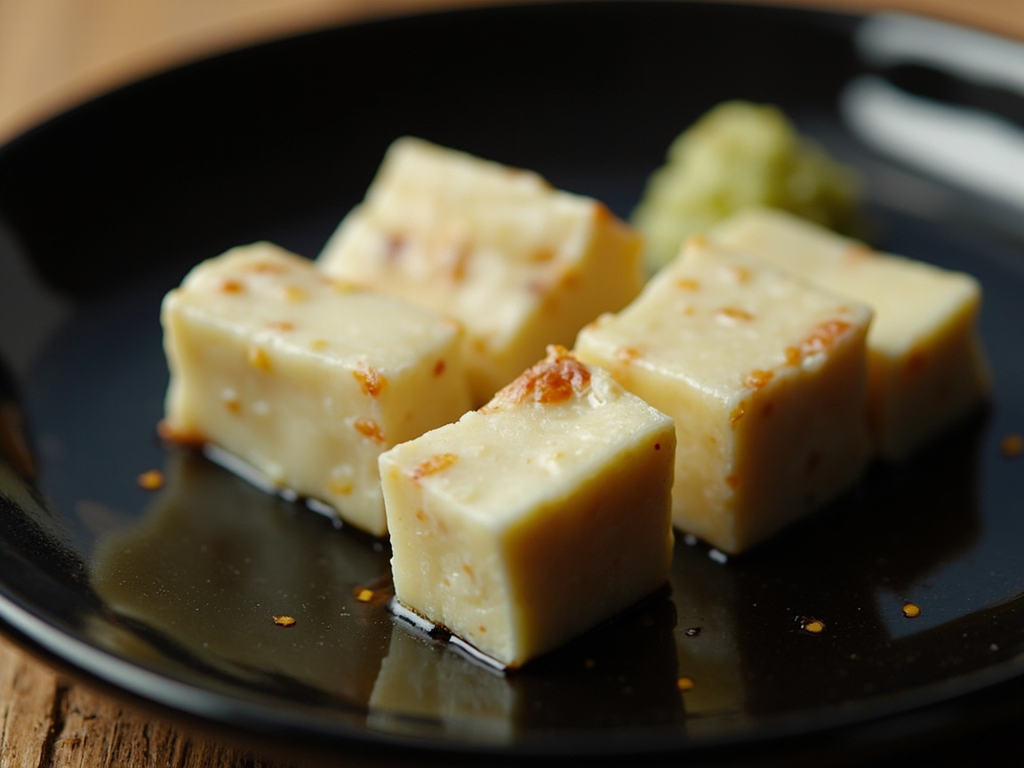
A creamy, pearly “tofu” that is not tofu: ground sesame, bound with kuzu and worked at length until it becomes a melting jelly, served with a dash of soy sauce and a hint of wasabi. The great piece of the monastic table on days of honor.
When a master came from afar crossing our threshold, I wished to offer him the best without spilling a drop of blood. So I ground the sesame until it yielded oil, married it to the kuzu from the mountain, and stirred, stirred without pause over the flame until the paste sang under the spatula. Never tire of stirring: it is in that patience that sesame becomes silk. Serve it cool, lightly seasoned — simplicity, you see, is the height of care.
- •White sesame seeds — one bowl (rich and fragrant base)
- •Kuzu starch (mountain arrowroot) — two measures (gelling binder)
- •Spring water — as needed for the binder (dilution)
- •Soy sauce (shōyu) — a drizzle (seasoning at serving)
- •Fresh grated wasabi — a dab (pungent vegetable accent)
Goma-dōfu — sesame “tofu” with kuzu
A creamy, pearly “tofu” that is not tofu: ground sesame, bound with kuzu and worked at length until it becomes a melting jelly, served with a dash of soy sauce and a hint of wasabi. The great piece of the monastic table on days of honor.
Why this dish? Goma-dōfu originated in Zen monasteries as a refined dish offered to visitors and masters: neither soy tofu nor animal product, but a sesame cream bound with kuzu starch. It embodies Dōgen's ideal — drawing the greatest delicacy from almost nothing.
When a master came from afar crossing our threshold, I wished to offer him the best without spilling a drop of blood. So I ground the sesame until it yielded oil, married it to the kuzu from the mountain, and stirred, stirred without pause over the flame until the paste sang under the spatula. Never tire of stirring: it is in that patience that sesame becomes silk. Serve it cool, lightly seasoned — simplicity, you see, is the height of care.
Ingredients (period version)
- White sesame seeds — one bowl (rich and fragrant base)
- Kuzu starch (mountain arrowroot) — two measures (gelling binder)
- Spring water — as needed for the binder (dilution)
- Soy sauce (shōyu) — a drizzle (seasoning at serving)
- Fresh grated wasabi — a dab (pungent vegetable accent)
Ingredients
- White sesame paste (light, non-bitter tahini) — 60 g (base)
- Kuzu starch (or substitute kuzu + a little starch) — 50 g (binder)
- Water — 450 ml (dilution)
- Soy sauce — for serving (seasoning)
- Wasabi — a dab (accent)
Method
- Dissolve the kuzu in cold water until completely smooth, with no lumps.
- Add the sesame paste and whisk to obtain a homogeneous liquid.
- Pour into a saucepan and heat over medium-low heat, stirring CONSTANTLY with a spatula.
- The mixture thickens, then becomes shiny and elastic: continue stirring vigorously for 10–15 minutes.
- Pour into a moistened mold, smooth the surface, let cool then set in the fridge for 2 hours.
- Unmold, cut into cubes, serve cold with a drizzle of soy sauce and a dab of wasabi.
How it was made : Without whisks or mixers, the monk cook (tenzo) ground the sesame in a suribachi mortar for long minutes, then stirred the preparation by hand over embers: a work of strength and patience considered a form of active meditation.
The contemporary twist : Plated as a pearly quenelle on a slate, topped with a gelled kombu dashi and an edible flower: goma-dōfu becomes a plant-based gastronomic amuse-bouche.
Sources : Shōjin ryōri tradition of Japanese Zen monasteries · Dōgen, Tenzo Kyōkun
Dogen · Charactorium