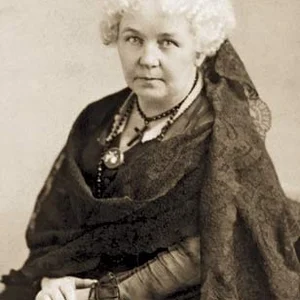

American women's rights activist (1815–1902), she co-organized the Seneca Falls Convention in 1848, the first major gathering for women's suffrage in the United States. Author of the Declaration of Sentiments, she devoted her life to the civic and political equality of women.
Frequently asked questions
Famous Quotes
« We hold these truths to be self-evident: that all men and women are created equal.»
« Woman is her own sovereign.»
Key Facts
- 1815: born in Johnstown, New York
- 1848: co-organized the Seneca Falls Convention, the first women's rights congress
- 1848: drafted the Declaration of Sentiments, modeled on the United States Declaration of Independence
- 1869: co-founded the National Woman Suffrage Association with Susan B. Anthony
- 1902: died, 18 years before the ratification of the 19th Amendment granting women the right to vote
Works & Achievements
The founding text of American feminism, drafted by Stanton in the mold of the Declaration of Independence. It listed 18 grievances against male domination and was the first official document to demand women's right to vote.
A monumental work co-written with Susan B. Anthony and Matilda Joslyn Gage, tracing the history of the American suffrage movement from its origins. A major historical source for understanding the beginnings of American feminism.
A speech delivered before the U.S. Congress and the NAWSA, considered Stanton's rhetorical masterpiece. In it, she argues that every individual — man or woman — must be equipped to face life's trials alone.
A critical commentary on biblical passages relating to women, showing that Scripture had been used to justify their subordination. The work scandalized religious circles and moderate suffragists alike.
Stanton's autobiography, written at age 83, tracing her life from childhood to old age. An invaluable document on the condition of women in the nineteenth century and on the inner workings of the suffrage movement.
Anecdotes
At the Seneca Falls Convention in 1848, Elizabeth Cady Stanton proposed a resolution demanding the right to vote for women — an idea so radical that her own husband, Henry Stanton, left town to avoid being associated with it. Only the abolitionist Frederick Douglass publicly supported her, helping the resolution pass by a narrow margin.
Mother of seven children, Stanton ran a full household while drafting speeches and petitions. She herself recounted how she would work through her arguments while kneading bread or watching the children, turning domestic chores into intellectual working time.
Well into her seventies, Stanton undertook a feminist rewriting of the Bible. Her work *The Woman's Bible* (1895) scandalized even her suffragist allies, who passed an official motion to distance themselves from it — she stood by it without flinching, refusing to sacrifice her convictions for political strategy.
In 1840, at the World Anti-Slavery Convention in London, Stanton and Lucretia Mott were barred from sitting as delegates on the grounds that they were women. Relegated to a screened-off gallery, they decided that day to organize a convention devoted entirely to women's rights — which led, eight years later, to Seneca Falls.
Elizabeth Cady Stanton never got to vote in her lifetime: she died in 1902, eighteen years before the 19th Amendment granted suffrage to American women in 1920. In her last public address, *The Solitude of Self*, she had declared with striking clarity that every human being must be sovereign over their own destiny.
Primary Sources
We hold these truths to be self-evident: that all men and women are created equal; that they are endowed by their Creator with certain inalienable rights; that among these are life, liberty, and the pursuit of happiness.
The strongest reason for giving woman all the opportunities for higher education, for the full development of her faculties, forces of mind and body... is the solitude and personal responsibility of her own individual life.
I felt as if I had been to a great feast, and had tasted of everything, and was satisfied... I had not supposed that women could accomplish so much in the face of such determined opposition.
The Bible and the Church have been the greatest stumbling blocks in the way of women's emancipation.
I am not willing to have the word 'male' inserted in the Constitution, disfranchising the women of this nation. I would rather fight another ten years than accept such a compromise.
Key Places
Elizabeth Cady Stanton's birthplace, where she grew up in the home of her father, a lawyer and judge. It was while reading the case files in his office that she first became aware of the legal inequalities facing women.
The town where the first major women's rights convention was held in July 1848, organized by Stanton and Lucretia Mott. The Wesleyan Chapel that hosted the event is today a national monument.
In 1840, Stanton attended the World Anti-Slavery Convention, where women were barred from participating in the debates. This defining humiliation convinced her to dedicate her life to women's rights.
Stanton testified before the U.S. Congress on multiple occasions to demand women's suffrage, most notably in 1869 and in 1892 with her celebrated address *The Solitude of Self*.
Stanton spent her final decades in New York, where she died on October 26, 1902. The city was also the center of her editorial and activist work throughout the 1860s and 1870s.
Typical Objects

Stanton was a tireless writer: she produced thousands of letters, speeches, articles, and petitions by hand. The Declaration of Sentiments itself was composed by hand before being read aloud in public.

The Bible was ever-present in Stanton's intellectual life — not as an object of blind devotion, but as a text to be dismantled: she annotated it for decades before publishing 'The Woman's Bible'.

Stanton and Anthony organized massive petition drives addressed to the U.S. Congress demanding the right to vote. These sheets covered in signatures were the movement's central political tool.

Stanton wore the "Bloomer costume" for a time — a more practical outfit with loose trousers, symbolizing the rejection of restrictive corsets and crinolines. She eventually abandoned it to keep attention focused on the suffragist cause.

From the 1870s onward, Stanton traveled the country as a professional lecturer, speaking from platforms in high schools, town halls, and theaters to fund her activism.

A feminist newspaper founded by Stanton and Anthony in 1868, 'The Revolution' championed women's suffrage and labor rights. Stanton was its chief editor and used its pages to develop the movement's theoretical arguments.
School Curriculum
Vocabulary & Tags
Key Vocabulary
Tags
Daily Life
Morning
Stanton rose early and devoted the first hours of the day to correspondence and writing, before the household came alive. A mother of seven, she had learned to concentrate her intellectual work in the rare quiet moments, often by oil lamp before dawn.
Afternoon
The afternoon was dominated by household management, supervising the children, and receiving visitors. But Stanton turned these moments into activist opportunities: she organized meetings at home, welcomed fellow campaigners, and sometimes dictated speeches to her older children, who served as her secretaries.
Evening
In the evenings, the family would often gather to read aloud or discuss politics. Stanton, an avid reader, immersed herself in works of law, philosophy, and theology that fueled her feminist arguments. On lecture tour evenings, she could be found addressing packed halls, sometimes well into the night.
Food
Stanton's diet was that of a middle-class American family of the nineteenth century: bread, meats, garden vegetables, and dairy products. Mindful of health and temperance, she paid attention to wholesome eating, though she was not vegetarian like some of her fellow reformers.
Clothing
Stanton wore the *Bloomer costume* for a time — a short dress over billowing trousers — as a symbol of liberation from the corset, before abandoning it for strategic reasons. She then dressed conventionally but without ostentation, favoring comfort over fashion and refusing garments too restrictive to move freely in.
Housing
Stanton lived in several middle-class homes over the course of her moves between **Seneca Falls**, **Tenafly** (New Jersey), and **New York**. Her household was lively, sometimes chaotic with seven children, but she always carved out a space for writing. In her later years she occupied a New York apartment where she received friends and fellow activists until her final days.
Historical Timeline
Period Vocabulary
Liens externes & ressources
Références
Œuvres
Déclaration des sentiments (Declaration of Sentiments)
1848
History of Woman Suffrage (tomes I à III)
1881–1886
The Solitude of Self
1892
The Woman's Bible
1895
Eighty Years and More: Reminiscences 1815–1897
1898