 flip
flipMalossol cucumbers with salt and dill
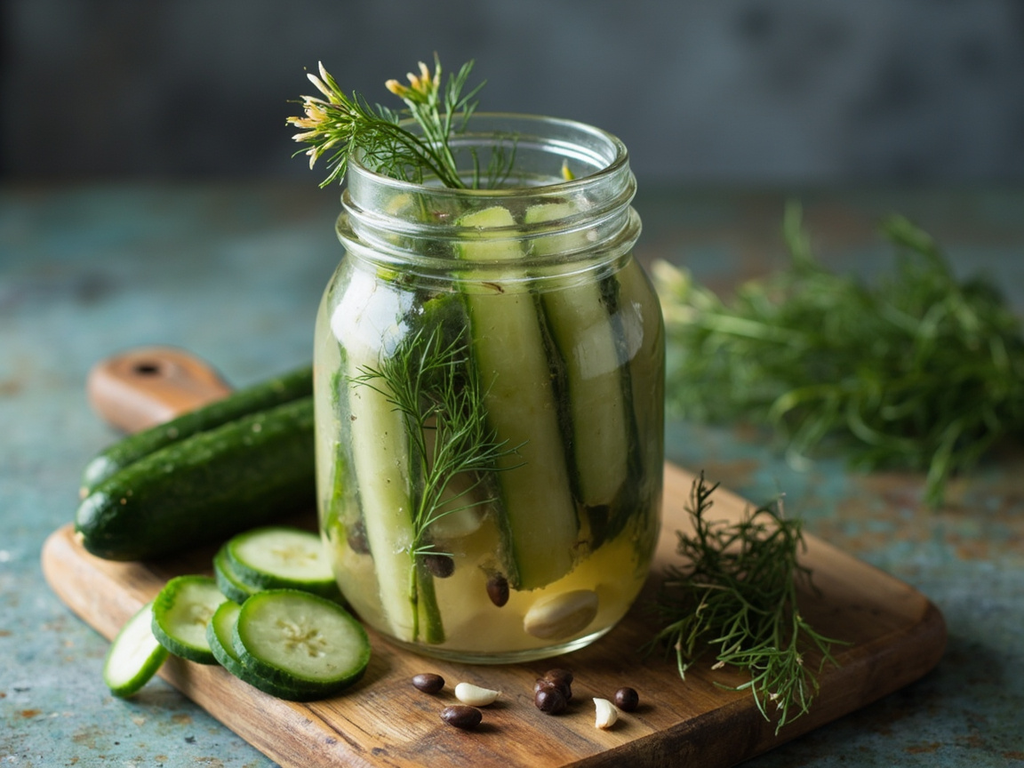
Malossol cucumbers with salt and dill
Why this dish? Russian winters, like the rationing years Elsa endured in France, required preserving summer vegetables. Malossol ('lightly salted') cucumbers, a pillar of Slavic supplies and obligatory companions to vodka and zakouski, embody the preservation know-how that a daughter of the Moscow bourgeoisie knew since childhood.
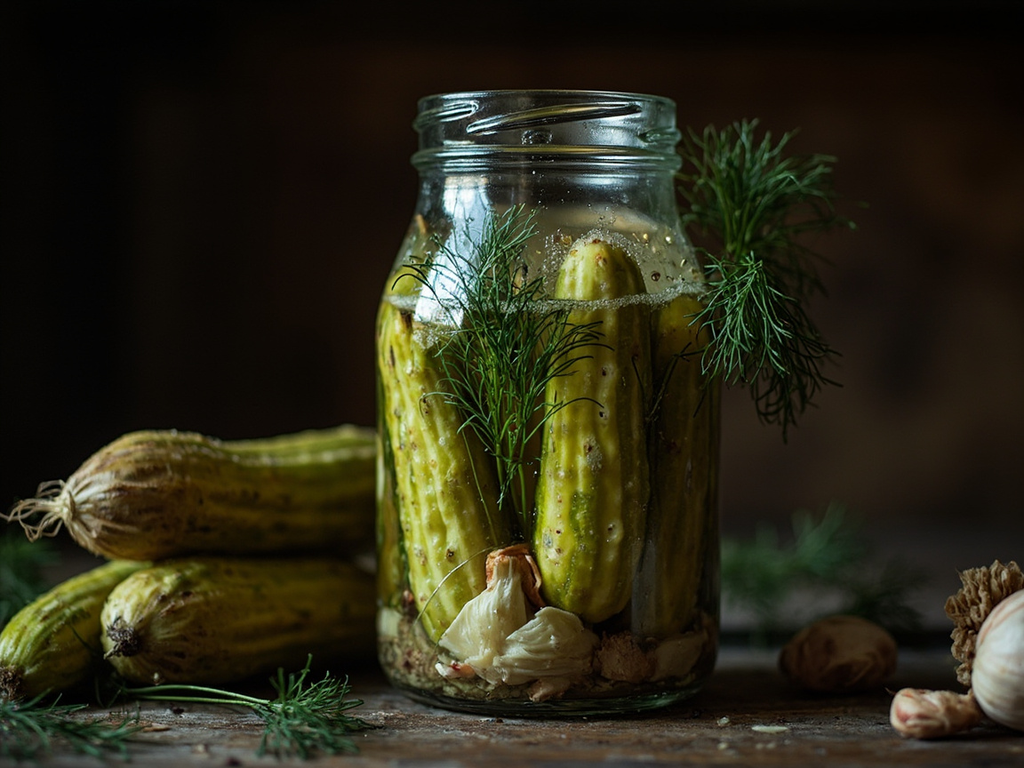
Cucumbers fermented 'lightly' in a brine flavored with dill, garlic, and aromatic leaves. In a few days, lacto-fermentation makes them crunchy, tangy, and vividly flavored, without vinegar. They are taken from the jar to accompany zakouski or sliced into a salad.
At home, summer never completely disappeared: we sealed it in jars to bring it out in the heart of January. Malossol cucumbers, 'lightly salted', were not those aggressive vinegar gherkins of the French—no—it was the mild brine, the dill in umbels, the garlic and blackcurrant leaf, and time doing its work all by itself. Three days on the windowsill, and they crunched under the tooth with that sour and fresh taste. In lean years, believe me, a good cucumber and a crust of bread was already a little feast.
- •Small firm cucumbers — as many as the jar holds (vegetable to ferment)
- •Dill in umbels — several stems gone to seed (dominant flavor)
- •Garlic — a few cloves (aromatic)
- •Blackcurrant, cherry, or oak leaves — a handful (tannins that maintain crunch)
- •Coarse salt — for the brine (preserving agent)
- •Spring water — to cover (brine)
Malossol cucumbers with salt and dill
Cucumbers fermented 'lightly' in a brine flavored with dill, garlic, and aromatic leaves. In a few days, lacto-fermentation makes them crunchy, tangy, and vividly flavored, without vinegar. They are taken from the jar to accompany zakouski or sliced into a salad.
Why this dish? Russian winters, like the rationing years Elsa endured in France, required preserving summer vegetables. Malossol ('lightly salted') cucumbers, a pillar of Slavic supplies and obligatory companions to vodka and zakouski, embody the preservation know-how that a daughter of the Moscow bourgeoisie knew since childhood.
At home, summer never completely disappeared: we sealed it in jars to bring it out in the heart of January. Malossol cucumbers, 'lightly salted', were not those aggressive vinegar gherkins of the French—no—it was the mild brine, the dill in umbels, the garlic and blackcurrant leaf, and time doing its work all by itself. Three days on the windowsill, and they crunched under the tooth with that sour and fresh taste. In lean years, believe me, a good cucumber and a crust of bread was already a little feast.
Ingredients (period version)
- Small firm cucumbers — as many as the jar holds (vegetable to ferment)
- Dill in umbels — several stems gone to seed (dominant flavor)
- Garlic — a few cloves (aromatic)
- Blackcurrant, cherry, or oak leaves — a handful (tannins that maintain crunch)
- Coarse salt — for the brine (preserving agent)
- Spring water — to cover (brine)
Ingredients
- Small pickling cucumbers (Kirby type) — 1 kg (vegetable to ferment)
- Non-chlorinated water — 1 L (brine)
- Non-iodized coarse salt — 50 to 60 g (≈ 5-6%) (preservation and crunch)
- Dill (flowering tops preferred) — 1 large bunch (signature flavor)
- Garlic — 4 cloves (aromatic)
- Blackcurrant or cherry leaves — a few (optional) (tannins, crunch)
- Peppercorns and coriander seeds — 1 tsp (brine spices)
- Horseradish (piece, optional) — 1 chunk (firmness and pungency)
Method
- Wash the cucumbers, soak them in cold water for 2 hours to keep them firm; trim a thin slice from both ends.
- Dissolve the salt in water to make the brine (≈ 5-6%).
- Pack the cucumbers in a clean jar with dill, garlic, aromatic leaves, pepper, and coriander; cover completely with brine.
- Keep the cucumbers submerged (a weight or a leaf), close loosely to allow gas to escape, and let ferment 3 to 5 days at room temperature: the brine turns cloudy, which is a good sign.
- Taste: as soon as the acidity pleases, refrigerate to slow fermentation; they keep for several weeks.
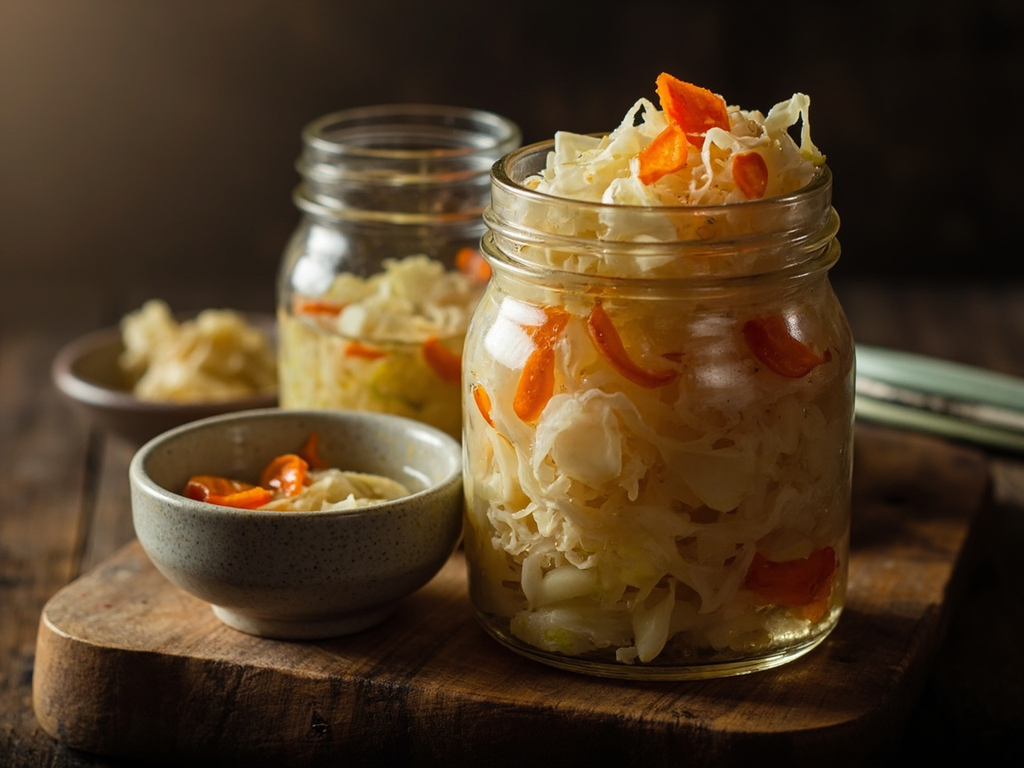
How it was made : Before refrigeration, salt lacto-fermentation was THE way to get through winter: sauerkraut, cabbage, mushrooms, and cucumbers filled Russian cellars. Malossol ('lightly salted') refers to a short, mild fermentation to be consumed fairly quickly, as opposed to long brining. Blackcurrant, cherry, or oak leaves provide tannins that keep the vegetable crunchy—a grandmother's trick that is perfectly scientific.
The contemporary twist : Serve them sliced in a fan on a slate board with a few blinis and a frosty glass: the 'dacha' aperitif is always a hit. Keep the brine, excellent as a base for cocktails or vinaigrette.
Sources : Darra Goldstein, A Taste of Russia: A Cookbook of Russian Hospitality, 1983 · Sandor Katz, The Art of Fermentation, 2012 (principles of lacto-fermentation)
Elsa Triolet · Charactorium