 flip
flipCecina de Yecapixtla and Green Salsa
Cecina de Yecapixtla and Green Salsa
Why this dish? Yecapixtla, in Zapata's native Morelos, has been famous since the 19th century for its cecina, salted and dried beef. At a wedding, village festival, or victory celebration, this dish — a bit of meat, a rare luxury for a peasant — was served to honor guests.
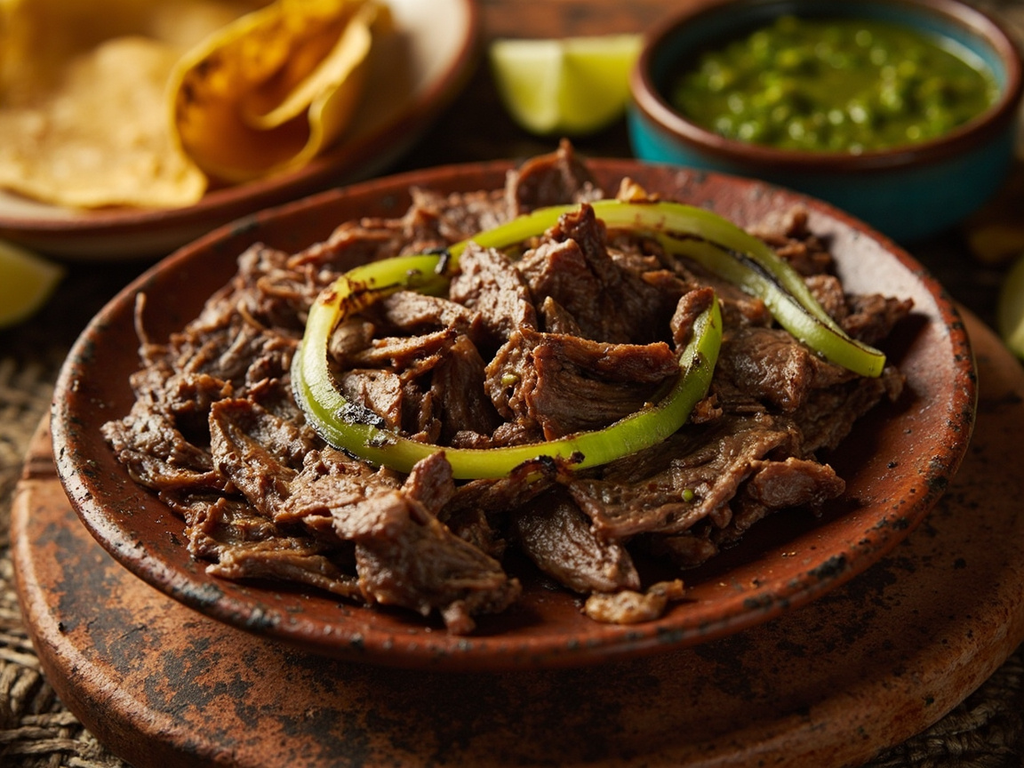
Thin slices of salted and lightly dried beef, grilled on the comal until crispy at the edges, served with tortillas, a spicy green salsa, and grilled onions. The festive meat of Morelos.
On a feast day, compañero, we slaughter the beast and prepare the cecina as only Yecapixtla knows how: slice the meat thin as a leaf, salt it, let it air. Then on the blazing comal it sizzles, perfuming the whole patio. We eat it with tortilla, the green salsa that wakes you up, and grilled onion. It's not every day a campesino eats meat — so when we do, it's because there's something to celebrate, and we do it right.
- •Beef in thin slices — for the guests (heart of the dish)
- •Salt — generously (salting and preservation)
- •Chile and tomatillos — to taste (green salsa)
- •Onion — a few (grilled garnish)
- •Corn tortillas — in quantity (accompaniment)
Cecina de Yecapixtla and Green Salsa
Thin slices of salted and lightly dried beef, grilled on the comal until crispy at the edges, served with tortillas, a spicy green salsa, and grilled onions. The festive meat of Morelos.
Why this dish? Yecapixtla, in Zapata's native Morelos, has been famous since the 19th century for its cecina, salted and dried beef. At a wedding, village festival, or victory celebration, this dish — a bit of meat, a rare luxury for a peasant — was served to honor guests.
On a feast day, compañero, we slaughter the beast and prepare the cecina as only Yecapixtla knows how: slice the meat thin as a leaf, salt it, let it air. Then on the blazing comal it sizzles, perfuming the whole patio. We eat it with tortilla, the green salsa that wakes you up, and grilled onion. It's not every day a campesino eats meat — so when we do, it's because there's something to celebrate, and we do it right.
Ingredients (period version)
- Beef in thin slices — for the guests (heart of the dish)
- Salt — generously (salting and preservation)
- Chile and tomatillos — to taste (green salsa)
- Onion — a few (grilled garnish)
- Corn tortillas — in quantity (accompaniment)
Ingredients
- Cecina (or flank/skirt steak sliced very thin) — 500 g (heart of the dish)
- Coarse salt — if meat is unsalted (quick salting)
- Tomatillos — 400 g (green salsa)
- Serrano chiles — 2 to 3 (green salsa)
- Fresh cilantro — 1 small bunch (salsa)
- Onions — 2 (including 1 small onion for grilling) (salsa and garnish)
- Corn tortillas — 12 (accompaniment)
- Lime — 2 (serving)
Method
- If the meat is not already salted, generously salt the thin slices and let rest 30 minutes, then pat dry.
- Prepare the green salsa: boil or roast tomatillos and chiles, blend with cilantro, a quarter onion, and salt.
- Grill whole small onions (cebollitas) on a very hot pan until charred.
- Sear the meat slices on a comal or very hot pan, 1 to 2 minutes per side, until the edges crisp.
- Reheat the tortillas and serve the cecina with green salsa, grilled onions, and lime wedges.
How it was made : Cecina de Yecapixtla, salted and air-dried meat, is a preservation technique inherited from both Spanish salting traditions and Mesoamerican drying methods. Its reputation in Morelos dates back at least to the 19th century. For peasants, meat remained a festive food, reserved for special occasions.
The contemporary twist : Presented as a DIY taco spread with multiple salsas, guacamole, and melted cheese (queso fundido), cecina becomes the convivial heart of a Mexican carne asada.
Sources : Long-Solís, Janet & Vargas, Luis Alberto, Food Culture in Mexico, Greenwood Press, 2005 · Pilcher, Jeffrey M., ¡Que vivan los tamales!, University of New Mexico Press, 1998
Emiliano Zapata · Charactorium