 flip
flipKönigsberger Klopse — Meatballs in White Caper Sauce
Königsberger Klopse — Meatballs in White Caper Sauce
Why this dish? Emblematic dish of Königsberg, the city where Kant was born, taught, and died without ever really leaving. These meatballs in light sauce, flavored with capers and anchovies, embody the bourgeois cuisine of East Prussia served at regulated tables like his, at the exact lunch hour.
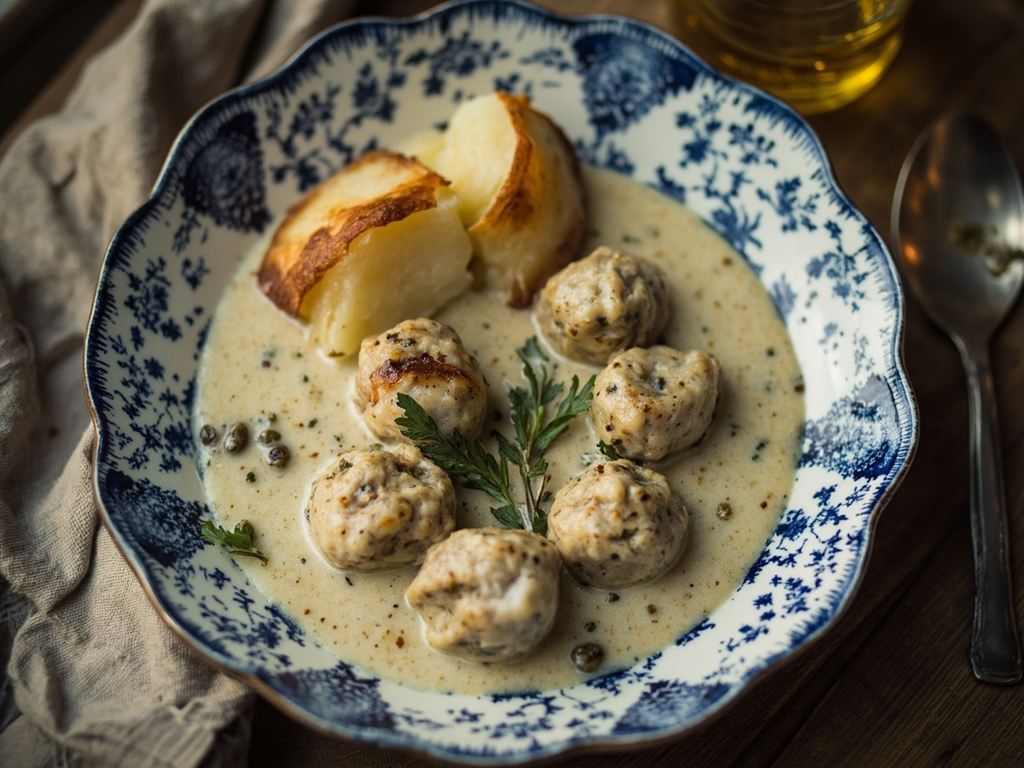
Minced meatballs simmered in broth, then coated in a lemon-white sauce sharpened with capers. A dish both mild and tangy, satisfying and delicate.
I confess to you without pretense: the mind cannot speculate serenely on a disordered digestion. At my table in Königsberg, at the stroke of one, these pale meatballs were presented to me, bathed in their caper sauce whose acidity awakens the palate as a good objection awakens reason. I added my mustard, always, and held that a meal must nourish threefold: the mouth, friendship, and conversation. Let my guests taste, then, but leave for dessert the task of contradicting me.
- •Minced veal and pork — a good portion per guest (base of meatballs)
- •Stale bread soaked in milk — one crumb (binder)
- •Egg — a few (binder)
- •Chopped onion — one (aromatic)
- •Salt anchovies — two or three fillets (umami, salt)
- •Capers in vinegar — a good spoonful (acidity, signature)
- •Butter and flour — equal parts (roux for sauce)
- •Meat broth — as needed (cooking and sauce)
- •Lemon juice — a dash (acidity)
Königsberger Klopse — Meatballs in White Caper Sauce
Minced meatballs simmered in broth, then coated in a lemon-white sauce sharpened with capers. A dish both mild and tangy, satisfying and delicate.
Why this dish? Emblematic dish of Königsberg, the city where Kant was born, taught, and died without ever really leaving. These meatballs in light sauce, flavored with capers and anchovies, embody the bourgeois cuisine of East Prussia served at regulated tables like his, at the exact lunch hour.
I confess to you without pretense: the mind cannot speculate serenely on a disordered digestion. At my table in Königsberg, at the stroke of one, these pale meatballs were presented to me, bathed in their caper sauce whose acidity awakens the palate as a good objection awakens reason. I added my mustard, always, and held that a meal must nourish threefold: the mouth, friendship, and conversation. Let my guests taste, then, but leave for dessert the task of contradicting me.
Ingredients (period version)
- Minced veal and pork — a good portion per guest (base of meatballs)
- Stale bread soaked in milk — one crumb (binder)
- Egg — a few (binder)
- Chopped onion — one (aromatic)
- Salt anchovies — two or three fillets (umami, salt)
- Capers in vinegar — a good spoonful (acidity, signature)
- Butter and flour — equal parts (roux for sauce)
- Meat broth — as needed (cooking and sauce)
- Lemon juice — a dash (acidity)
Ingredients
- Minced veal — 300 g (meatballs)
- Minced pork — 200 g (meatballs)
- Stale white bread — 1 slice (binder)
- Milk — 5 cl (soak bread)
- Egg — 1 (binder)
- Onion — 1 small (aromatic)
- Anchovy fillets — 2 (umami)
- Capers — 2 tbsp (acidity)
- Butter — 30 g (roux)
- Flour — 30 g (roux)
- Meat broth — 50 cl (cooking + sauce)
- Lemon juice — 1/2 lemon (acidity)
- Salt, pepper, nutmeg — to taste (seasoning)
Method
- Soak bread in milk, squeeze, then mix with veal, pork, egg, minced onion, and one crushed anchovy fillet. Season with salt, pepper, nutmeg.
- Shape walnut-sized meatballs.
- Bring broth to a simmer and poach meatballs for 10–12 minutes; set aside. Strain broth.
- Make a blond roux with butter and flour, then gradually whisk in hot broth to make a smooth sauce.
- Add capers, the second chopped anchovy, and lemon juice. Taste and adjust acidity.
- Return meatballs to sauce, warm gently, and serve immediately with steamed potatoes.
How it was made : In 18th-century East Prussia, meatballs were poached in broth rather than fried, keeping them tender and providing the sauce base. Capers and anchovies, imported via Königsberg's Baltic trade (a Hanseatic port), provided acidity and salt without costly spices. The potato, spread in Prussia after Frederick II's edicts (from 1756), commonly accompanied such dishes.
The contemporary twist : Serve the Klopse shaped into neat quenelles, sauce napped at the last moment, with a few fried capers as a crunchy garnish — a nod to 'critique of pure sauce'.
Immanuel Kant · Charactorium