 flip
flipAkagome no kowameshi — sacred steamed red rice
Akagome no kowameshi — sacred steamed red rice
Why this dish? It is said that before crossing the sea, Jingū placed rice before the kami of Sumiyoshi Shrine to ensure their protection. Ancient red rice (akagome), cultivated since the Yayoi period, was the purest offering that could be presented to an empress protected by the gods.
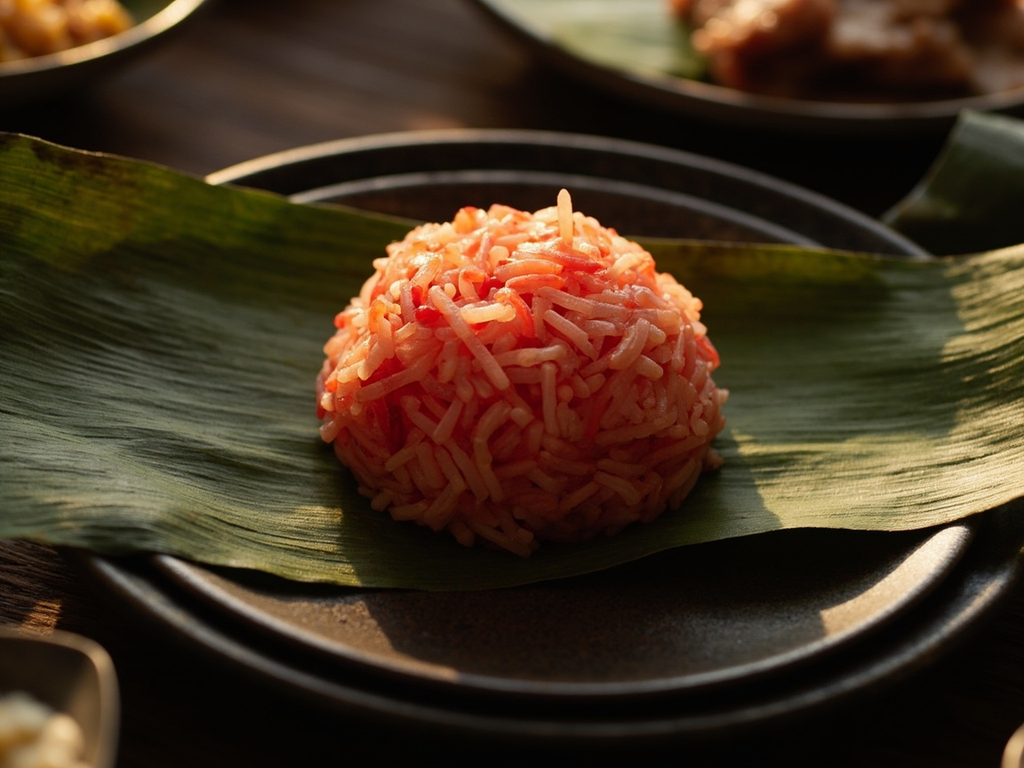
A slightly red-tinted rice, steamed until firm and glossy, presented in a small mound on a leaf. Its subtle sweetness and straw-like fragrance make it the offering par excellence, a distant ancestor of the sekihan still eaten on festive days.
Approach, and see how the grain reddens under the steam. Before I parted the waves toward Silla, I set this rice before the kami of Sumiyoshi, for no one crosses the sea without first feeding the gods. Wash it seven times until the water is clear as autumn sky, then let it rest in the jar a full night. Steam alone cooks it—never boiling water, that is the secret the priestesses told me. When it shines, offer it first, eat afterward: thus we share the table of the kami.
- •Ancient red rice (akagome) — one measure (sacred grain, base)
- •Pure spring water — for soaking (purification and hydration)
- •Oak or bamboo leaf — one (offering base)
Akagome no kowameshi — sacred steamed red rice
A slightly red-tinted rice, steamed until firm and glossy, presented in a small mound on a leaf. Its subtle sweetness and straw-like fragrance make it the offering par excellence, a distant ancestor of the sekihan still eaten on festive days.
Why this dish? It is said that before crossing the sea, Jingū placed rice before the kami of Sumiyoshi Shrine to ensure their protection. Ancient red rice (akagome), cultivated since the Yayoi period, was the purest offering that could be presented to an empress protected by the gods.
Approach, and see how the grain reddens under the steam. Before I parted the waves toward Silla, I set this rice before the kami of Sumiyoshi, for no one crosses the sea without first feeding the gods. Wash it seven times until the water is clear as autumn sky, then let it rest in the jar a full night. Steam alone cooks it—never boiling water, that is the secret the priestesses told me. When it shines, offer it first, eat afterward: thus we share the table of the kami.
Ingredients (period version)
- Ancient red rice (akagome) — one measure (sacred grain, base)
- Pure spring water — for soaking (purification and hydration)
- Oak or bamboo leaf — one (offering base)
Ingredients
- Brown red rice (or glutinous rice + a little red rice) — 300 g (base)
- Water — soaking + steaming (hydration)
- Pinch of sea salt — 1 pinch (enhancement (optional))
Method
- Rinse the rice several times until the water runs clear.
- Soak for 6 to 8 hours (or overnight) in cold water.
- Drain, then steam for 30 to 40 minutes in a steamer basket lined with a cloth, until the grains are firm and translucent.
- Mold into a small dome on a clean leaf. Serve warm.
How it was made : In the Yayoi-Kofun period, rice cookers were unknown: rice was steamed in a perforated jar (koshiki) set over a cauldron, yielding a firm rice called kowameshi ("hard rice"), quite different from today's soft rice. Red rice was the dominant variety before white rice arrived.
The contemporary twist : Served as a small quenelle on a lacquered oak leaf, sprinkled with a few black sesame seeds: a minimalist nod worthy of a shrine.
Empress Jingu · Charactorium