 flip
flipSarmale cu mămăligă (stuffed cabbage rolls and polenta)
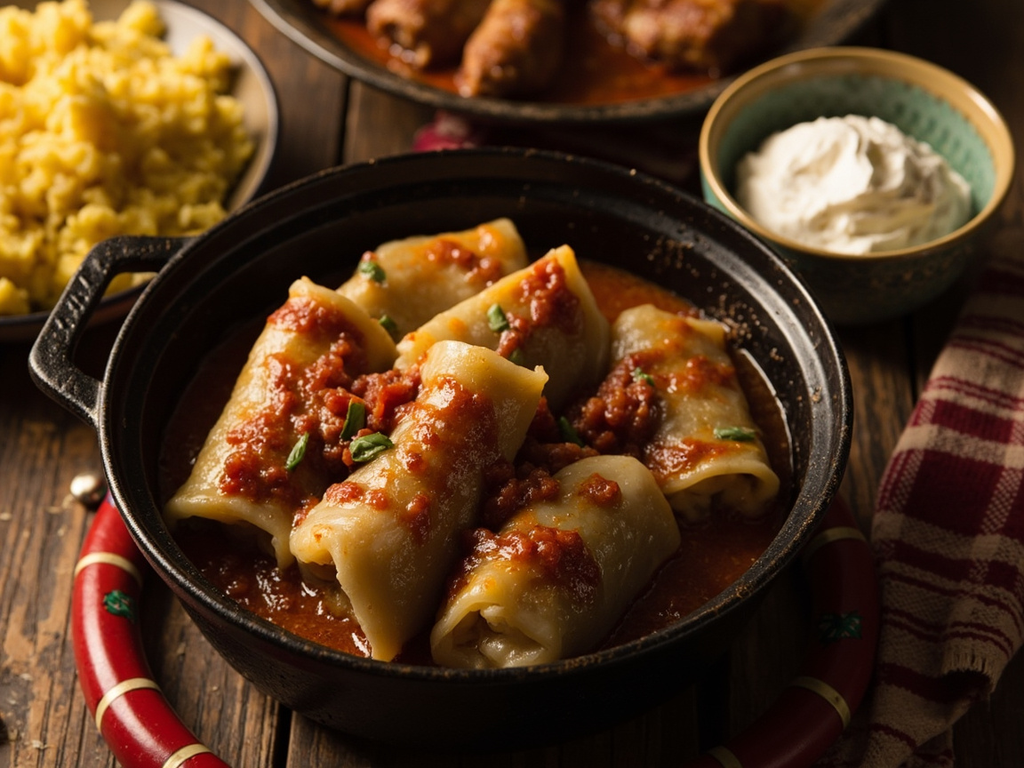
Sarmale cu mămăligă (stuffed cabbage rolls and polenta)
Why this dish? Sarmale are THE dish for great Romanian occasions — Christmas, Easter, family meals that last for hours. For a man born in Romania in 1909 and steeped in this culture, these little sour cabbage rolls stuffed with meat are the madeleine of the family feast, the exact opposite of the writer's solitude at his table.
Fermented cabbage leaves rolled around a filling of meat, rice and onion, slow-cooked for hours until meltingly tender. Served with mămăligă, golden cornmeal polenta, and a dollop of sour cream. The Sunday and holiday dish.
Ah, sarmale! You must understand that you don't make them for just one evening; you make them for a celebration, and you always prepare too many — that is the rule. We would roll the sour cabbage leaves tight like cigars, and the pot would cook so long that the whole house smelled of sourness and smoke. My grandmother claimed they were even better reheated the next day, which is an absurd and magnificent truth: a dish that improves by waiting, like certain truths. We eat them with mămăligă and a cloud of cream, unhurriedly, talking too loudly.
- •Whole fermented cabbage leaves (varză murată) — one whole cabbage (wrapper — provides fermented acidity)
- •Pork mince — a good amount (filling)
- •Rice — a large handful (filling)
- •Onion — several (filling)
- •Cornmeal — according to number of guests (mămăligă)
- •Dried dill, peppercorns, bay leaves — to taste (aromatics)
Sarmale cu mămăligă (stuffed cabbage rolls and polenta)
Fermented cabbage leaves rolled around a filling of meat, rice and onion, slow-cooked for hours until meltingly tender. Served with mămăligă, golden cornmeal polenta, and a dollop of sour cream. The Sunday and holiday dish.
Why this dish? Sarmale are THE dish for great Romanian occasions — Christmas, Easter, family meals that last for hours. For a man born in Romania in 1909 and steeped in this culture, these little sour cabbage rolls stuffed with meat are the madeleine of the family feast, the exact opposite of the writer's solitude at his table.
Ah, sarmale! You must understand that you don't make them for just one evening; you make them for a celebration, and you always prepare too many — that is the rule. We would roll the sour cabbage leaves tight like cigars, and the pot would cook so long that the whole house smelled of sourness and smoke. My grandmother claimed they were even better reheated the next day, which is an absurd and magnificent truth: a dish that improves by waiting, like certain truths. We eat them with mămăligă and a cloud of cream, unhurriedly, talking too loudly.
Ingredients (period version)
- Whole fermented cabbage leaves (varză murată) — one whole cabbage (wrapper — provides fermented acidity)
- Pork mince — a good amount (filling)
- Rice — a large handful (filling)
- Onion — several (filling)
- Cornmeal — according to number of guests (mămăligă)
- Dried dill, peppercorns, bay leaves — to taste (aromatics)
Ingredients
- Lacto-fermented cabbage leaves (jarred, Romanian-style) or sauerkraut leaves — 1 large jar (tangy wrapper)
- Pork shoulder mince — 600 g (filling)
- Short-grain rice — 120 g (filling)
- Onions — 3 (filling)
- Tomato paste — 2 tbsp (cooking broth)
- Dried dill, bay leaves, peppercorns — to taste (aromatics)
- Cornmeal (polenta) — 250 g (mămăligă)
- Sour cream (smântână) — for serving (accompaniment)
Method
- Sauté chopped onions, mix with meat, raw rice, dill, salt and pepper.
- Spread each fermented cabbage leaf, place a spoonful of filling and roll tightly, tucking in the edges.
- Line the bottom of a casserole with shredded cabbage, arrange sarmale in layers, tuck in bay leaves and peppercorns, cover with water mixed with tomato paste.
- Cook covered over very low heat (or in the oven at 150°C) for 2.5 to 3 hours, until everything is meltingly tender.
- For mămăligă: rain the cornmeal into salted boiling water and stir for 20 min until a firm polenta forms. Serve sarmale with mămăligă and a spoonful of sour cream.
How it was made : Cabbage was stored all winter in large barrels of brine where it fermented whole — leaves were taken as needed. Mămăligă, cornmeal polenta, was for a long time the bread of Romanian peasants, cooked in a cauldron and overturned onto a board to be sliced with a thread. Corn, which arrived from the Americas after 1492, was fully integrated into 20th-century Romanian cuisine.
The contemporary twist : For plating, turn the mămăligă out onto a wooden board in a dome and slice it with kitchen twine in front of guests, as in the countryside — a little table theater.
Sources : Sanda Marin, Carte de bucate
Eugène Ionesco · Charactorium