 flip
flipMajapahit Tumpeng Kuning
Majapahit Tumpeng Kuning
Why this dish? The tumpeng is the quintessential ritual dish for major Javanese ceremonies. Gajah Mada, as Mahapatih, presided over the feasts of the Trowulan court where the cone of golden rice, symbol of the cosmic Mount Meru, was erected to honor the gods and celebrate the empire's military victories.
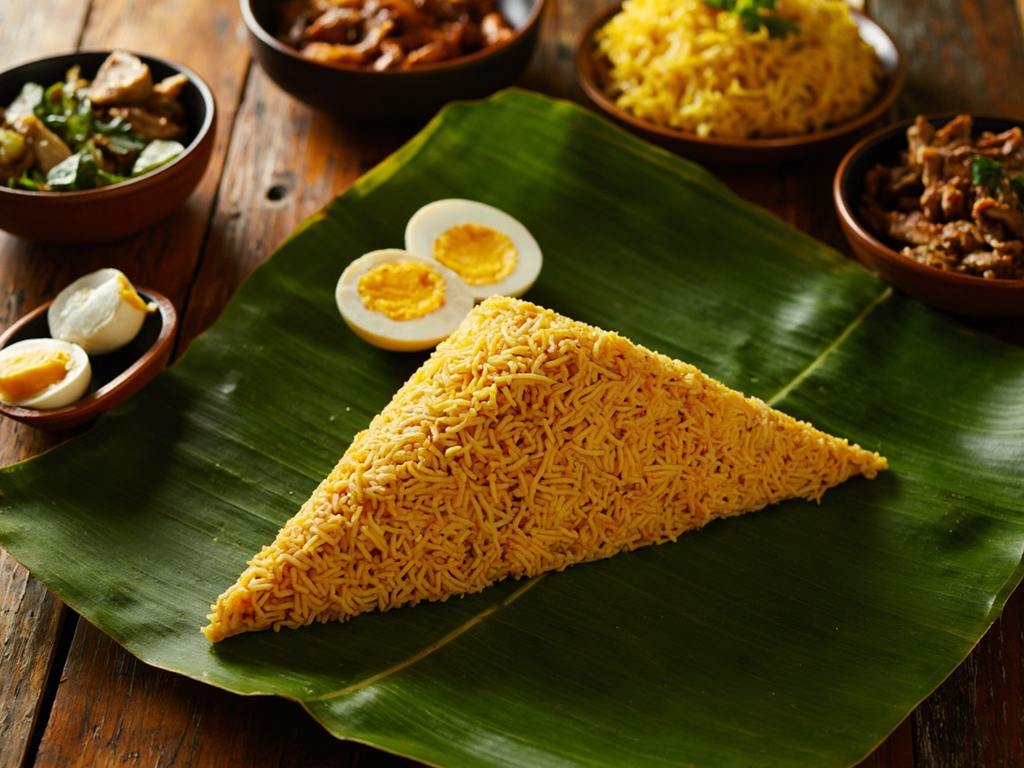
Cone of rice cooked with turmeric and coconut milk, molded into the shape of a sacred mountain and surrounded by small accompaniments (grilled chicken, eggs, vegetables stir-fried with galangal). The tumpeng is shared collectively: the tip goes to the most honored person.
Listen well, you who come from afar. This golden cone you see raised on the banana leaf is Meru itself, the mountain that holds up the sky. The rice has drunk the turmeric and the santan until it became the sun. When Majapahit triumphs, when another island recognizes our sovereignty, I have the tumpeng erected before the assembled court and I cut off the tip to offer it to my queen Tribhuwana. Each accompaniment has its place around the mountain just as each vassal has his place around the throne. Those who eat together do not betray each other — that is the law of my table.
- •White rice from Java — a large measure of rice (base of the cone)
- •Fresh turmeric (kunir) — a piece the size of a thumb (golden color and slight bitterness)
- •Fresh coconut milk (santan) — the milk of one coconut (creaminess and fragrance)
- •Fresh galangal (laos) — a small piece, pounded (warm, peppery aroma)
- •Lemongrass (sereh) — two stalks (fresh fragrance)
- •Salam leaf — three leaves (woody aroma)
- •Salt — to taste (seasoning)
- •Banana leaf — one large leaf (molding and presentation)
Majapahit Tumpeng Kuning
Cone of rice cooked with turmeric and coconut milk, molded into the shape of a sacred mountain and surrounded by small accompaniments (grilled chicken, eggs, vegetables stir-fried with galangal). The tumpeng is shared collectively: the tip goes to the most honored person.
Why this dish? The tumpeng is the quintessential ritual dish for major Javanese ceremonies. Gajah Mada, as Mahapatih, presided over the feasts of the Trowulan court where the cone of golden rice, symbol of the cosmic Mount Meru, was erected to honor the gods and celebrate the empire's military victories.
Listen well, you who come from afar. This golden cone you see raised on the banana leaf is Meru itself, the mountain that holds up the sky. The rice has drunk the turmeric and the santan until it became the sun. When Majapahit triumphs, when another island recognizes our sovereignty, I have the tumpeng erected before the assembled court and I cut off the tip to offer it to my queen Tribhuwana. Each accompaniment has its place around the mountain just as each vassal has his place around the throne. Those who eat together do not betray each other — that is the law of my table.
Ingredients (period version)
- White rice from Java — a large measure of rice (base of the cone)
- Fresh turmeric (kunir) — a piece the size of a thumb (golden color and slight bitterness)
- Fresh coconut milk (santan) — the milk of one coconut (creaminess and fragrance)
- Fresh galangal (laos) — a small piece, pounded (warm, peppery aroma)
- Lemongrass (sereh) — two stalks (fresh fragrance)
- Salam leaf — three leaves (woody aroma)
- Salt — to taste (seasoning)
- Banana leaf — one large leaf (molding and presentation)
Ingredients
- Fragrant long-grain rice (or jasmine rice) — 400 g (base of the cone)
- Fresh turmeric — 5 cm (or 1 tsp powder) (coloring)
- Coconut milk — 200 ml (creaminess)
- Fresh galangal — 3 cm (aroma)
- Lemongrass — 2 stalks, crushed (fragrance)
- Indonesian bay leaves (or regular bay leaves) — 2 leaves (woody aroma)
- Salt — 1 tsp (seasoning)
- Water — 400 ml (cooking liquid)
Method
- Rinse the rice until the water runs clear, then drain.
- Grate the fresh turmeric and galangal. Crush the lemongrass stalks.
- In a pot, combine the rice, coconut milk, water, grated turmeric, galangal, lemongrass, and bay leaves. Add salt.
- Bring to a boil while stirring, then reduce heat to low, cover, and cook for 18–20 minutes without opening.
- Remove from heat, let rest covered for 10 minutes, then discard the aromatics.
- Press the hot rice into a conical mold (or shape by hand on a banana leaf, pressing firmly).
- Unmold onto a serving plate, tip pointing up. Surround with accompaniments of your choice: grilled chicken, hard-boiled eggs, sautéed vegetables.
How it was made : The tumpeng is attested in Javanese tradition since the Hindu-Buddhist period. The Nagarakretagama (1365), a court poem composed by Mpu Prapanca under Hayam Wuruk, Gajah Mada's direct successor, describes in detail the royal feasts of Majapahit. Turmeric rice was a marker of celebration. The conical shape represents Mount Meru, the axis of the cosmos in Javanese Hindu cosmology.
The contemporary twist : Serve individual mini-tumpengs in a small conical bowl, unmolded onto a banana leaf cut into a circle, for a spectacular individual portion.
Sources : Mpu Prapanca, Nagarakretagama (Desawarṇana), canto 88–91, description of the royal feasts of Majapahit, 1365 · Denys Lombard, Le Carrefour javanais, EHESS, 1990 (vol. 2, on court cuisine)
Gajah Mada · Charactorium