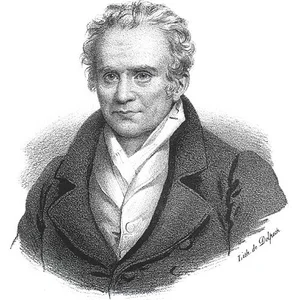

French mathematician (1746–1818), inventor of descriptive geometry and co-founder of the École Polytechnique. A close ally of Napoleon, he played a major role in modernizing scientific and technical education in France.
Gaspard Monge(1746 — 1818)
Gaspard Monge
France
8 min read
Frequently asked questions
Key Facts
- 1746: Born in Beaune, Burgundy
- 1768: Invents descriptive geometry at the Royal School of Military Engineering in Mézières
- 1794: Co-founds the École Polytechnique with Lazare Carnot and other scholars
- 1798–1799: Takes part in the Egyptian expedition alongside Napoleon Bonaparte
- 1818: Dies in Paris; his work lays the foundations of modern differential geometry
Works & Achievements
Monge developed a revolutionary method for representing three-dimensional objects on a flat surface through orthogonal projections. Classified as a military secret for thirty years, this invention founded a new mathematical and technical discipline that became the basis of modern technical drawing.
Together with Lazare Carnot and other scientists, Monge conceived and launched the École Centrale des Travaux Publics (the future École Polytechnique), France's first major scientific institution. This school lastingly reformed higher education and served as a model around the world.
The first printed treatise to systematically set out the method of projections, drawn from his lectures at the École Normale de l'An III. This work established descriptive geometry as a discipline and made it a compulsory subject in engineering education across Europe.
A major work in analytical geometry in which Monge advanced the study of curves and surfaces using algebraic methods. He greatly enriched the theory of surfaces and laid foundations that would be built upon in differential geometry.
As president of the Commission of Sciences and Arts, Monge oversaw the scientific and archaeological survey of Egypt. This colossal undertaking gave rise to the *Description de l'Égypte*, published between 1809 and 1828.
Anecdotes
As a young draftsman at the Royal School of Engineering in Mézières, Monge was given a military fortification problem that officers typically solved through lengthy arithmetic calculations. Within a few hours he proposed a geometric solution so elegant that the commandant initially refused to believe it, suspecting an error. Persuaded by the demonstration, the officer immediately had the method classified as a state secret, judging that it would give France a decisive advantage if it remained unknown to enemy powers. This discovery, kept secret for thirty years, would nonetheless go on to revolutionize the training of engineers throughout the world.
When the École Polytechnique was founded in 1794, Monge threw himself into the work with extraordinary energy: he wrote the curricula, recruited the faculty, personally taught descriptive geometry, and oversaw the administrative organization. He saw in this new institution a means of training a scientific and technical elite capable of serving the nation, combining for the first time pure mathematics and applied sciences within a single course of study. The École Polytechnique rapidly became a model imitated across Europe.
During the Egyptian expedition (1798–1799), Napoleon chose Monge as one of his trusted scholars, and the two men forged a sincere and lasting friendship. Monge presided over the Commission of Sciences and Arts charged with studying ancient and modern Egypt; he took part in measuring the pyramids and surveying the monuments, contributing to the work that would give rise to the monumental *Description de l'Égypte*.
When Napoleon fell in 1815, Monge, then 69 years old, was hit hard by the Restoration: his titles were stripped from him, and in 1816 the Bourbons expelled him from the Académie des sciences — an unbearable humiliation for the aged scholar. He died two years later, in 1818, but his former students from the École Polytechnique, defying the bans imposed by the royalist authorities, came in great numbers to follow his funeral cortège, a moving testament to the loyalty his students bore him.
Primary Sources
Descriptive geometry has two purposes: the first, to provide methods for representing on a drawing sheet, which has only two dimensions — namely length and width — all bodies in nature that have three.
Through the combined use of two projections, one can determine exactly the shape and position of any object in space, and from this deduce all the geometric properties belonging to it.
The purpose of this treatise is to bring together the principal applications that can be made of algebraic analysis to the geometry of curves and surfaces, and to show how the two sciences can mutually support one another.
We are here surrounded by wonders that our Commission strives to measure and describe. The monuments of ancient Egypt surpass anything the imagination could have conceived; I think of you and our daughters every day.
Key Places
Birthplace of Gaspard Monge, born on **9 May 1746**. The son of a traveling merchant, he received his early education from the Oratorians there and showed exceptional mathematical talent from a very young age.
It was at Mézières (now Charleville-Mézières) that Monge invented descriptive geometry around **1765** while solving a military fortification problem. He taught mathematics and physics there for several years before the Revolution.
Co-founded by Monge in **1794** under the name École Centrale des Travaux Publics, it became the crown jewel of French scientific education. Monge taught descriptive geometry there and trained generations of engineers who transformed France.
During the Egyptian expedition (**1798–1799**), Monge stayed in Cairo and oversaw the work of the Commission of Sciences and Arts. He contributed to the study of ancient Egyptian monuments, which would eventually give rise to the *Description de l'Égypte*.
Monge lived and died in Paris on **28 May 1818**, worn down by the persecutions of the Restoration. His funeral prompted a spontaneous gathering of his former students from the École Polytechnique, who came to pay their last respects.
Typical Objects

An essential instrument for the geometer, the compass allowed Monge to draw with precision the arcs and circles in his descriptive geometry diagrams. He used it daily in his lectures and research work.

The ruler and set square were the basic tools of the descriptive geometer, indispensable for constructing the orthogonal projections that form the core of Monge's method. These instruments had a prominent place in every technical drawing workshop.

An orthographic drawing is a technical diagram produced by descriptive geometry: it represents a three-dimensional object through its projections onto two perpendicular planes. Monge made it the foundation of engineering training at the École Polytechnique.

Published in 1799, Monge's manual was the first work to codify descriptive geometry as a teachable discipline. It circulated in all the leading engineering schools across Europe and became a model for generations of scientists.

As a founding member of the Institut de France, Monge wore the embroidered academic dress during formal sessions. This garment symbolized the new organization of scientific knowledge under the Republic and later the Empire.

During the Egyptian campaign, Monge and the scholars of the Commission used sextants to measure angles, map the territory, and study ancient monuments. The sextant embodied the alliance between science and Napoleonic conquest.
School Curriculum
Vocabulary & Tags
Key Vocabulary
Daily Life
Morning
Monge rose early and devoted his mornings to mathematical research, filling sheets of paper with geometric figures and calculations. At the École Polytechnique, he often taught in the morning, leading cohorts of students through the rigor of geometric proof.
Afternoon
His afternoons were taken up with administrative duties: committee meetings, correspondence with European scholars, and supervision of technical drawing workshops. During the Revolutionary period, he also attended sessions of the Institut de France and the Committee of Public Instruction.
Evening
In the evenings, Monge enjoyed hosting students, colleagues, and political figures at home, in the atmosphere of a learned salon typical of the era. He engaged in lively conversations on politics, the arts, and the sciences, and attended dinners in Napoleonic high society.
Food
Like many educated bourgeois contemporaries, Monge ate at regular hours, with meals of meat, vegetables, and bread. His stays in Egypt introduced him to unfamiliar foods and spices, which the expedition's scholars observed with scientific curiosity.
Clothing
In his daily life as a professor and administrator, Monge wore the sober yet distinguished dress of the cultivated bourgeoisie: dark coat, jabot, breeches, and wig under the Ancien Régime, then simpler attire after the Revolution. As a Count of the Empire, he wore the embroidered uniform of Napoleonic dignitaries on ceremonial occasions.
Housing
Monge long lived in Paris apartments close to the École Polytechnique. Under the Empire, his comfortable circumstances allowed him to occupy large apartments with a well-stocked study filled with books, maps, and scientific instruments, in the manner typical of Parisian notables.
Historical Timeline
Period Vocabulary
Liens externes & ressources
Références
Œuvres
Invention de la géométrie descriptive
vers 1765
Cofondation de l'École Polytechnique
1794
Géométrie descriptive
1799
Application de l'analyse à la géométrie
1807
Participation à la Description de l'Égypte
1798-1801
See also
Related Characters
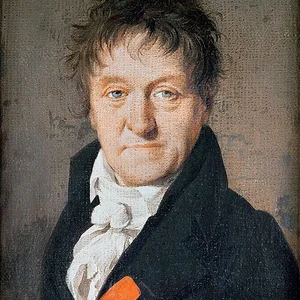
Lazare Carnot
1753 — 1823
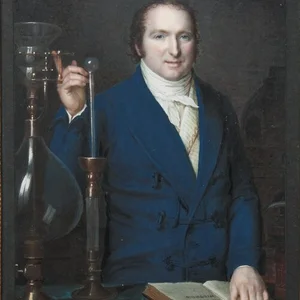
Antoine François de Fourcroy
1755 — 1809
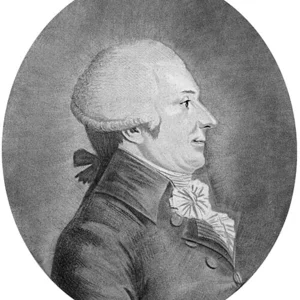
Louis-Bernard Guyton de Morveau
1737 — 1816
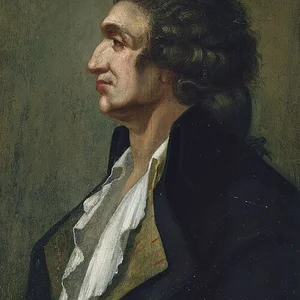
Marie Jean Antoine Nicolas de Condorcet
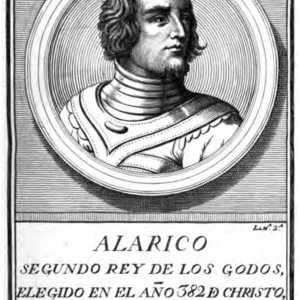
Alaric I
370 — 410
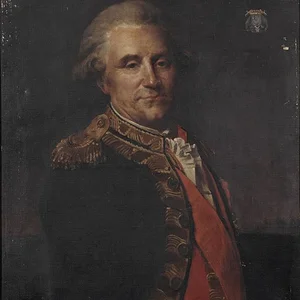
Antoine-Jean-Marie Thévenard
1733 — 1815